Radiation Safety and Quality Assurance Division, National Cancer Center Hospital, Chuo-ku, Tokyo, Japan.
Department of Radiological Technology Radiological Oncology, National Cancer Center Hospital, Chuo-ku, Tokyo, Japan.
J Appl Clin Med Phys. 2023 Apr;24(4):e13865. doi: 10.1002/acm2.13865. Epub 2022 Dec 26.
The setup of lung shield (LS) in total body irradiation (TBI) with the computed radiography (CR) system is a time-consuming task and has not been quantitatively evaluated. The TBI mobile imager (TBI-MI) can solve this problem through real-time monitoring. Therefore, this study aimed to perform commissioning and performance evaluation of TBI-MI to promote its use in clinical practice.
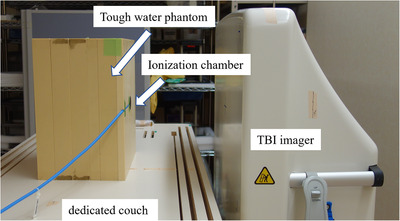
The source-axis distance in TBI treatment, TBI-MI (CNERGY TBI, Cablon Medical B.V.), and the LS position were set to 400, 450, and 358 cm, respectively. The evaluation items were as follows: accuracy of image scaling and measured displacement error of LS, image quality (linearity, signal-to-noise ratio, and modulation transfer function) using an EPID QC phantom, optimal thresholding to detect intra-fractional motion in the alert function, and the scatter radiation dose from TBI-MI.
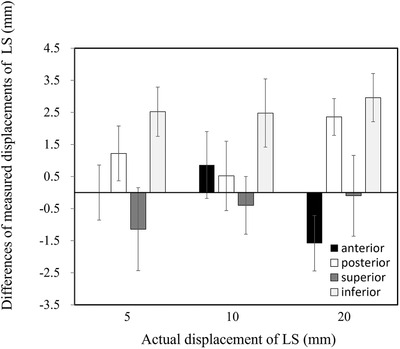
The accuracy of image scaling and the difference in measured displacement of the LS was <4 mm in any displacements and directions. The image quality of TBI imager was slightly inferior to the CR image but was visually acceptable in clinical practice. The signal-to-noise ratio was improved at high dose rate. The optimal thresholding value to detect a 10-mm body displacement was determined to be approximately 5.0%. The maximum fraction of scattering radiation to irradiated dose was 1.7% at patient surface.
MI-TBI can quantitatively evaluate LS displacement with acceptable image quality. Furthermore, real-time monitoring with alert function to detect intrafraction patient displacement can contribute to safe TBI treatment.
全身照射(TBI)中使用计算机射线照相(CR)系统设置肺屏蔽(LS)是一项耗时的任务,尚未进行定量评估。TBI 移动成像仪(TBI-MI)可以通过实时监测来解决此问题。因此,本研究旨在对 TBI-MI 进行调试和性能评估,以促进其在临床实践中的应用。
TBI 治疗中的源轴距离、TBI-MI(CNERGY TBI,Cablon Medical B.V.)和 LS 位置分别设置为 400、450 和 358cm。评估项目如下:图像缩放的准确性和 LS 测量位移误差,使用 EPID QC 体模评估图像质量(线性度、信噪比和调制传递函数),警示功能检测分次内运动的最佳阈值,以及来自 TBI-MI 的散射辐射剂量。
在任何位移和方向上,图像缩放的准确性和 LS 测量位移的差异均<4mm。TBI 成像仪的图像质量略逊于 CR 图像,但在临床实践中是可以接受的。在高剂量率下,信噪比得到了提高。确定检测 10mm 身体位移的最佳阈值约为 5.0%。在患者表面,散射辐射对受照剂量的最大分数为 1.7%。
MI-TBI 可以定量评估 LS 位移,具有可接受的图像质量。此外,具有警示功能的实时监测可检测分次内患者位移,有助于安全的 TBI 治疗。