Department of Biological and Medical Psychology, University of Bergen, Jonas Lies Vei 91, 5009, Bergen, Norway.
Department of Neurology, Jena University Hospital, Am Klinikum 1, 07747, Jena, Germany.
Brain Struct Funct. 2023 Mar;228(2):577-588. doi: 10.1007/s00429-022-02602-x. Epub 2022 Dec 27.
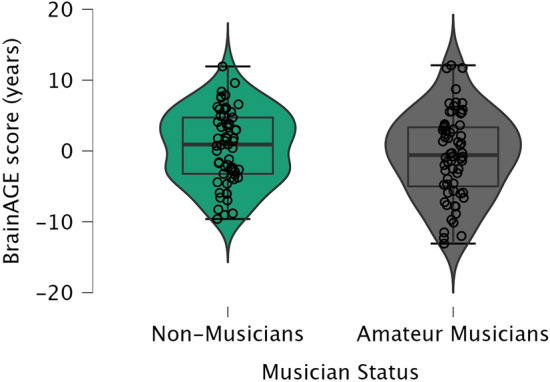
Music-making and engagement in music-related activities have shown procognitive benefits for healthy and pathological populations, suggesting reductions in brain aging. A previous brain aging study, using Brain Age Gap Estimation (BrainAGE), showed that professional and amateur-musicians had younger appearing brains than non-musicians. Our study sought to replicate those findings and analyze if musical training or active musical engagement was necessary to produce an age-decelerating effect in a cohort of healthy individuals. We scanned 125 healthy controls and investigated if musician status, and if musical behaviors, namely active engagement (AE) and musical training (MT) [as measured using the Goldsmiths Musical Sophistication Index (Gold-MSI)], had effects on brain aging. Our findings suggest that musician status is not related to BrainAGE score, although involvement in current physical activity is. Although neither MT nor AE subscales of the Gold-MSI are predictive for BrainAGE scores, dispositional resilience, namely the ability to deal with challenge, is related to both musical behaviors and sensitivity to musical pleasure. While the study failed to replicate the findings in a previous brain aging study, musical training and active musical engagement are related to the resilience factor of challenge. This finding may reveal how such musical behaviors can potentially strengthen the brain's resilience to age, which may tap into a type of neurocognitive reserve.
音乐创作和参与与音乐相关的活动已被证明对健康人群和病态人群具有认知益处,表明大脑衰老的减少。之前的一项大脑衰老研究使用大脑年龄差距估计(BrainAGE)表明,专业和业余音乐家的大脑比非音乐家年轻。我们的研究旨在复制这些发现,并分析在健康人群中是否需要进行音乐训练或积极的音乐参与才能产生延缓大脑衰老的效果。我们扫描了 125 名健康对照者,并调查了音乐家身份以及音乐行为(即积极参与(AE)和音乐训练(MT)[使用 Goldsmiths 音乐复杂性指数(Gold-MSI)测量])是否对大脑衰老有影响。我们的研究结果表明,音乐家身份与 BrainAGE 分数无关,尽管与当前的身体活动有关。尽管 Gold-MSI 的 MT 和 AE 分量表都不能预测 BrainAGE 分数,但性格韧性,即应对挑战的能力,与音乐行为和对音乐愉悦的敏感性有关。虽然该研究未能在以前的大脑衰老研究中复制发现,但音乐训练和积极的音乐参与与挑战的适应力因素有关。这一发现可能揭示了这些音乐行为如何能够增强大脑对年龄的适应能力,这可能涉及到一种神经认知储备。