Institute of Marine Research, NO-5984, Matredal, Norway.
Department of eResearch, Queensland University of Technology, GPO Box 2434, Brisbane, QLD, 4001, Australia.
Fish Physiol Biochem. 2023 Feb;49(1):97-116. doi: 10.1007/s10695-022-01163-4. Epub 2022 Dec 27.
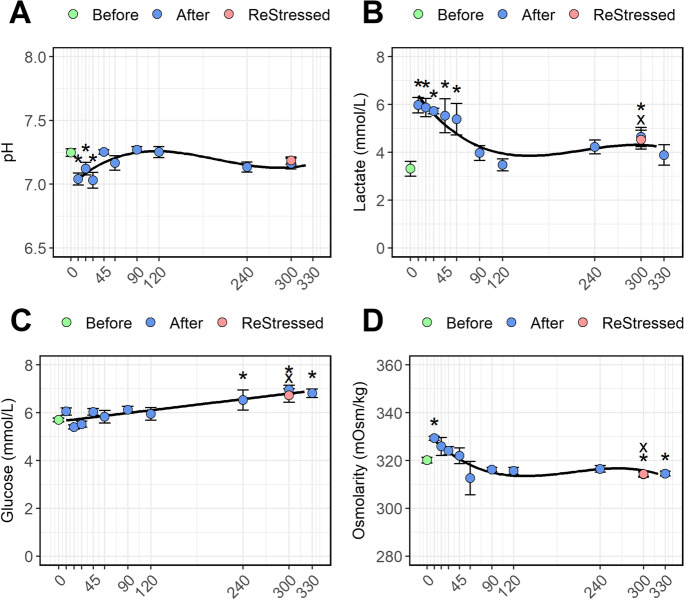
Farmed Atlantic salmon (Salmo salar) welfare and performance can be strongly influenced by stress episodes caused by handling during farming practices. To better understand the changes occurring after an acute stress response, we exposed a group of Atlantic salmon parr to an acute stressor, which involved netting and transferring fish to several new holding tanks. We describe a time-course response to stress by sampling parr in groups before (T0) and 10, 20, 30, 45, 60, 120, 240, 300, and 330 min post-stress. A subgroup of fish was also subjected to the same stressor for a second time to assess their capacity to respond to the same challenge again within a short timeframe (ReStressed). Fish plasma was assessed for adrenocorticotropic hormone (ACTH), cortisol, and ions levels. Mucus cortisol levels were analyzed and compared with the plasma cortisol levels. At 5 selected time points (T0, 60, 90, 120, 240, and ReStressed), we compared the head kidney transcriptome profile of 10 fish per time point. The considerably delayed increase of ACTH in the plasma (60 min post-stress), and the earlier rise of cortisol levels (10 min post-stress), suggests that cortisol release could be triggered by more rapidly responding factors, such as the sympathetic system. This hypothesis may be supported by a high upregulation of several genes involved in synaptic triggering, observed both during the first and the second stress episodes. Furthermore, while the transcriptome profile showed few changes at 60 min post-stress, expression of genes in several immune-related pathways increased markedly with each successive time point, demonstrating the role of the immune system in fish coping capacity. Although many of the genes discussed in this paper are still poorly characterized, this study provides new insights regarding the mechanisms occurring during the stress response of salmon parr and may form the basis for a useful guideline on timing of sampling protocols.
养殖大西洋鲑(Salmo salar)的福利和性能可能会受到养殖过程中因处理而引起的应激事件的强烈影响。为了更好地理解急性应激反应后发生的变化,我们将一组大西洋鲑幼鱼暴露于急性应激源中,该应激源涉及网捕和将鱼转移到几个新的暂养箱中。我们描述了幼鱼对急性应激的时程反应,在应激前(T0)和应激后 10、20、30、45、60、120、240、300 和 330 分钟时对幼鱼进行分组取样。还对一组鱼进行了第二次相同的应激处理,以评估它们在短时间内再次应对相同挑战的能力(再应激)。评估了鱼血浆中的促肾上腺皮质激素(ACTH)、皮质醇和离子水平。分析了粘液皮质醇水平,并与血浆皮质醇水平进行了比较。在 5 个选定的时间点(T0、60、90、120 和 240 以及再应激),我们比较了每个时间点 10 条鱼的头肾转录组谱。血浆中 ACTH 的增加明显延迟(应激后 60 分钟),而皮质醇水平的升高较早(应激后 10 分钟),这表明皮质醇的释放可能是由更快速反应的因素触发的,例如交感神经系统。这一假设可能得到支持,因为在第一次和第二次应激发作中,几个涉及突触触发的基因都被高度上调。此外,尽管在应激后 60 分钟时转录组谱显示出很少的变化,但随着时间的推移,几个免疫相关途径中的基因表达显著增加,表明免疫系统在鱼类应对能力中的作用。虽然本文讨论的许多基因仍然特征描述较差,但这项研究为鲑鱼幼鱼应激反应过程中发生的机制提供了新的见解,并可能为采样方案时间安排提供有用的指南。