Section of Epidemiology, Health Services and Population Research Department, King's College London, London, UK.
Department of Primary Health Care Sciences, Unit of Mental Health, University of Zimbabwe, Harare, Zimbabwe.
BMJ Open. 2022 Dec 5;12(12):e057844. doi: 10.1136/bmjopen-2021-057844.
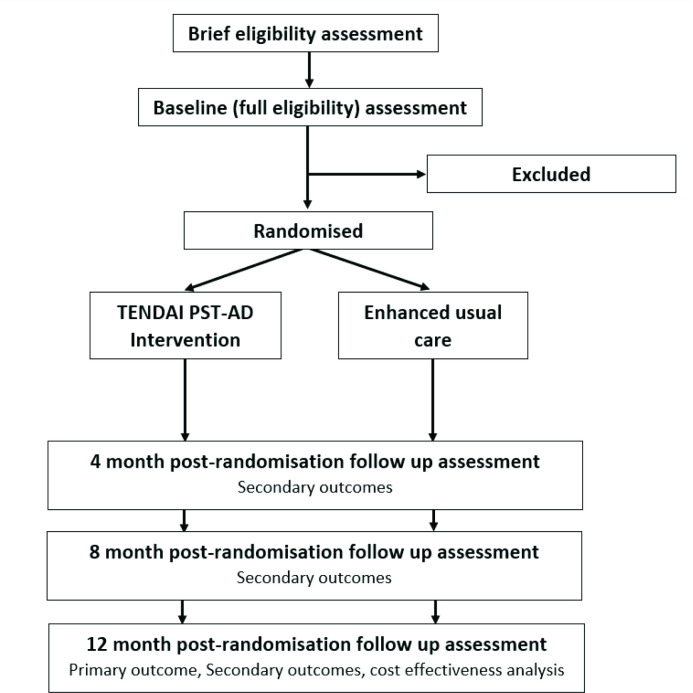
Non-adherence to antiretroviral therapy (ART) is the main cause of viral non-suppression and its risk is increased by depression. In countries with high burden of HIV, there is a lack of trained professionals to deliver depression treatments. This paper describes the protocol for a 2-arm parallel group superiority 1:1 randomised controlled trial, to test the effectiveness and cost effectiveness of the TENDAI stepped care task-shifted intervention for depression, ART non-adherence and HIV viral suppression delivered by lay interventionists.
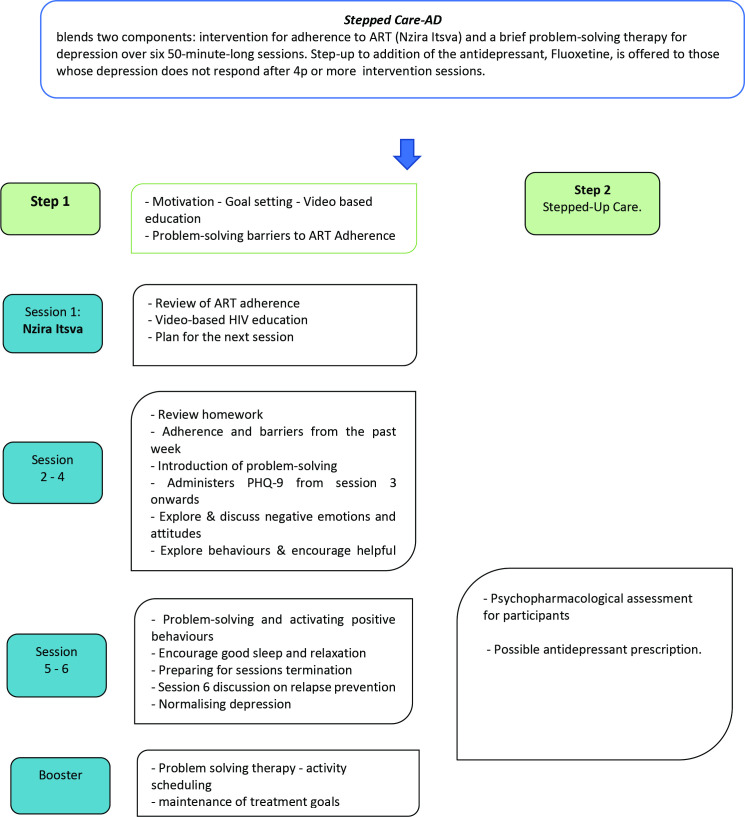
Two hundred and ninety people living with HIV aged ≥18 years with probable depression (Patient Health Questionnaire=>10) and viral non-suppression (≥ 1000 HIV copies/mL) are being recruited from HIV clinics in towns in Zimbabwe. The intervention group will receive a culturally adapted 6-session psychological treatment, Problem-Solving Therapy for Adherence and Depression (PST-AD), including problem-solving therapy, positive activity scheduling, skills to cope with stress and poor sleep and content to target barriers to non-adherence to ART. Participants whose score on the Patient Health Questionnaire-9 remains ≥10, and/or falls by less than 5 points, step up to a nurse evaluation for possible antidepressant medication. The control group receives usual care for viral non-suppression, consisting of three sessions of adherence counselling from existing clinic staff, and enhanced usual care for depression in line with the WHO Mental Health Gap intervention guide. The primary outcome is viral suppression (<1000 HIV copies/mL) at 12 months post-randomisation.
The study and its tools were approved by MRCZ/A/2390 in Zimbabwe and RESCM-18/19-5580 in the UK. Study findings will be shared through the community advisory group, conferences and open access publications.
NCT04018391.
不遵医嘱服用抗逆转录病毒疗法(ART)是病毒未被抑制的主要原因,而抑郁会增加这种风险。在 HIV 负担沉重的国家,缺乏接受过培训的专业人员来提供抑郁症治疗。本文介绍了一项 2 臂平行组优效性 1:1 随机对照试验的方案,以测试 TENDAI 分级照护转移干预措施对抑郁、ART 不依从和 HIV 病毒抑制的有效性和成本效益,该干预措施由非专业干预人员实施。
从津巴布韦城镇的 HIV 诊所招募了 290 名年龄≥18 岁、患有可能的抑郁症(患者健康问卷>10 分)和病毒未被抑制(≥1000 拷贝/mL)的 HIV 感染者。干预组将接受 6 节文化适应的心理治疗,即解决问题的坚持和抑郁治疗(PST-AD),包括解决问题的治疗、积极的活动计划、应对压力和睡眠不佳的技能以及针对 ART 不依从的障碍的内容。如果患者的患者健康问卷-9 得分仍然≥10 分,或下降幅度低于 5 分,则升级为护士评估,以确定是否可能使用抗抑郁药物。对照组接受针对病毒未被抑制的常规护理,包括现有临床工作人员提供的 3 节依从性咨询,以及根据世界卫生组织心理健康差距干预指南提供的针对抑郁的强化常规护理。主要结局是随机分组后 12 个月的病毒抑制(<1000 拷贝/mL)。
该研究及其工具得到了津巴布韦 MRCZ/A/2390 和英国 RESCM-18/19-5580 的批准。研究结果将通过社区咨询小组、会议和开放获取出版物进行分享。
NCT04018391。