Australian Institute of Health Innovation, Macquarie University, Sydney, New South Wales, Australia
Australian Institute of Health Innovation, Macquarie University, Sydney, New South Wales, Australia.
BMJ Open. 2022 Sep 1;12(9):e060394. doi: 10.1136/bmjopen-2021-060394.
Rare diseases are characterised by low incidence, often with little evidence for effective treatments. Isolated patients and specialist centres for rare diseases are increasingly connected, thanks to the internet. This scoping review aimed to identify issues facing people with a rare disease that authors report may be addressed by electronic resources (mobile applications, websites, social media platforms, telehealth and online portals).
Scoping review guided by the PRISMA-ScR (Preferred Reporting Items for Systematic Reviews and Meta-Analyses extension for Scoping Reviews) guidelines.
Medline, Embase and PsycInfo were searched, supplemented by hand searches of selected journals, in July 2021.
Peer-reviewed literature in English was searched using terms for rare disease (incidence <1:2000), electronic modalities (eg, mobile phone) and patient support terms. No date limit was set. Conference abstracts were included.
Data extracted: rare disease/group of diseases, name of the e-resource, need identified in the patient cohort, features of the e-resource, any other findings or observations of interest. From this, a framework was developed synthesising features across diseases and resources.
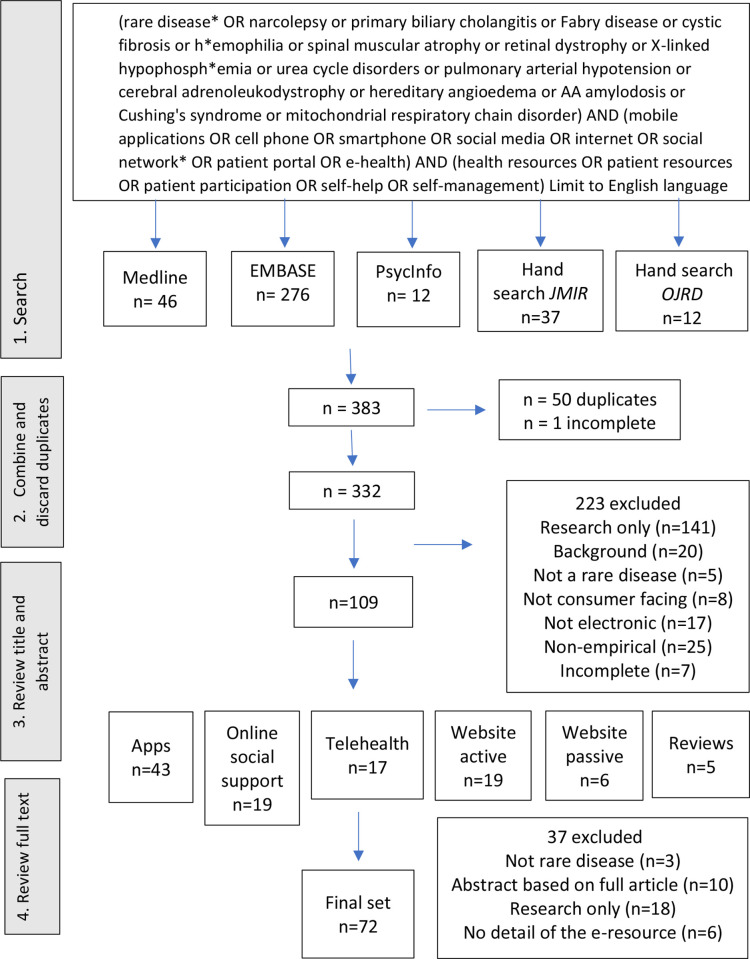
Seventy-two papers were found (from 383). Fifty-six electronic resources were described in 64 papers, while 12 papers were exploratory studies. Cystic fibrosis (n=28) was the most frequently addressed, followed by haemophilia (n=16).Four domains and 23 subdomains of needs were extracted from the papers. The domains of needs were: support for self-management, access to high-quality information, access to appropriate specialist services, and social support. Subdomains are sometimes related to needs of individual rare diseases (eg, social isolation due to infection risk in people with cystic fibrosis). Fifteen electronic resources were identified that supported parents of children with rare disorders.
While it can be argued that rare diseases, per se, may be no less distressing or onerous to care for than a high prevalence disease, rare diseases have unique features: the lengthy odyssey to find a diagnosis, then appropriate specialists, the lack of evidence around effective treatments, guidelines or access to knowledgeable general health service providers. Designers of electronic resources are urged to consult key stakeholders to enhance the effectiveness and usability of resources for people with a rare disease.
罕见病的发病率较低,通常缺乏有效治疗方法,因此具有特征性。由于互联网的发展,孤立的患者和罕见病专科中心之间的联系越来越紧密。本范围综述旨在确定作者报告的罕见病患者可能面临的问题,这些问题可以通过电子资源(移动应用程序、网站、社交媒体平台、远程医疗和在线门户)来解决。
根据 PRISMA-ScR(系统评价和荟萃分析扩展的首选报告项目用于范围综述)指南进行范围综述。
2021 年 7 月,在 Medline、Embase 和 PsycInfo 上进行了搜索,并对选定期刊进行了手工搜索补充。
使用罕见病(发病率<1:2000)、电子模式(如手机)和患者支持术语的英文同行评审文献进行搜索。没有设置日期限制。包括会议摘要。
提取的数据:罕见病/一组疾病、电子资源的名称、患者群体中确定的需求、电子资源的特征、任何其他相关发现或感兴趣的观察结果。在此基础上,开发了一个框架,综合了不同疾病和资源的特征。
共发现 72 篇论文(来自 383 篇)。64 篇论文描述了 56 种电子资源,而 12 篇论文是探索性研究。囊性纤维化(n=28)是最常涉及的疾病,其次是血友病(n=16)。从论文中提取了四个领域和 23 个子领域的需求。需求领域包括:自我管理支持、高质量信息获取、适当专科服务获取和社会支持。子领域有时与个别罕见疾病的需求相关(例如,囊性纤维化患者因感染风险而导致的社交孤立)。确定了 15 种支持患有罕见疾病儿童的父母的电子资源。
虽然可以说罕见病本身的护理可能并不比高流行疾病的护理更令人痛苦或麻烦,但罕见病具有独特的特征:漫长的诊断之旅,然后是适当的专科医生,缺乏有效治疗方法、指南或了解一般卫生服务提供者的知识。敦促电子资源设计人员咨询主要利益相关者,以提高资源对罕见病患者的有效性和可用性。