Quintana Kiley Boone, Miller Ilana, Regier Debra S
Division of Pediatric Genetics, University of New Mexico, Albuquerque, NM.
Genetics and Metabolism, Children's National Hospital, Washington, DC.
Genet Med Open. 2024 Jan 29;2:101819. doi: 10.1016/j.gimo.2024.101819. eCollection 2024.
With increases in precision medicine initiatives and genetically defined rare diseases, the genetics and metabolism workforce is necessary to provide around-the-clock care for patients. Here, we describe the impact that home-based call has on the geneticist and metabolist workforce.
Physicians from 3 populations were self-identified (pediatric subspecialist, geneticist, metabolist) and completed a survey regarding the impact of home-based call service on their sleep and wellness.
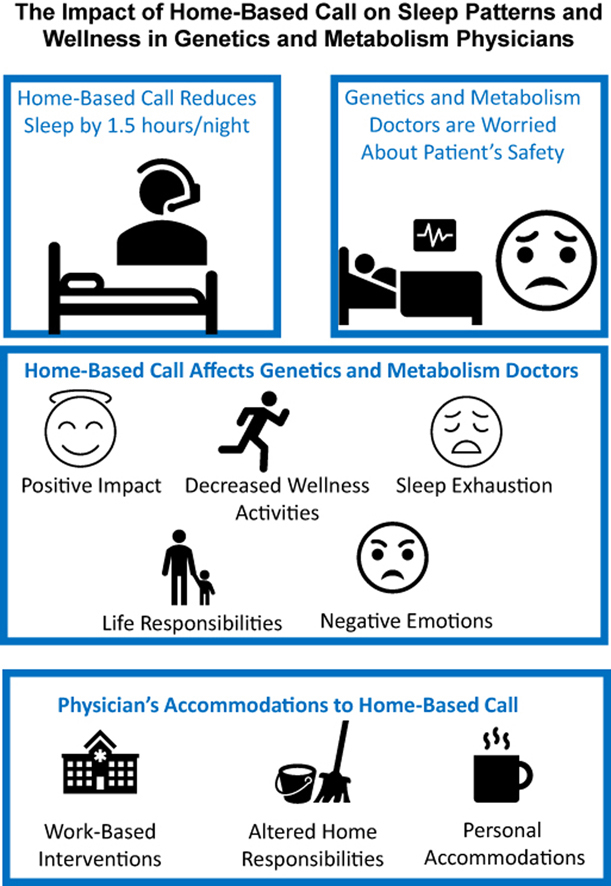
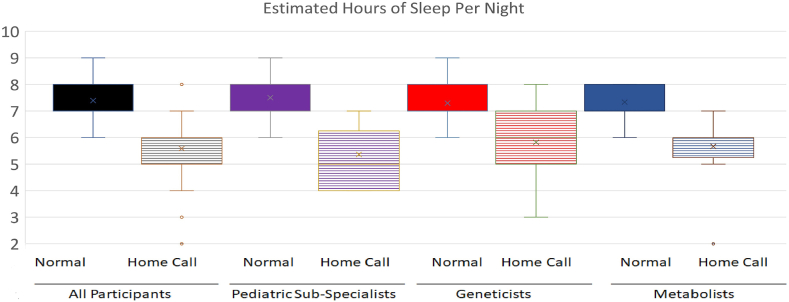
Estimated sleep while serving on home-based call was reduced from 7.5 to 5.4 hours per night. Safety concerns were noted by geneticists and metabolists for themselves (55%) and their families (28%), similar to other subspecialists. Geneticists and metabolists were more likely than other pediatric subspecialists to be worried about their patient's safety while on home-based call (48% vs 9%). Themes from open-ended questions regarding the impact of home-call included positive responses, decreased access to wellness activities, sleep exhaustion, impact on life responsibility, and impact on mood. Reported coping mechanisms included work-based initiatives, off-loading personal responsibility, and creating personal accommodations.
Institutional-based supports for home-based call were endorsed by only 29% of respondents; thus, interventions at the institutional level would be expected to have a large effect on overall provider wellness.
随着精准医疗计划的增加以及基因定义的罕见病的出现,遗传学和代谢领域的工作人员对于为患者提供全天候护理至关重要。在此,我们描述了居家值班对遗传学家和代谢专家工作人员的影响。
来自3类人群的医生(儿科专科医生、遗传学家、代谢专家)自行报名,并完成了一项关于居家值班服务对其睡眠和健康影响的调查。
参与居家值班时每晚的估计睡眠时间从7.5小时减少到5.4小时。遗传学家和代谢专家对自身(55%)及其家人(28%)存在安全担忧,这与其他专科医生类似。与其他儿科专科医生相比,遗传学家和代谢专家在居家值班时更担心患者的安全(48%对9%)。关于居家值班影响的开放式问题的主题包括积极回应、减少参与健康活动的机会、睡眠疲惫、对生活责任的影响以及对情绪的影响。报告的应对机制包括基于工作的举措、减轻个人责任以及进行个人调整。
只有29%的受访者认可基于机构的居家值班支持;因此,预计机构层面的干预措施将对整体医疗服务人员的健康产生重大影响。