Genetics and Rare Diseases Research Division, Ospedale Pediatrico Bambino Gesù, IRCCS, 00146, Rome, Italy.
Sorbonne Université, INSERM, CNRS, Institut de la Vision, 17 Rue Moreau, 75012, Paris, France.
Sci Rep. 2022 Dec 30;12(1):22597. doi: 10.1038/s41598-022-26822-7.
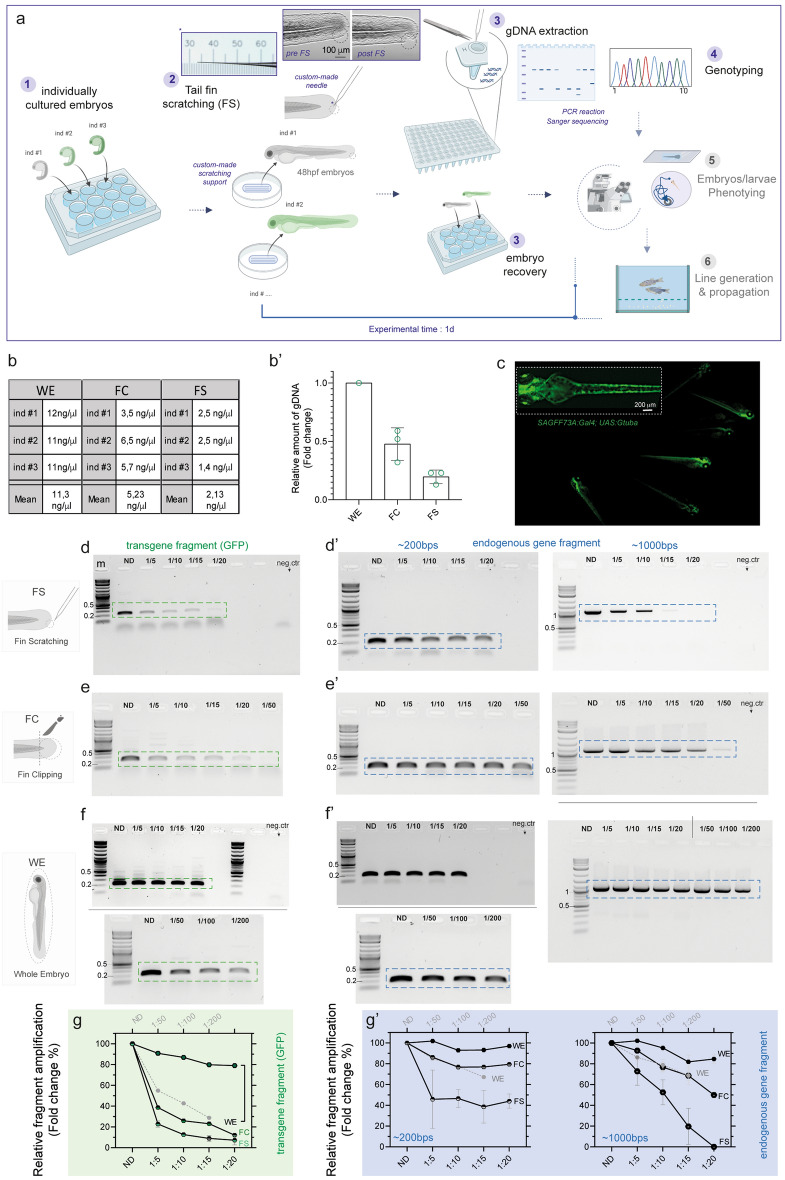
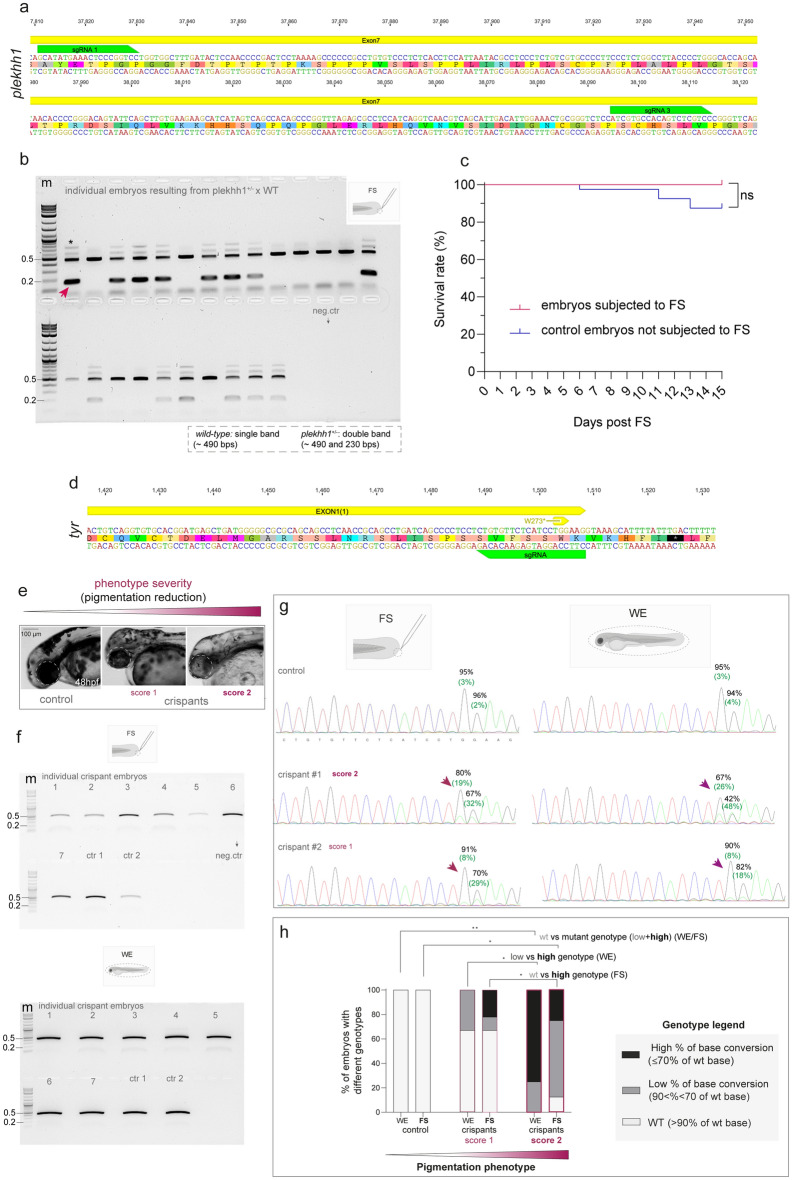
Current genetic modification and phenotyping methods in teleost fish allow detailed investigation of vertebrate mechanisms of development, modeling of specific aspects of human diseases and efficient testing of drugs at an organ/organismal level in an unparalleled fast and large-scale mode. Fish-based experimental approaches have boosted the in vivo verification and implementation of scientific advances, offering the quality guaranteed by animal models that ultimately benefit human health, and are not yet fully replaceable by even the most sophisticated in vitro alternatives. Thanks to highly efficient and constantly advancing genetic engineering as well as non-invasive phenotyping methods, the small zebrafish is quickly becoming a popular alternative to large animals' experimentation. This approach is commonly associated to invasive procedures and increased burden. Here, we present a rapid and minimally invasive method to obtain sufficient genomic material from single zebrafish embryos by simple and precise tail fin scratching that can be robustly used for at least two rounds of genotyping already from embryos within 48 h of development. The described protocol betters currently available methods (such as fin clipping), by minimizing the relative animal distress associated with biopsy at later or adult stages. It allows early selection of embryos with desired genotypes for strategizing culturing or genotype-phenotype correlation experiments, resulting in a net reduction of "surplus" animals used for mutant line generation.
当前的鱼类遗传修饰和表型分析方法可以详细研究脊椎动物的发育机制,模拟人类疾病的特定方面,并以无与伦比的快速和大规模模式在器官/机体水平上高效地测试药物。基于鱼类的实验方法促进了科学进步的体内验证和实施,提供了动物模型所保证的质量,最终有益于人类健康,即使是最复杂的体外替代方法也尚未完全替代。由于高效且不断推进的基因工程以及非侵入性的表型分析方法,小型斑马鱼迅速成为大型动物实验的热门替代方法。这种方法通常与侵入性程序和负担增加有关。在这里,我们提出了一种快速且微创的方法,通过简单而精确的尾鳍划痕从单个斑马鱼胚胎中获得足够的基因组材料,该方法至少可以从发育后 48 小时的胚胎中进行两轮基因型分析,并且具有良好的稳定性。与目前可用的方法(如鳍剪)相比,该方法通过最大限度地减少与后期或成年阶段活检相关的动物痛苦,从而改善了相对动物的痛苦。它允许早期选择具有所需基因型的胚胎,用于制定培养或基因型-表型相关性实验的策略,从而减少用于突变系生成的“过剩”动物的数量。