Department of General Internal Medicine, Unit 1465, The University of Texas MD Anderson Cancer Center, P.O. Box 301402, Houston, TX, 77230-1402, USA.
SWOG Statistics and Data Management Center, Seattle, WA, USA.
Support Care Cancer. 2022 Dec 31;31(1):93. doi: 10.1007/s00520-022-07525-1.
Information is limited about adherence to practice guidelines in patients with hepatitis B virus (HBV), hepatitis C virus (HCV), or HIV infection receiving anticancer treatment.
Newly diagnosed adult cancer patients were enrolled in a multicenter, prospective cohort study (SWOG S1204) during 2013-2017 to evaluate the prevalence of HBV, HCV, or HIV in patients initiating anticancer treatment. At 6 months, records of virus-positive patients were reviewed for antiviral therapy use; anticancer treatment dose reduction; and HBV reactivation (elevated viral load). Categorical variables were compared using chi-square or Fisher's exact test.
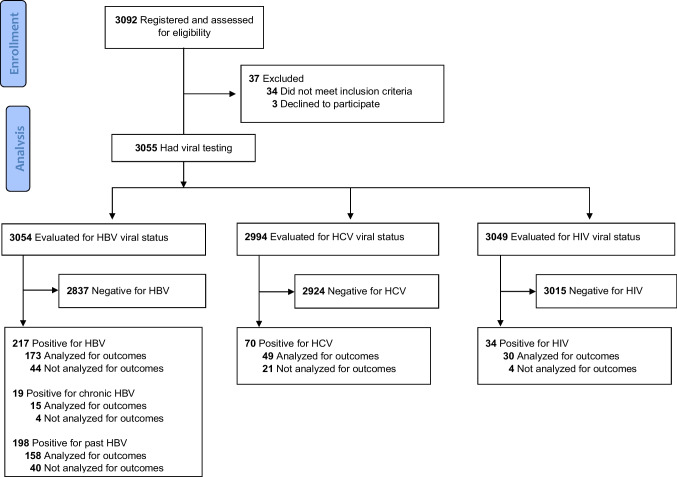
Of 3055 enrolled patients with viral testing, 230 had chronic or past HBV, HCV, or HIV with 6-month follow-up data (chronic HBV, 15 patients; past HBV, 158; HCV, 49; HIV, 30). Twenty percent (3/15) of chronic HBV and 11% (17/158) of past HBV patients were co-infected with HCV and/or HIV. Rates of antiviral therapy use by 6 months were as follows: chronic HBV, 85% (11/13); past HBV receiving anti-B cell therapy, 60% (3/5); past HBV receiving systemic anticancer therapy without anti-B cell therapy, 8% (8/105); HCV, 6% (2/35); and HIV, 90% (19/21). Among patients with available data, anticancer treatment dose was reduced in 1 of 145 patients with past HBV and 1 of 42 with HCV. HBV reactivation occurred in 1 of 15 patients with chronic HBV; this patient was not receiving antiviral therapy.
Many patients with cancer and viral infections either do not receive guideline-recommended antiviral treatment or receive antiviral treatment that is not recommended in guidelines. Further education is needed to improve adherence to guidelines.
在接受癌症治疗的乙型肝炎病毒 (HBV)、丙型肝炎病毒 (HCV) 或人类免疫缺陷病毒 (HIV) 感染者中,有关其对治疗实践指南的遵循情况的信息有限。
在 2013 年至 2017 年期间,新诊断的成年癌症患者参加了一项多中心前瞻性队列研究(SWOG S1204),以评估开始接受癌症治疗的患者中 HBV、HCV 或 HIV 的流行情况。在 6 个月时,对病毒阳性患者的记录进行了审查,以评估抗病毒治疗的使用情况、癌症治疗剂量的减少情况以及乙型肝炎病毒的再激活(病毒载量升高)情况。使用卡方检验或 Fisher 确切概率法比较分类变量。
在接受病毒检测的 3055 例入组患者中,有 230 例患有慢性或既往 HBV、HCV 或 HIV,并且有 6 个月的随访数据(慢性 HBV,15 例;既往 HBV,158 例;HCV,49 例;HIV,30 例)。20%(3/15)的慢性 HBV 患者和 11%(17/158)的既往 HBV 患者合并感染 HCV 和/或 HIV。6 个月时抗病毒治疗的使用率如下:慢性 HBV,85%(11/13);接受抗 B 细胞治疗的既往 HBV,60%(3/5);接受系统抗癌治疗而无抗 B 细胞治疗的既往 HBV,8%(8/105);HCV,6%(2/35);HIV,90%(19/21)。在有可用数据的患者中,有 1 例既往 HBV 患者和 1 例 HCV 患者减少了癌症治疗剂量。15 例慢性 HBV 患者中有 1 例发生了乙型肝炎病毒再激活;该患者未接受抗病毒治疗。
许多患有癌症和病毒感染的患者要么未接受指南推荐的抗病毒治疗,要么接受了不符合指南推荐的抗病毒治疗。需要进一步教育以提高对指南的遵循率。