School of Dentistry, Makerere University, Kampala, Uganda.
School of Dental Sciences, University of Nairobi, Nairobi, Kenya.
BMC Oral Health. 2022 Dec 30;22(1):656. doi: 10.1186/s12903-022-02677-2.
Cerebral palsy (CP) is a non-progressive neuromuscular condition diagnosed in childhood. CP as a form of disability, does not cause any specific oral disease. However, some oral conditions are more commonly associated with people with CP compared to the general population. The overarching aim of the current study was to determine the oral hygiene status, gingival status, and the prevalence of dental caries in children with CP attending a leading hospital institution for children with disabilities in Kampala, Uganda. Additionally, we determined the barriers faced by children with CP in accessing oral healthcare.
This cross-sectional study was carried out at the Comprehensive Rehabilitation Services Uganda hospital in Kampala, Uganda. Our study population consisted of a convenient sample of 90 children diagnosed with CP aged 3-17 years and their caregivers. A validated and interviewer administered structured questionnaire was used to collect socio-demographic data of the participants. A modified World Health Organization oral health assessment form for those aged 3-17 years was used to gather data on oral health status (plaque score, gingival bleeding and dental caries.) The data was subjected to statistical tests with critical value set up at 5%.
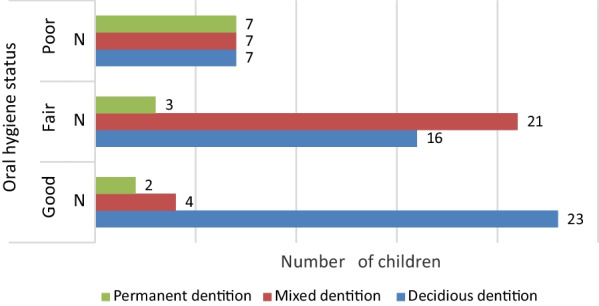
Only 32.2% of the children evaluated had adequate oral hygiene, while 44.4% of the children experienced gingival bleeding. The prevalence of dental caries for both deciduous and permanent dentition was 63.3%, with DMFT values of 3.8 ± 4.5. The most common barrier reported by the caregivers was the challenge in modality of transportation availability from the children's homes to the health facilities (34.4%).
Children with CP in the study population have a significant prevalence of oral diseases and face several barriers to oral healthcare. Results from this study aim to provide relevant support to advocate for a nationwide change in policy to improve access to dental care to decrease the burden of oral diseases in children with special healthcare needs.
脑瘫(CP)是一种儿童时期诊断出的非进行性神经肌肉疾病。CP 作为一种残疾形式,不会导致任何特定的口腔疾病。然而,与普通人群相比,一些口腔状况在 CP 患者中更为常见。本研究的总体目标是确定在乌干达坎帕拉一家领先的残疾儿童医院就诊的 CP 儿童的口腔卫生状况、牙龈状况和龋齿患病率。此外,我们还确定了 CP 儿童在获得口腔保健方面面临的障碍。
这是一项在乌干达坎帕拉综合康复服务乌干达医院进行的横断面研究。我们的研究人群包括 90 名被诊断患有 CP 的年龄在 3-17 岁的儿童及其照顾者的便利样本。使用经过验证的、由访谈者管理的结构化问卷收集参与者的社会人口统计学数据。使用针对 3-17 岁人群的世界卫生组织口腔健康评估表收集口腔健康状况数据(菌斑评分、牙龈出血和龋齿)。使用统计检验对数据进行分析,临界值设为 5%。
只有 32.2%的评估儿童具有足够的口腔卫生,而 44.4%的儿童出现牙龈出血。乳牙和恒牙的龋齿患病率均为 63.3%,DMFT 值为 3.8±4.5。照顾者报告的最常见障碍是从儿童之家到卫生设施的交通方式可用性方面的挑战(34.4%)。
研究人群中的 CP 儿童口腔疾病患病率较高,并且在获得口腔保健方面面临多种障碍。本研究的结果旨在提供相关支持,倡导在全国范围内改变政策,以改善对牙科护理的获取,从而减轻有特殊医疗需求的儿童的口腔疾病负担。