Jiao Sally, Katz Lynn E, Shell M Scott
Department of Chemical Engineering, University of California, Santa Barbara, California93106, United States.
Department of Civil, Architectural and Environmental Engineering, University of Texas at Austin, Austin, Texas78712, United States.
ACS Cent Sci. 2022 Dec 28;8(12):1609-1617. doi: 10.1021/acscentsci.2c01011. Epub 2022 Nov 30.
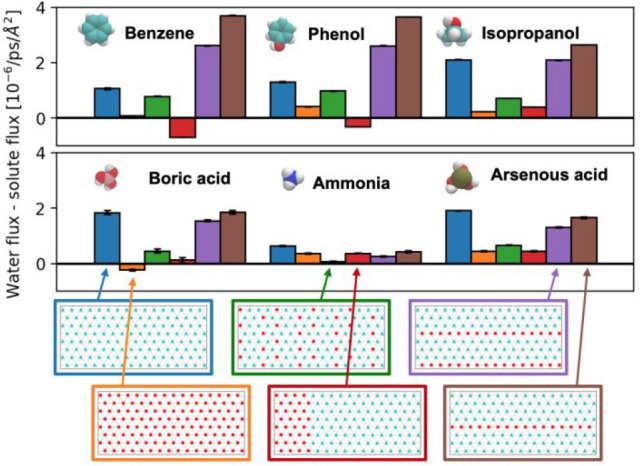
Next-generation membranes for purification and reuse of highly contaminated water require materials with precisely tuned functionality to address key challenges, including the removal of small, charge-neutral solutes. Bioinspired multifunctional membrane surfaces enhance transport properties, but the combinatorically large chemical space is difficult to navigate through trial and error. Here, we demonstrate a computational inverse design approach to efficiently identify promising materials and elucidate design rules. We develop a combined evolutionary optimization, machine learning, and molecular simulation workflow to spatially design chemical functional group patterning in a model nanopore that enhances transport of water relative to solutes. The genetic optimization discovers nonintuitive functionalization strategies that hinder the transport of solutes through the pore, simply by patterning hydrophobic methyl and hydrophilic hydroxyl functional groups. Examining these patterns, we demonstrate that they exploit an unexpected diffusive solute hopping mechanism. This inverse design procedure and the identification of novel molecular mechanisms for pore chemical heterogeneity to impact solute selectivity demonstrate new routes to the design of membrane materials with novel functionalities. More broadly, this work illustrates how chemical design is a powerful strategy to modulate water-mediated surface-solute interactions in complex, soft material systems that are relevant to diverse technologies.
用于净化和再利用高污染水的下一代膜需要具有精确调节功能的材料,以应对关键挑战,包括去除小的、电荷中性的溶质。受生物启发的多功能膜表面可增强传输性能,但组合庞大的化学空间很难通过反复试验来探索。在此,我们展示了一种计算逆向设计方法,以有效地识别有前景的材料并阐明设计规则。我们开发了一种结合进化优化、机器学习和分子模拟的工作流程,在模型纳米孔中进行空间化学官能团图案设计,以增强水相对于溶质的传输。遗传优化发现了非直观的功能化策略,即通过对疏水甲基和亲水羟基官能团进行图案化,阻碍溶质通过孔的传输。通过研究这些图案,我们证明它们利用了一种意想不到的扩散溶质跳跃机制。这种逆向设计程序以及对孔隙化学异质性影响溶质选择性的新型分子机制的识别,展示了设计具有新型功能的膜材料的新途径。更广泛地说,这项工作说明了化学设计是一种强大的策略,可在与多种技术相关的复杂软材料系统中调节水介导的表面 - 溶质相互作用。