Mehar Saima, Anam Iqra, Masood Zubia, Alvi Sofia, Khan Wali, Kabir Muhammad, Shahbaz Muhammad, Khan Tawseef
Department of Chemistry, Sardar Bahadur Khan Women's University (SBKWU), Quetta, Pakistan.
Department of Zoology, Sardar Bahadur Khan Women's University (SBKWU), Quetta, Pakistan.
Saudi J Biol Sci. 2023 Feb;30(2):103540. doi: 10.1016/j.sjbs.2022.103540. Epub 2022 Dec 13.
Among other aquatic animals, fish can also accumulate a large number of toxic metals in their various body organs, which may enter in the human body and cause serious health issues. Therefore, the basic aim of this study was to observe the level of some heavy metals (i.e., Pb, Fe, Cu, Cd, Cr) found in the different tissues of collected from the Karachi and Gwadar coasts of Pakistan.
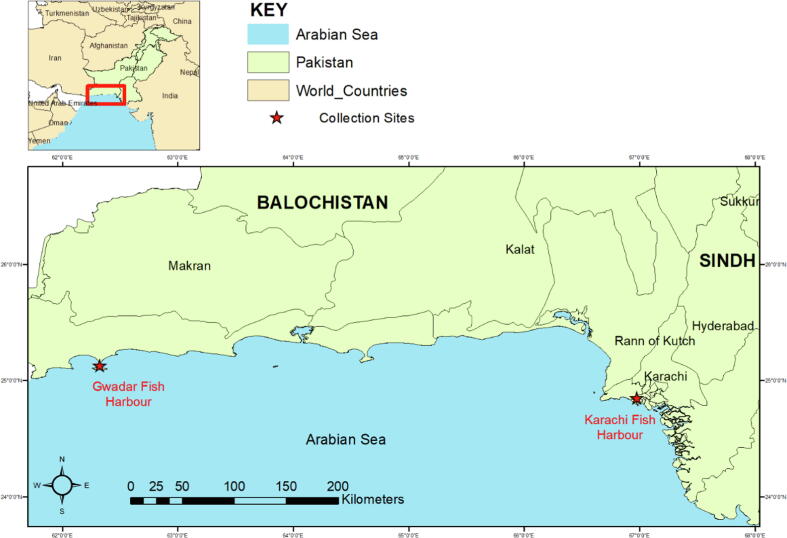
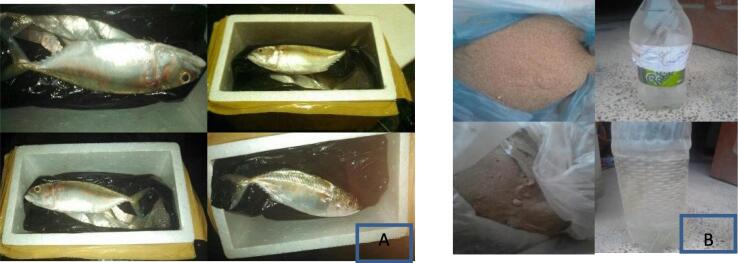
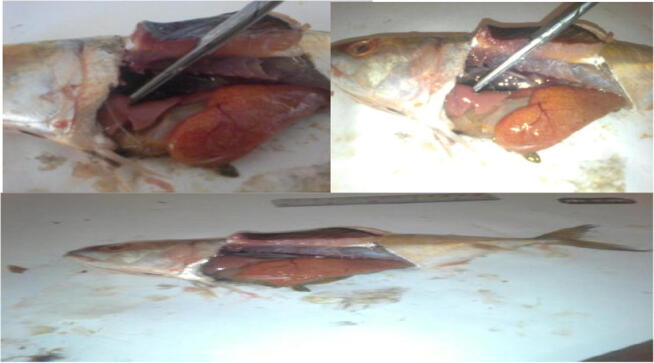
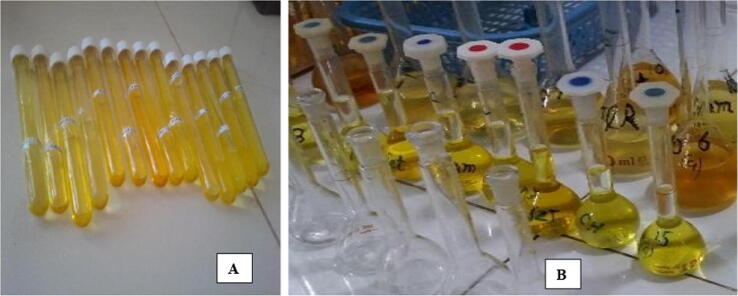
About 200 fish samples of five different size groups of were collected from Gwadar and Karachi fish harbors during April to September 2020. Total 10 samples of each size group i.e., S1, S2, S3, S4 & S5 were collected from each coast. Heavy metals were analyzed in fish samples by using the atomic absorption spectrophotometer (AAS).
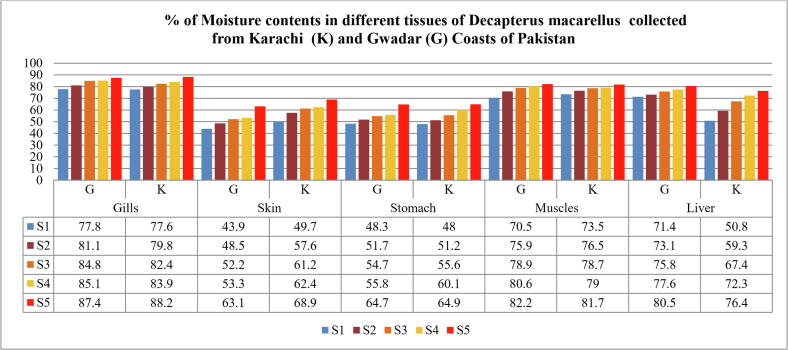
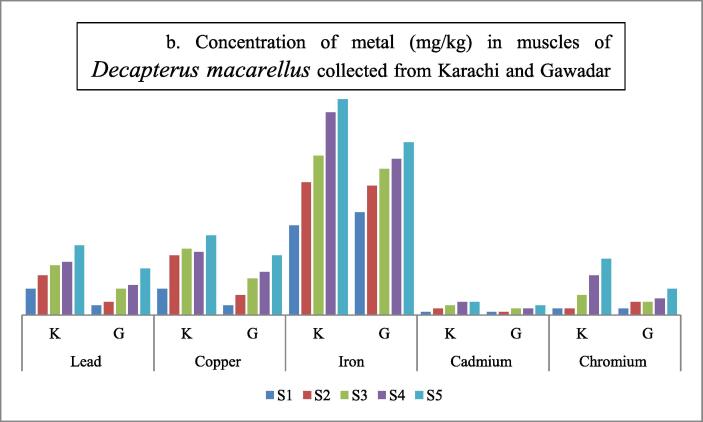
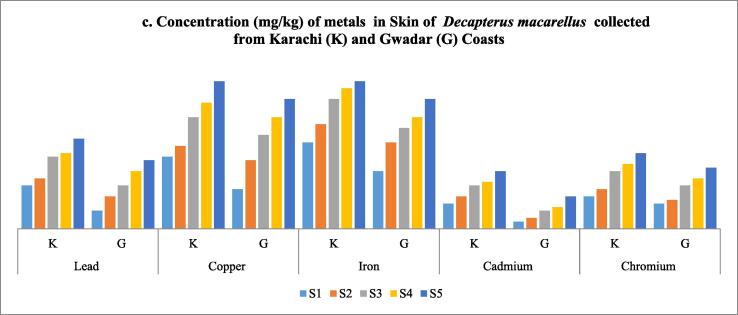
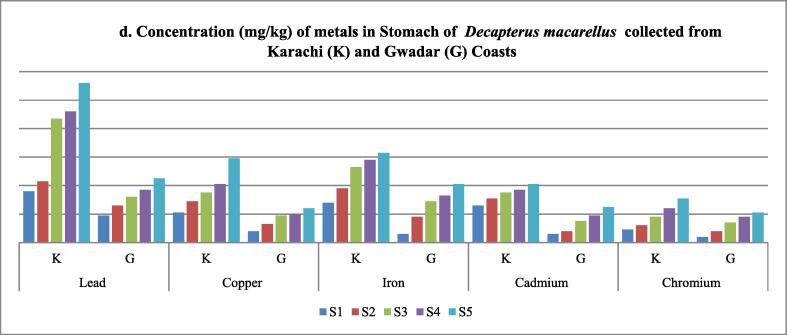
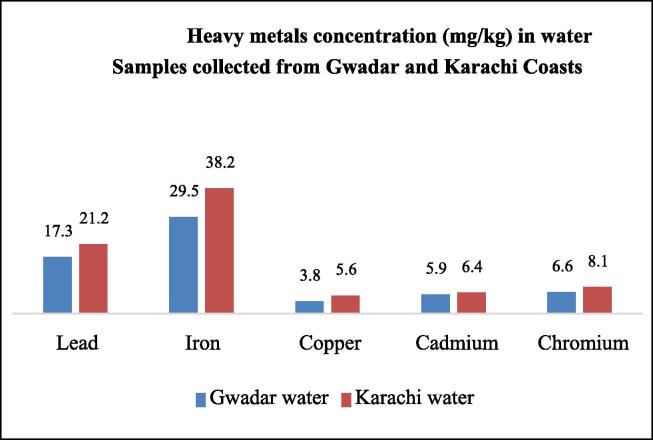
The overall results revealed that some metals like Cu, Pb, Cd & Cr contents were high in the stomach, while less in the muscles. Whereas, the concentration of Fe was found to be high in the liver, while low in skin of fish. The average values of bioaccumulation of these heavy metals (BAF) were found in decreasing order of Cu > Cd > Fe > Cr > Pb. In this study, except Cd and Cr, all metals were found within the permissible limits. Both sediment and water from the selected site areas were also analyzed to observe their pollution levels in the order of; sediment > water > fish tissues.
Thus, it was concluded that the Karachi environment was much more polluted than the Gwadar environment because it is in an industrial unit and a busy sea site for trade. Moreover, consuming muscles from this species is safe for human health except for iron toxicity, but the use of the liver is not beneficial for all selected metals. Thus, the present work will also be helpful to monitor these toxic metals in a food chain and maintain a healthy life, and reduce all kinds of health risks associated with them.
在其他水生动物中,鱼类的各个身体器官也会积累大量有毒金属,这些金属可能进入人体并引发严重的健康问题。因此,本研究的基本目的是观察从巴基斯坦卡拉奇和瓜达尔海岸采集的鱼类不同组织中某些重金属(即铅、铁、铜、镉、铬)的含量水平。
2020年4月至9月期间,从瓜达尔和卡拉奇渔港采集了约200份分属五个不同大小组的鱼类样本。每个海岸的每个大小组(即S1、S2、S3、S4和S5)各采集10个样本。使用原子吸收分光光度计(AAS)对鱼类样本中的重金属进行分析。
总体结果显示,铜、铅、镉和铬等一些金属在胃中的含量较高,而在肌肉中的含量较低。然而,铁的浓度在鱼肝中较高,而在鱼皮中较低。这些重金属的生物累积平均值(BAF)按铜>镉>铁>铬>铅的顺序递减。在本研究中,除镉和铬外,所有金属均在允许限值范围内。还对选定地点区域的沉积物和水进行了分析,以观察它们的污染程度顺序为:沉积物>水>鱼组织。
因此,得出的结论是,卡拉奇的环境比瓜达尔的环境污染严重得多,因为它位于一个工业区域且是繁忙的贸易海域。此外,除铁毒性外,食用该物种的肌肉对人类健康是安全的,但肝脏对于所有选定的金属来说都无益。因此,本研究也将有助于监测食物链中的这些有毒金属,维持健康生活,并降低与之相关的各种健康风险。