Tahity Tanha, Islam Md Rakeb Ul, Bhuiyan Nurer Zaman, Choudhury Tasrina Rabia, Yu Jimmy, Noman Md Abu, Hosen Mohammad Mozammal, Quraishi Shamshad B, Paray Bilal Ahamad, Arai Takaomi, Hossain Mohammad Belal
Department of Fisheries and Marine Science, Noakhali Science and Technology University, Noakhali 3814, Bangladesh.
Independent Researcher, Mustankivenkatu 2C 38, 00980 Helsinki, Finland.
Toxics. 2022 Jul 22;10(8):410. doi: 10.3390/toxics10080410.
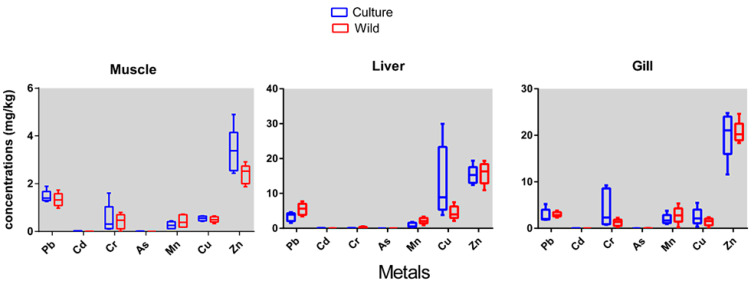
Globally, both natural water bodies and aquaculture systems are being severely contaminated by heavy metals due to rising anthropogenic activities. Fish living in aquatic environments can easily accumulate metals in their bodies, which can then be transferred to consumers and put them at risk. In this study, metal concentrations (Pb, Cd, Cr, As, Mn, Cu, Zn) in different organs (gill, liver, and muscle) of farmed and wild Barramundi (Lates calcarifer) fish from the northern Bay of Bengal were evaluated to quantify and compare contamination levels and related human health risk. Heavy metal concentrations were higher in liver tissues of farmed Barramundi than in wild Barramundi, with the following relative mean values in the liver, gills, and muscle: Zn > Cu > Pb > Mn > Cd > Cr > As; Zn > Cr > Cu > Pb > Mn > Cd > As; Zn > Pb > Cu > Cr > Mn > Cd > As; Zn > Pb > Cu > Cr > Mn > Cd > As; and Zn > Pb > Cu > Cr > Mn > Cd > As, respectively. The differences in heavy metal accumulation observed between farmed and wild fish were probably related to the differences in their environmental conditions and dietary element concentrations. However, ANOVA indicated that the variation of metals in wild and Barramundi was not statically significant. Pb concentrations in the liver tissue of farmed Barramundi exceeded the national and international threshold limits, whereas concentrations of other metals were within the limit. Among the examined organs in both fish species (wild and farmed), muscle had the lowest concentration compared to others, and liver was the target organ for Pb, Cu, and Cd accumulations. Metals such as Zn and Mn exhibited higher concentration in the gills. However, all the studied heavy metals were below the maximum permissible limits of national and international standards, but the mean concentrations of Pb and Cd values in the liver of farmed Barramundi exceeded all international and national guidelines. Based on the contamination factors (CF) and pollution indices (PLI and MPI), the degree of contamination in the fish organs was as follows: gills > liver > muscle. The major accumulation tissues for both farmed and wild fish were found to be the gills (MPI = 0.970) and the liver (MPI = 0.692). Based on the estimated daily intake (EDI), the fish samples examined in this study are safe for human consumption as within the recommended daily allowance (RDA) range established by various authorities. According to the Target Hazard Quotient (THQ) and Carcinogenic Risk (CR) calculations, though the Barramundi fishes depicted no potential hazard to humans, farmed fish posed a higher health risk than wild fish.
在全球范围内,由于人为活动的增加,天然水体和水产养殖系统都受到重金属的严重污染。生活在水生环境中的鱼类很容易在体内积累金属,然后这些金属会转移到消费者体内,使他们面临风险。在本研究中,对来自孟加拉湾北部的养殖和野生尖吻鲈(Lates calcarifer)不同器官(鳃、肝脏和肌肉)中的金属浓度(铅、镉、铬、砷、锰、铜、锌)进行了评估,以量化和比较污染水平以及相关的人类健康风险。养殖尖吻鲈肝脏组织中的重金属浓度高于野生尖吻鲈,肝脏、鳃和肌肉中的相对平均值如下:锌>铜>铅>锰>镉>铬>砷;锌>铬>铜>铅>锰>镉>砷;锌>铅>铜>铬>锰>镉>砷;锌>铅>铜>铬>锰>镉>砷;以及锌>铅>铜>铬>锰>镉>砷。养殖鱼和野生鱼之间观察到的重金属积累差异可能与它们的环境条件和饮食元素浓度差异有关。然而,方差分析表明野生尖吻鲈和养殖尖吻鲈体内金属的变化在统计学上并不显著。养殖尖吻鲈肝脏组织中的铅浓度超过了国家和国际阈值限制,而其他金属的浓度在限值范围内。在两种鱼类(野生和养殖)的所有检查器官中,肌肉中的浓度与其他器官相比最低,肝脏是铅、铜和镉积累的靶器官。锌和锰等金属在鳃中的浓度较高。然而,所有研究的重金属均低于国家和国际标准的最大允许限值,但养殖尖吻鲈肝脏中铅和镉的平均浓度超过了所有国际和国家指南。根据污染因子(CF)和污染指数(PLI和MPI),鱼类器官的污染程度如下:鳃>肝脏>肌肉。养殖鱼和野生鱼的主要蓄积组织均为鳃(MPI = 0.970)和肝脏(MPI = 0.692)。根据估计每日摄入量(EDI),本研究中检测的鱼样本对人类消费是安全的,因为在各权威机构确定的推荐每日摄入量(RDA)范围内。根据目标危险商数(THQ)和致癌风险(CR)计算,虽然尖吻鲈对人类没有潜在危害,但养殖鱼比野生鱼构成更高的健康风险。