Ratheesh A, Hett D, Ramain J, Wong E, Berk L, Conus P, Fristad M A, Goldstein T, Hillegers M, Jauhar S, Kessing L V, Miklowitz D J, Murray G, Scott J, Tohen M, Yatham L N, Young A H, Berk M, Marwaha S
Orygen, 35 Poplar Road, Parkville, VIC, Australia.
Centre for Youth Mental Health, The University of Melbourne, Melbourne, Australia.
Int J Bipolar Disord. 2023 Jan 3;11(1):1. doi: 10.1186/s40345-022-00275-3.
Given the likelihood of progressive illness in bipolar disorder (BD), it is important to understand the benefits and risks of interventions administered early in illness course. We conducted a systematic review of the effectiveness of interventions in the early course of BD I or II.
We completed a systematic search on MEDLINE, PsycINFO, EMBASE, the Cochrane Central Register of Controlled Trials, CINAHL and Google Scholar from 1/1/1979 till 14/9/2022. We included controlled trials examining intervention effects on symptomatic, course, functional and tolerability outcomes of patients in the 'early course' of BD I or II. We classified patients to be in early course if they (a) were seeking help for the first time for a manic episode, (b) had a lifetime history of up to 3 manic episodes, or (c) had up to 6 lifetime mood episodes. Evidence quality was assessed using the GRADE approach.
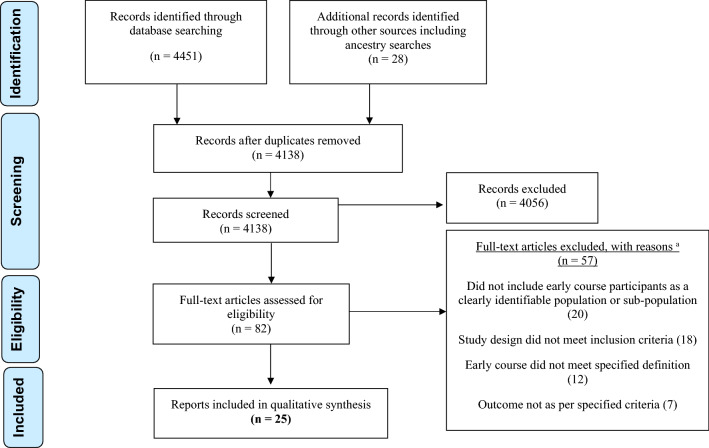
From 4135 unique publications we included 25 reports representing 2212 participants in 16 randomized studies, and 17,714 participants from nine non-randomized studies. Available evidence suggested that in early illness course, lithium use was associated with lower recurrence risk compared with other mood stabilizers. Mood stabilizers were also associated with better global functioning, compared with the use of antipsychotics in the medium term. While summative findings regarding psychological therapies were limited by heterogeneity, family-focused and cognitive-behavioral interventions were associated with reduced recurrence risk or improved symptomatic outcomes. There was some evidence that the same pharmacological interventions were more efficacious in preventing recurrences when utilized in earlier rather than later illness course.
While there are promising initial findings, there is a need for more adequately powered trials to examine the efficacy and tolerability of interventions in youth and adults in early illness course. Specifically, there is a compelling need to compare the relative benefits of lithium with other pharmacological agents in preventing recurrences. In addition to symptomatic outcomes, there should be a greater focus on functional impact and tolerability. Effective pharmacological and psychological interventions should be offered to those in early course of BD, balancing potential risks using shared decision-making approaches.
鉴于双相情感障碍(BD)病情进展的可能性,了解在病程早期进行干预的益处和风险很重要。我们对双相I型或II型障碍病程早期干预措施的有效性进行了系统评价。
我们在MEDLINE、PsycINFO、EMBASE、Cochrane对照试验中央注册库、CINAHL和谷歌学术上完成了一项系统检索,检索时间为1979年1月1日至2022年9月14日。我们纳入了对照试验,这些试验考察了干预措施对双相I型或II型障碍“病程早期”患者的症状、病程、功能和耐受性结局的影响。如果患者符合以下条件,我们将其归类为病程早期:(a)首次因躁狂发作寻求帮助;(b)终生有至多3次躁狂发作史;或(c)终生有至多6次情绪发作。使用GRADE方法评估证据质量。
从4135篇独立发表的文献中,我们纳入了25篇报告,这些报告代表了16项随机研究中的2212名参与者,以及9项非随机研究中的17714名参与者。现有证据表明,在病程早期,与其他心境稳定剂相比,使用锂盐与较低的复发风险相关。与中期使用抗精神病药物相比,心境稳定剂也与更好的整体功能相关。虽然心理治疗的总结性结果因异质性而受限,但以家庭为中心和认知行为干预与复发风险降低或症状结局改善相关。有一些证据表明,相同的药物干预措施在病程早期而非晚期使用时,在预防复发方面更有效。
虽然有一些有前景的初步研究结果,但需要更多样本量充足的试验来考察病程早期青少年和成人干预措施的疗效和耐受性。具体而言,迫切需要比较锂盐与其他药物在预防复发方面的相对益处。除了症状结局外,应更加关注功能影响和耐受性。应向双相情感障碍病程早期的患者提供有效的药物和心理干预措施,采用共同决策方法平衡潜在风险。