Meng Qing, Li Wujiao, Jiang Hanfang, Yan Huimin, Wang Heping, Ye Binjun, Zhou Lintao, Chen Yunsheng
Department of Clinical Microbiology Laboratory, Shenzhen Children's Hospital, No. 7019 Yitian Road, Futian District, Shenzhen, 518038, Guangdong, China.
Department of Respiratory Diseases, Shenzhen Children's Hospital, No. 7019 Yitian Road, Futian District, Shenzhen, 518038, Guangdong, China.
Infect Dis Ther. 2023 Feb;12(2):563-575. doi: 10.1007/s40121-022-00751-4. Epub 2023 Jan 4.
This study aimed to understand the impact of the coronavirus disease 2019 (COVID-19) epidemic on the distribution and antibiotic resistance of pathogenic bacteria isolated from the lower respiratory tract of children in our hospital.
Antimicrobial susceptibility tests were performed on bacteria isolated clinically from the lower respiratory tracts of children in our hospital from 2018 to 2021 by the Kirby-Bauer method and automated systems.
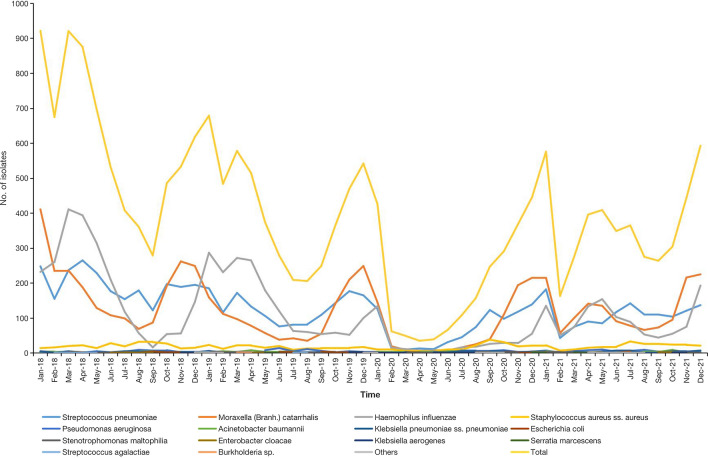
From 2018 to 2021, the top three lower respiratory tract clinical isolates in our hospital were Streptococcus pneumoniae, Moraxella catarrhalis, and Haemophilus influenzae. These three species showed obvious seasonal epidemic patterns, and their numbers decreased significantly during the COVID-19 epidemic, from 4559 in 2019 to 1938 in 2020. Bacterial resistance to antibiotics also changed before and after the COVID-19 epidemic. The annual proportions of methicillin-resistant S. aureus (MRSA) were 41%, 37.4%, 26.2%, and 29.8%. The resistance rates of Klebsiella pneumoniae to ceftriaxone were 40.5%, 51.9%, 35.3%, and 53.3%, and the detection rates of carbapenem-resistant K. pneumoniae (CRKP) were 2.7%, 11.1%, 5.9%, and 4.4%. The detection rates of β-lactamase-producing H. influenzae were 51.9%, 59.2%, 48.9%, and 55.3%. The rate of MRSA, ceftriaxone-resistant K. pneumoniae, CRKP, and β-lactamase-producing H. influenzae decreased significantly in 2020 compared with 2019, whereas that of carbapenem-resistant P. aeruginosa and carbapenem-resistant A. baumannii increased. The detection rates of β-lactamase-negative ampicillin-resistant H. influenzae (BLNAR) gradually increased over the 4 years.
Protective measures against COVID-19, including reduced movement of people, hand hygiene, and surgical masks, may block the transmission of S. pneumoniae, H. influenzae, and M. catarrhalis and reduce the detection rate of MRSA, ceftriaxone-resistant K. pneumoniae, CRKP, and β-lactamase-producing H. influenzae.
本研究旨在了解2019年冠状病毒病(COVID-19)疫情对我院儿童下呼吸道分离出的病原菌分布及抗生素耐药性的影响。
采用 Kirby-Bauer 法和自动化系统,对我院2018年至2021年临床分离自儿童下呼吸道的细菌进行药敏试验。
2018年至2021年,我院下呼吸道临床分离菌排名前三的是肺炎链球菌、卡他莫拉菌和流感嗜血杆菌。这三种菌呈现明显的季节性流行模式,在COVID-19疫情期间其数量显著下降,从2019年的4559株降至2020年的1938株。COVID-19疫情前后细菌对抗生素的耐药性也发生了变化。耐甲氧西林金黄色葡萄球菌(MRSA)的年度比例分别为41%、37.4%、26.2%和29.8%。肺炎克雷伯菌对头孢曲松的耐药率分别为40.5%、51.9%、35.3%和53.3%,耐碳青霉烯类肺炎克雷伯菌(CRKP)的检出率分别为2.7%、11.1%、5.9%和4.4%。产β-内酰胺酶流感嗜血杆菌的检出率分别为51.9%、59.2%、48.9%和55.3%。与2019年相比,2020年MRSA、耐头孢曲松肺炎克雷伯菌、CRKP和产β-内酰胺酶流感嗜血杆菌的比例显著下降,而耐碳青霉烯类铜绿假单胞菌和耐碳青霉烯类鲍曼不动杆菌的比例上升。β-内酰胺酶阴性氨苄西林耐药流感嗜血杆菌(BLNAR)的检出率在4年中逐渐上升。
针对COVID-19的防护措施,包括减少人员流动、手部卫生和佩戴外科口罩,可能会阻断肺炎链球菌、流感嗜血杆菌和卡他莫拉菌的传播,并降低MRSA、耐头孢曲松肺炎克雷伯菌和产β-内酰胺酶流感嗜血杆菌的检出率。