Department of Medical Epidemiology and Biostatistics, Karolinska Institutet, Stockholm, Sweden.
Department of Clinical Neuroscience, Karolinska Institutet, Stockholm, Sweden.
Ann Rheum Dis. 2023 Mar;82(3):316-323. doi: 10.1136/ard-2022-223134. Epub 2022 Dec 6.
To assess the effects of occupational inhalable exposures on rheumatoid arthritis (RA) development and their interactions with smoking and RA-risk genes, stratifying by presence of anticitrullinated protein antibodies (ACPA).
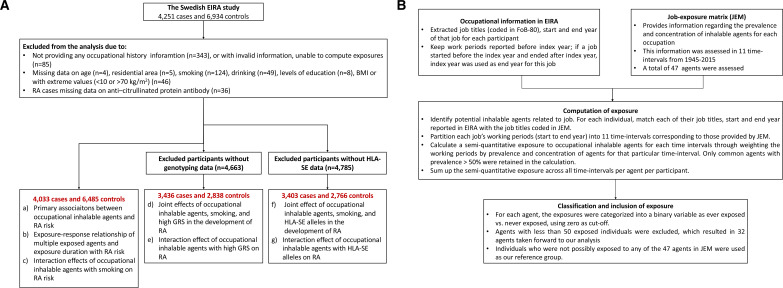
Data came from the Swedish Epidemiological Investigation of RA, consisting of 4033 incident RA cases and 6485 matched controls. Occupational histories were retrieved, combining with a Swedish national job-exposure matrix, to estimate exposure to 32 inhalable agents. Genetic data were used to define Genetic Risk Score (GRS) or carrying any copy of human leucocyte antigen class II shared epitope (HLA-SE) alleles. Associations were identified with unconditional logistical regression models. Attributable proportion due to interaction was estimated to evaluate presence of interaction.
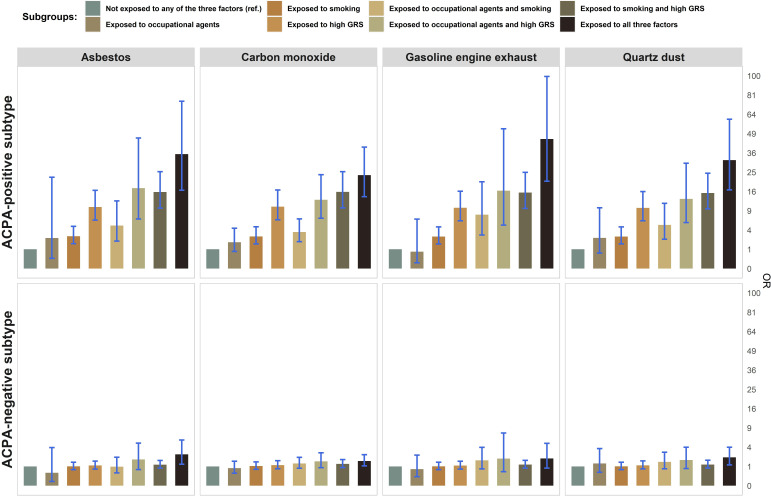
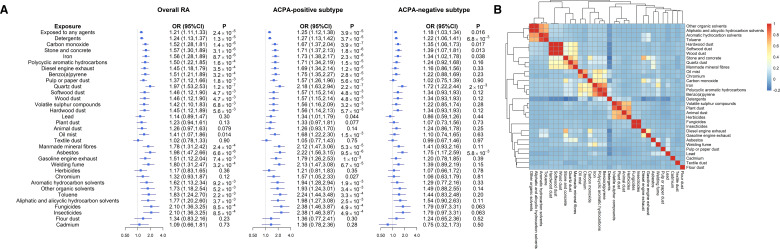
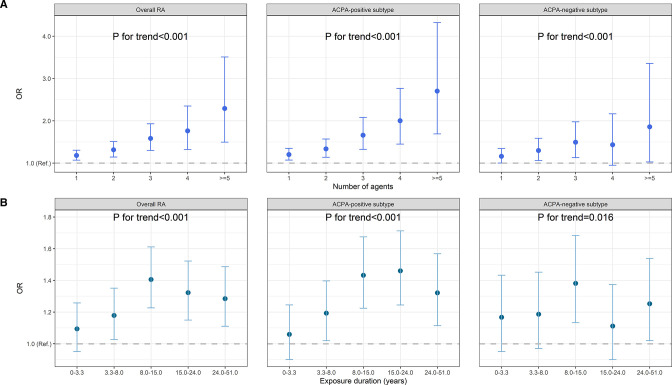
Exposure to any occupational inhalable agents was associated with increased risk for ACPA-positive RA (OR 1.25, 95% CI 1.12 to 1.38). The risk increased as number of exposed agents increased (P<0.001) or duration of exposure elongated (P<0.001). When jointly considering exposure to any occupational inhalable agents, smoking and high GRS, a markedly elevated risk for ACPA-positive RA was observed among the triple-exposed group compared with those not exposed to any (OR 18.22, 95% CI 11.77 to 28.19). Significant interactions were found between occupational inhalable agents and smoking/genetic factors (high GRS or HLA-SE) in ACPA-positive RA.
Occupational inhalable agents could act as important environmental triggers in RA development and interact with smoking and RA-risk genes leading to excessive risk for ACPA-positive RA. Future studies are warranted to assess preventive strategies aimed at reducing occupational hazards and smoking, especially among those who are genetically vulnerable.
评估职业可吸入暴露对类风湿关节炎(RA)发展的影响,并在存在抗瓜氨酸蛋白抗体(ACPA)的情况下,对其与吸烟和 RA 风险基因的相互作用进行分层分析。
数据来自瑞典 RA 流行病学研究,包括 4033 例新发 RA 病例和 6485 例匹配对照。职业史通过与瑞典国家职业暴露矩阵相结合进行检索,以估计 32 种可吸入物质的暴露情况。遗传数据用于定义遗传风险评分(GRS)或携带人类白细胞抗原 II 类共享表位(HLA-SE)等位基因的任何副本。采用无条件逻辑回归模型确定关联。为了评估是否存在相互作用,估计了归因于相互作用的比例。
暴露于任何职业性可吸入物与 ACPA 阳性 RA 的风险增加相关(OR 1.25,95%CI 1.12 至 1.38)。随着暴露于的职业性可吸入物数量的增加(P<0.001)或暴露时间的延长(P<0.001),风险增加。当同时考虑暴露于任何职业性可吸入物、吸烟和高 GRS 时,与未暴露于任何因素的人群相比,三重暴露组的 ACPA 阳性 RA 风险显著升高(OR 18.22,95%CI 11.77 至 28.19)。在 ACPA 阳性 RA 中,发现职业性可吸入物与吸烟/遗传因素(高 GRS 或 HLA-SE)之间存在显著的相互作用。
职业性可吸入物可能作为 RA 发展的重要环境触发因素,并与吸烟和 RA 风险基因相互作用,导致 ACPA 阳性 RA 的风险显著增加。未来的研究有必要评估旨在减少职业危害和吸烟的预防策略,特别是在那些遗传易感性高的人群中。