Rheumatology Unit, Department of Medicine, University of Verona, Verona, Italy
Rheumatology Unit, Department of Medicine, University of Verona, Verona, Italy.
RMD Open. 2022 Feb;8(1). doi: 10.1136/rmdopen-2021-002055.
Environmental air pollution has been associated with disruption of the immune system at a molecular level. The primary aim of the present study was to describe the association between long-term exposure to air pollution and risk of developing immune-mediated conditions.
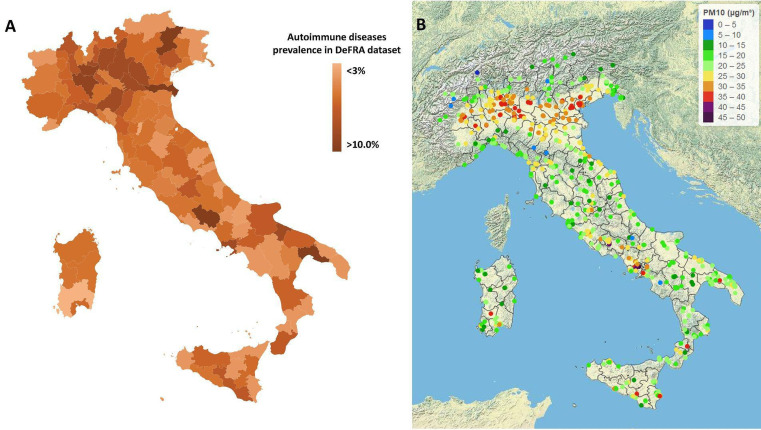
We conducted a retrospective observational study on a nationwide dataset of women and men. Diagnoses of various immune-mediated diseases (IMIDs) were retrieved. Data on the monitoring of particulate matter (PM)10 and PM2.5 concentrations were retrieved from the Italian Institute of Environmental Protection and Research. Generalised linear models were employed to determine the relationship between autoimmune diseases prevalence and PM.
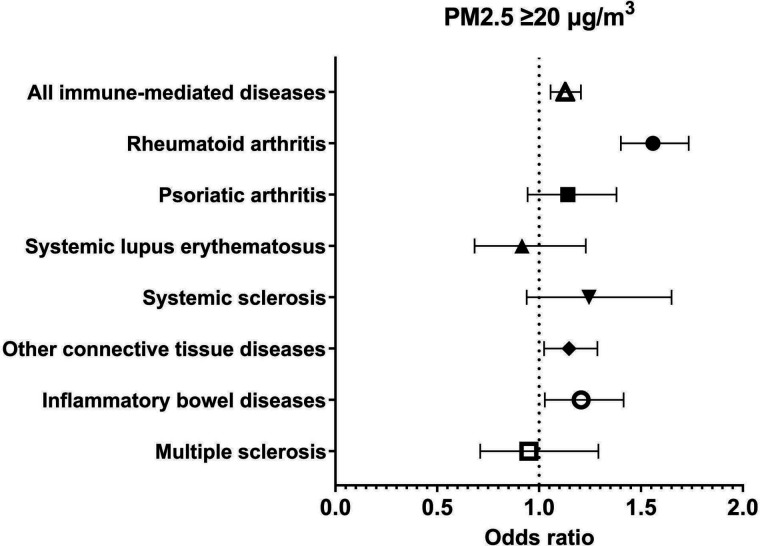
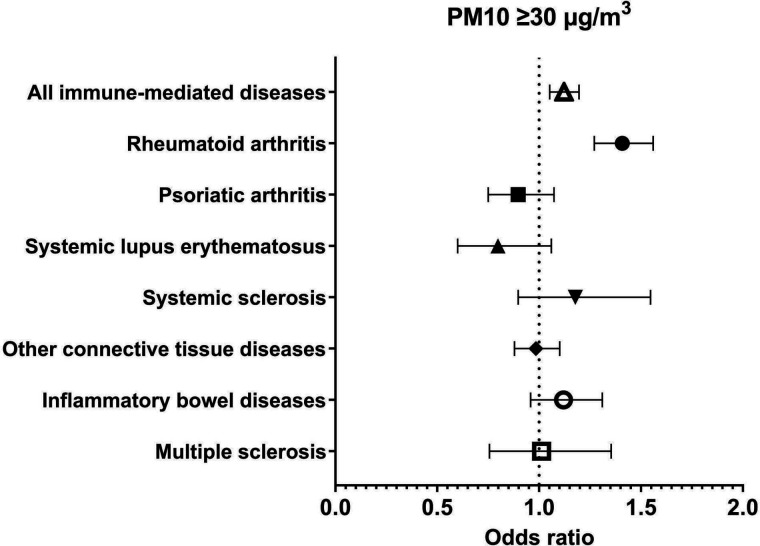
81 363 subjects were included in the study. We found a positive association between PM10 and the risk of autoimmune diseases (ρ+0.007, p 0.014). Every 10 µg/m increase in PM10 concentration was associated with an incremental 7% risk of having autoimmune disease. Exposure to PM10 above 30 µg/m3 and PM2.5 above 20 µg/m was associated with a 12% and 13% higher risk of autoimmune disease, respectively (adjusted OR (aOR) 1.12, 95% CI 1.05 to 1.20, and aOR 1.13, 95% CI 1.06 to 1.20). Exposure to PM10 was associated with an increased risk of rheumatoid arthritis; exposure to PM2.5 was associated with an increased risk of rheumatoid arthritis, connective tissue diseases (CTDs) and inflammatory bowel diseases (IBD).
Long-term exposure to air pollution was associated with higher risk of developing autoimmune diseases, in particular rheumatoid arthritis, CTDs and IBD. Chronic exposure to levels above the threshold for human protection was associated with a 10% higher risk of developing IMIDs.
环境空气污染已被证明会在分子水平上扰乱免疫系统。本研究的主要目的是描述长期暴露于空气污染与发生免疫介导疾病的风险之间的关系。
我们对全国范围内的女性和男性数据集进行了回顾性观察性研究。检索了各种免疫介导疾病(IMIDs)的诊断。从意大利环境保护与研究研究所检索了关于细颗粒物(PM)10 和 PM2.5 浓度监测的数据。采用广义线性模型来确定自身免疫性疾病患病率与 PM 之间的关系。
共纳入 81363 例患者。我们发现 PM10 与自身免疫性疾病的风险呈正相关(ρ+0.007,p0.014)。PM10 浓度每增加 10μg/m3,患自身免疫性疾病的风险就会增加 7%。暴露于 PM10 浓度超过 30μg/m3 和 PM2.5 浓度超过 20μg/m3 分别与自身免疫性疾病风险增加 12%和 13%相关(调整后的比值比[aOR] 1.12,95%CI 1.05 至 1.20 和 aOR 1.13,95%CI 1.06 至 1.20)。暴露于 PM10 与类风湿关节炎风险增加相关;暴露于 PM2.5 与类风湿关节炎、结缔组织疾病(CTDs)和炎症性肠病(IBD)风险增加相关。
长期暴露于空气污染与发生自身免疫性疾病的风险增加相关,特别是类风湿关节炎、CTDs 和 IBD。慢性暴露于高于人类保护阈值的水平与发生 IMIDs 的风险增加 10%相关。