Department of Medicine, Division of Rheumatology, Hospital for Special Surgery-Weill Cornell Medicine, New York, NY, USA.
Barbara Volcker Center for Women and Rheumatic Disease, Hospital for Special Surgery, New York, NY, USA.
Lupus Sci Med. 2022 Dec;9(1). doi: 10.1136/lupus-2022-000840.
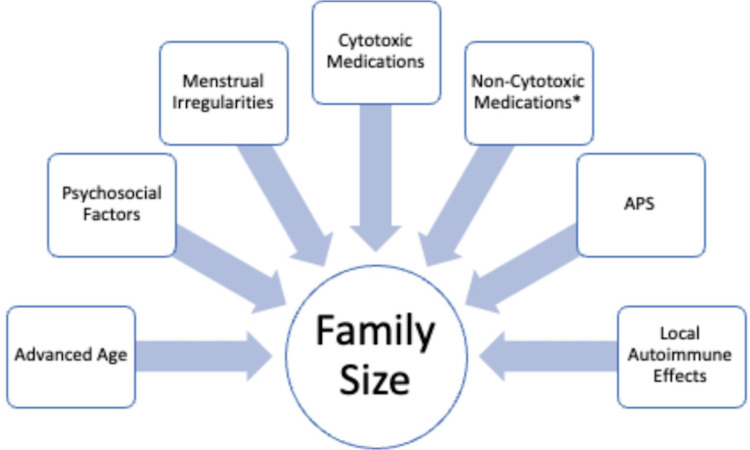
Fertility is often a concern for women with SLE. In addition to known indirect factors that influence the ability of a woman with SLE to become pregnant, such as cytotoxic agents, other medications, advanced age and psychosocial effects of the disease, direct disease-related factors are believed to influence fertility. These include diminished ovarian reserve, menstrual irregularities (a function of disease activity) and the presence of antiphospholipid antibodies. The question of whether SLE intrinsically affects fertility, however, remains unanswered. In this review, we address known factors affecting fertility, assess current data regarding a direct impact of SLE on fertility and evaluate potential disease-related risk factors. We focus primarily on studies measuring anti-Müllerian hormone and antral follicle count, the most widely measured markers of ovarian reserve. Our goal is to provide information to rheumatologists faced with counselling patients with SLE regarding their fertility, family planning and options for assisted reproductive technologies, which now include fertility preservation through oocyte cryopreservation.
生育能力常常是系统性红斑狼疮(SLE)患者关注的问题。除了已知的影响 SLE 女性生育能力的间接因素,如细胞毒性药物、其他药物、年龄增长和疾病的心理社会影响外,人们还认为直接与疾病相关的因素会影响生育能力。这些因素包括卵巢储备功能下降、月经不规律(疾病活动的一种表现)和抗磷脂抗体的存在。然而,SLE 是否会对生育能力产生内在影响,这一问题仍未得到解答。在这篇综述中,我们将讨论影响生育能力的已知因素,评估 SLE 对生育能力的直接影响的现有数据,并评估潜在的与疾病相关的风险因素。我们主要关注测量抗苗勒管激素和窦卵泡计数的研究,这是最广泛测量的卵巢储备标志物。我们的目标是为面临为 SLE 患者提供生育能力、计划生育和辅助生殖技术选择咨询的风湿病医生提供信息,现在这些选择包括通过卵母细胞冷冻保存进行生育力保存。