Murali Karumathil M, Mullan Judy, Roodenrys Steven, Cheikh Hassan Hicham I, Lonergan Maureen A
Department of Nephrology, Wollongong Hospital, Wollongong, NSW, Australia.
School of Medicine, University of Wollongong, Wollongong, NSW, Australia.
Patient Prefer Adherence. 2022 Dec 30;16:3465-3477. doi: 10.2147/PPA.S388060. eCollection 2022.
To assess the quantitative and categorical agreement between two methods of measuring medication adherence: pharmacy refill-based medication possession rates and self-reported medication adherence scale.
Categorisation of adherence metrics using empirical cut-off scores can lead to misclassification, which can be overcome by expressing adherence as a continuous variable. Pharmacy refill-based adherence can be reported as actual rates, but the validity of expressing self-reported medication adherence scores as a continuous variable to reflect adherence is unknown and its quantitative agreement with refill-based adherence rates untested.
Patients with kidney disease, including dialysis patients, from Illawarra Shoalhaven region of New South Wales, Australia were recruited between January 2015 and June 2016 to this cross-sectional study. Medication adherence was assessed using the self-reported Morisky Medication Adherence Scale (MMAS) and two pharmacy refill-based measures, Medication Possession Ratio (MPR) and Proportion of Days Covered (PDC) for antihypertensives and cardiometabolic drugs. Categorical and quantitative agreement between self-reported adherence and pharmacy refill-based adherence were assessed using tests of trend, analysis of covariance (ANCOVA), Cohen's kappa and Bland-Altman analysis.
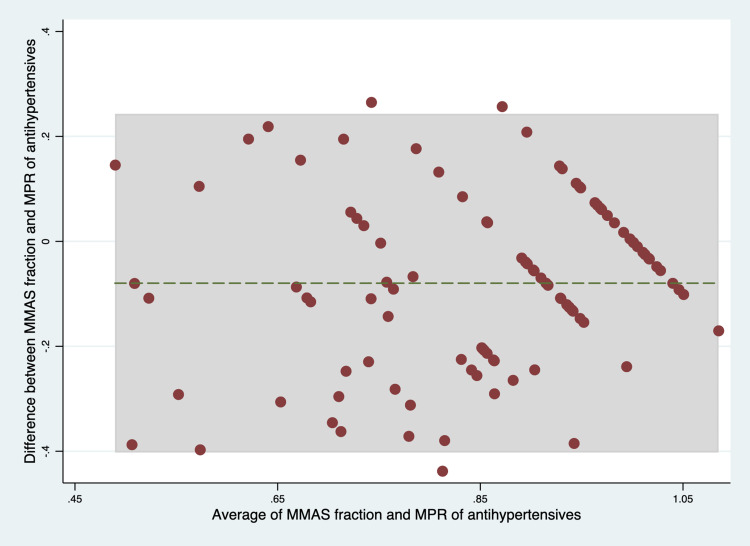
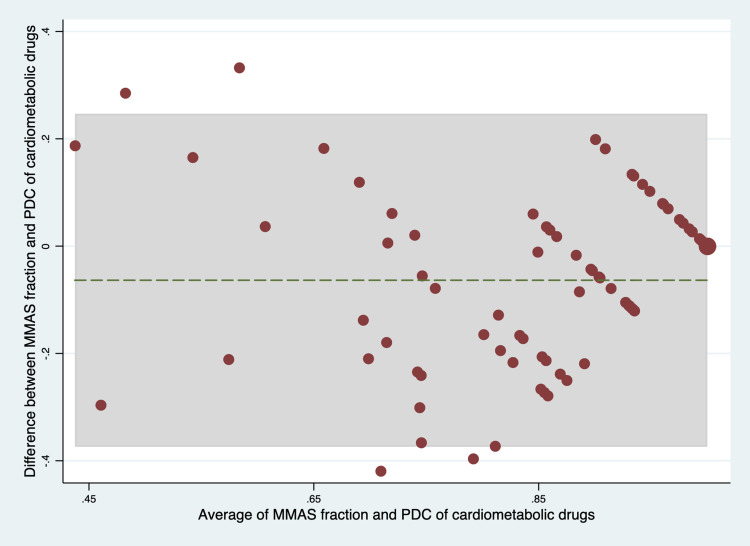
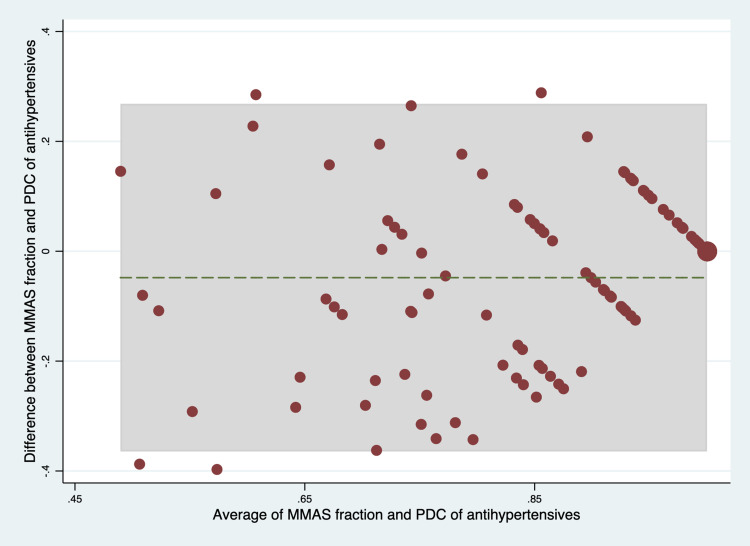
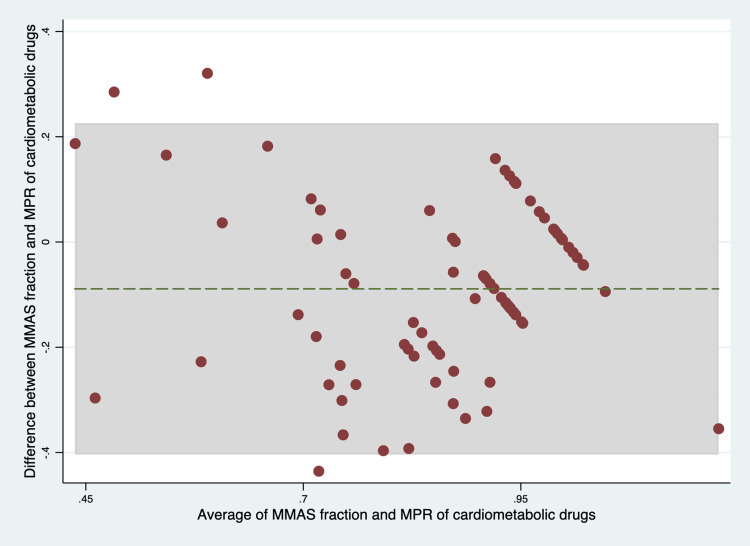
We recruited 113 patients. There was a significant declining trend of MPR (p < 0.001) and PDC (<0.001 for antihypertensives, p = 0.004 for cardiometabolic) scores among categories with worsening MMAS adherence. Adjusted ANCOVA showed significant association between self-report and pharmacy refill-based adherence (p < 0.001). Weighted Cohen's kappa statistics showed fair agreement between the self-report and pharmacy refill-based categories. Bland-Altman's analysis showed less than 5% of cases were outside the limits of agreement (-0.36 to 0.27) and the bias for MMAS was negative (-0.05 to -0.09), indicating MMAS did not overestimate adherence.
There is modest agreement between pharmacy refill-based measures and self-report MMAS measures when assessed categorically or quantitatively. Assessing adherence as a continuous variable should be considered to overcome the challenges associated with categorization of adherence based on arbitrary thresholds.
评估两种测量药物依从性方法之间的定量和分类一致性:基于药房配药的药物持有率和自我报告的药物依从性量表。
使用经验性临界值对依从性指标进行分类可能会导致错误分类,将依从性表示为连续变量可克服这一问题。基于药房配药的依从性可报告为实际比率,但将自我报告的药物依从性得分表示为反映依从性的连续变量的有效性尚不清楚,且其与基于配药的依从率的定量一致性未经检验。
2015年1月至2016年6月,在澳大利亚新南威尔士州伊拉瓦拉肖尔黑文地区招募了包括透析患者在内的肾病患者参与这项横断面研究。使用自我报告的莫利斯基药物依从性量表(MMAS)以及两种基于药房配药的测量方法,即药物持有率(MPR)和抗高血压药及心脏代谢药物的覆盖天数比例(PDC)来评估药物依从性。使用趋势检验、协方差分析(ANCOVA)、科恩kappa系数和布兰德-奥特曼分析来评估自我报告的依从性与基于药房配药的依从性之间的分类和定量一致性。
我们招募了113名患者。随着MMAS依从性恶化,MPR(p<0.001)和PDC(抗高血压药p<0.001,心脏代谢药物p = 0.004)得分呈显著下降趋势。调整后的ANCOVA显示自我报告与基于药房配药的依从性之间存在显著关联(p<0.001)。加权科恩kappa统计显示自我报告与基于药房配药的类别之间具有中等一致性。布兰德-奥特曼分析显示,不到5%的病例超出一致性界限(-0.36至0.27),MMAS的偏差为负(-0.05至-0.09),表明MMAS没有高估依从性。
在进行分类或定量评估时,基于药房配药的测量方法与自我报告的MMAS测量方法之间存在适度一致性。应考虑将依从性评估为连续变量,以克服基于任意阈值对依从性进行分类所带来的挑战。