Division of Rheumatology/Immunology/Allergy, Department of Internal Medicine, Taichung Armed-Forces General Hospital, No 348, Sec. 2, Chung-Shan Rd, Taiping Dist., Taichung, 41152, Taiwan.
Department of Medical Laboratory Science and Biotechnology, Central Taiwan University of Science and Technology, Taichung, Taiwan.
Eur J Med Res. 2023 Jan 6;28(1):10. doi: 10.1186/s40001-022-00982-8.
Gouty arthritis (GA) is a chronic systemic disease with recurrent acute monoarthritis. In a previous study, a higher incidence of acute flares was observed during the initial marked decrease in serum urate level. Our study evaluated the effect of early urate-lowering therapy in patients with acute GA flares.
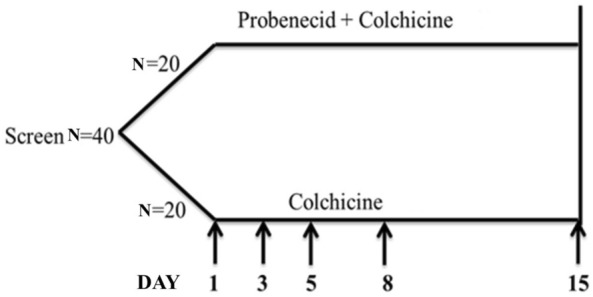
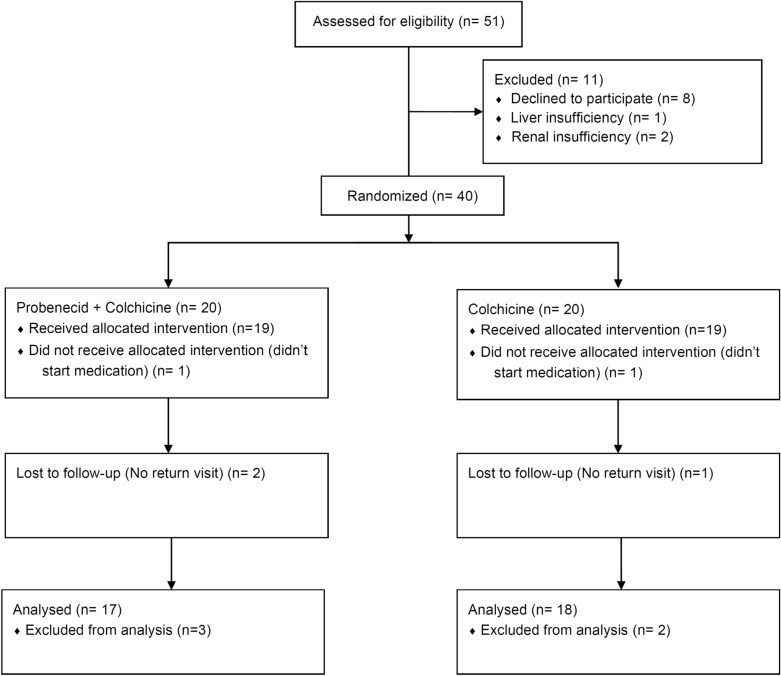
This study included 40 patients with acute GA; of them, 20 received colchicine 0.5 mg colchicine twice daily, while 20 received probenecid 500 mg and colchicine 0.5 mg twice daily. We evaluated GA severity and laboratory data for 2 weeks after the initial therapy. Medians and interquartile ranges (IQRs) were calculated to evaluate clinical presentations between these two groups.
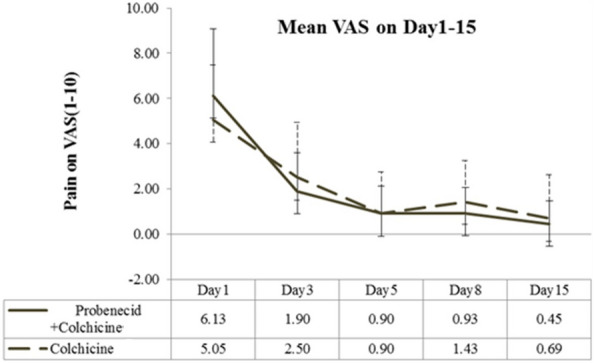
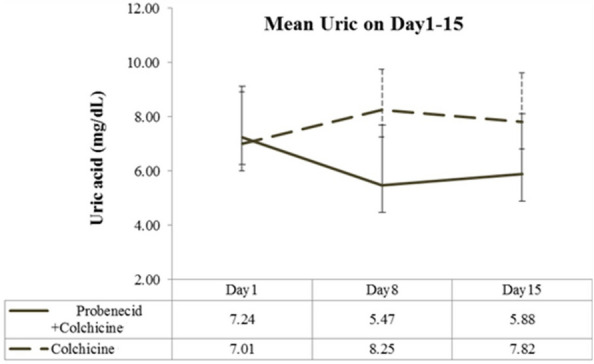
Rapidly decreasing median serum uric acid levels was found in the patients treated with probenecid and colchicine compared with the patients treated with colchicine alone on day 8 (- 1.9 [IQR, - 3.7 to 0] vs 0.8 [IQR, - 0.1-2.2]; P < 0.001). However, the median decrease in visual analog scale score did not differ significantly between the two groups (- 5.5 [IQR, - 8.0 to - 3.0] vs - 3.5 [IQR, - 5.9 to - 2.0]; P = 0.080).
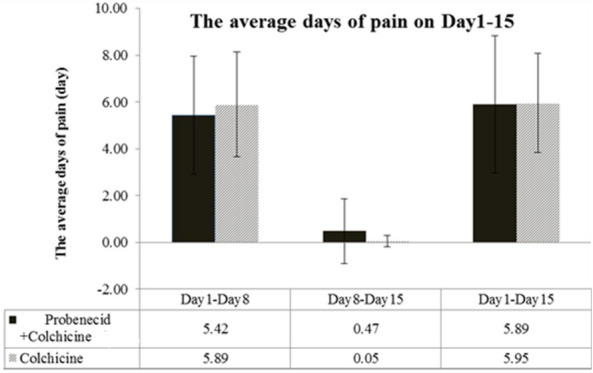
No significant increase was noted in acute gout flare severity or duration among GA patients treated with early aggressive control of hyperuricemia using probenecid plus colchicine.
痛风性关节炎(GA)是一种复发性急性单关节炎的慢性系统性疾病。在之前的研究中,在血清尿酸水平初始显著下降期间观察到急性发作的发生率更高。本研究评估了急性 GA 发作患者早期降尿酸治疗的效果。
本研究纳入了 40 例急性 GA 患者;其中 20 例接受秋水仙碱 0.5mg,每日两次;20 例接受丙磺舒 500mg 和秋水仙碱 0.5mg,每日两次。我们在初始治疗后 2 周评估 GA 严重程度和实验室数据。中位数和四分位距(IQR)用于评估两组之间的临床表现。
与单独使用秋水仙碱相比,使用丙磺舒和秋水仙碱治疗的患者在第 8 天血清尿酸水平的中位数下降更快(-1.9[IQR,-3.7 至 0]与 0.8[IQR,-0.1-2.2];P<0.001)。然而,两组之间视觉模拟评分中位数的下降无显著差异(-5.5[IQR,-8.0 至-3.0]与-3.5[IQR,-5.9 至-2.0];P=0.080)。
在使用丙磺舒联合秋水仙碱早期积极控制高尿酸血症的 GA 患者中,急性痛风发作的严重程度或持续时间没有显著增加。