Affiliated Cancer Hospital & Institute of Guangzhou Medical University, Guangzhou Key Laboratory of "Translational Medicine On Malignant Tumor Treatment", Guangzhou, 510095, China.
Sun Yat-Sen University Cancer Center, State Key Laboratory of Oncology in South China, Collaborative Innovation Center for Cancer Medicine, Guangzhou, 510060, China.
J Exp Clin Cancer Res. 2023 Jan 6;42(1):9. doi: 10.1186/s13046-022-02586-w.
N4-acetylcytidine (ac4C), a widespread modification in human mRNAs that is catalyzed by the N-acetyltransferase 10 (NAT10) enzyme, plays an important role in promoting mRNA stability and translation. However, the biological functions and regulatory mechanisms of NAT10-mediated ac4C were poorly defined.
ac4C mRNA modification status and NAT10 expression levels were analyzed in gastric cancer (GC) samples and compared with the corresponding normal tissues. The biological role of NAT10-mediated ac4C and its upstream and downstream regulatory mechanisms were determined in vitro and in vivo. The therapeutic potential of targeting NAT10 in GC was further explored.
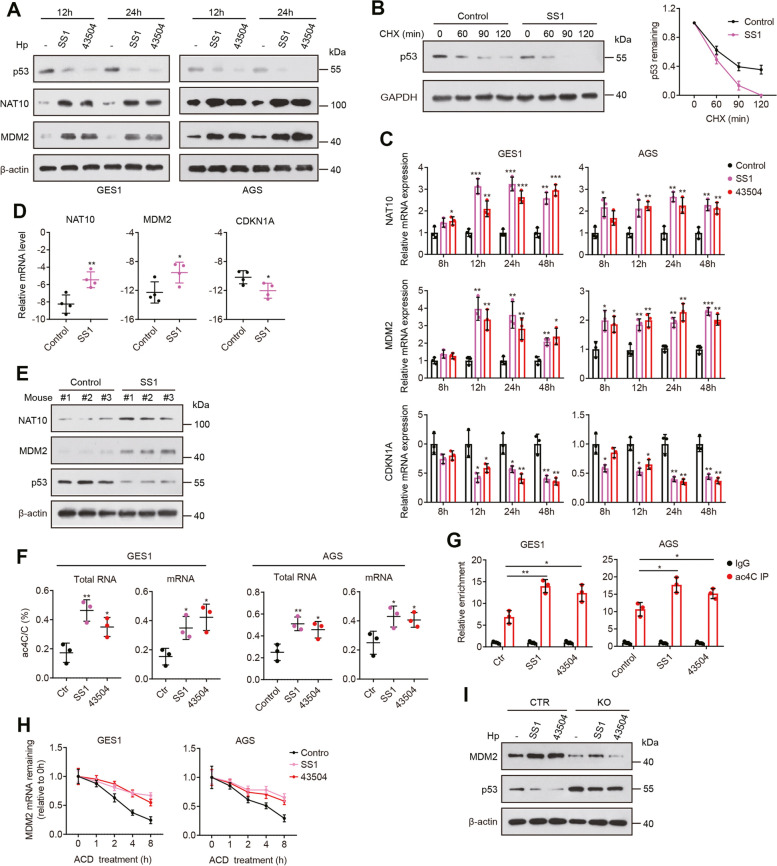
Here, we demonstrated that both ac4C mRNA modification and its acetyltransferase NAT10 were increased in GC, and increased NAT10 expression was associated with disease progression and poor patient prognosis. Functionally, we found that NAT10 promoted cellular G2/M phase progression, proliferation and tumorigenicity of GC in an ac4C-depedent manner. Mechanistic analyses demonstrated that NAT10 mediated ac4C acetylation of MDM2 transcript and subsequently stabilized MDM2 mRNA, leading to its upregulation and p53 downregulation and thereby facilitating gastric carcinogenesis. In addition, Helicobacter pylori (Hp) infection contributed to NAT10 induction, causing MDM2 overexpression and subsequent p53 degradation. Further investigations revealed that targeting NAT10 with Remodelin showed anti-cancer activity in GC and augmented the anti-tumor activity of MDM2 inhibitors in p53 wild-type GC.
These results suggest the critical role of NAT10-mediated ac4C modification in GC oncogenesis and reveal a previously unrecognized signaling cascade involving the Hp-NAT10-MDM2-p53 axis during GC development.
N4-乙酰胞苷(ac4C)是一种广泛存在于人类 mRNA 中的修饰,由 N-乙酰转移酶 10(NAT10)酶催化,在促进 mRNA 稳定性和翻译方面发挥着重要作用。然而,NAT10 介导的 ac4C 的生物学功能和调节机制尚未得到明确界定。
分析了胃癌(GC)样本中的 ac4C mRNA 修饰状态和 NAT10 表达水平,并与相应的正常组织进行了比较。在体外和体内确定了 NAT10 介导的 ac4C 及其上下游调节机制的生物学作用。进一步探讨了靶向 NAT10 在 GC 中的治疗潜力。
我们证明了 ac4C mRNA 修饰及其乙酰转移酶 NAT10 在 GC 中均增加,并且增加的 NAT10 表达与疾病进展和患者预后不良相关。功能上,我们发现 NAT10 以 ac4C 依赖的方式促进 GC 细胞的 G2/M 期进展、增殖和致瘤性。机制分析表明,NAT10 介导了 MDM2 转录本的 ac4C 乙酰化,随后稳定了 MDM2 mRNA,导致其上调和 p53 下调,从而促进了胃发生癌变。此外,幽门螺杆菌(Hp)感染导致 NAT10 诱导,导致 MDM2 过表达和随后的 p53 降解。进一步的研究表明,用雷莫司琼靶向 NAT10 显示出对 GC 的抗癌活性,并增强了 MDM2 抑制剂在 p53 野生型 GC 中的抗肿瘤活性。
这些结果表明,NAT10 介导的 ac4C 修饰在 GC 致癌作用中起着关键作用,并揭示了在 GC 发展过程中涉及 Hp-NAT10-MDM2-p53 轴的一个以前未被认识的信号级联。