Department of Hematology, Nippon Medical School, Tokyo, Japan.
Division of Hematology, Department of Medicine, Jichi Medical University, Tochigi, Japan.
Cancer Sci. 2023 Apr;114(4):1297-1308. doi: 10.1111/cas.15720. Epub 2023 Jan 27.
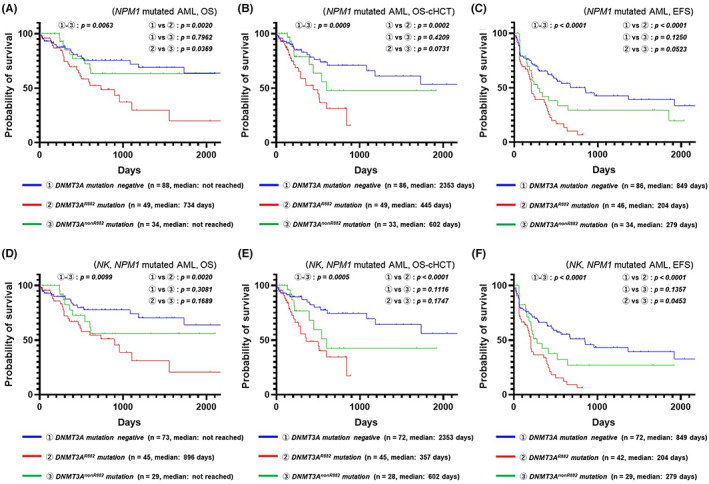
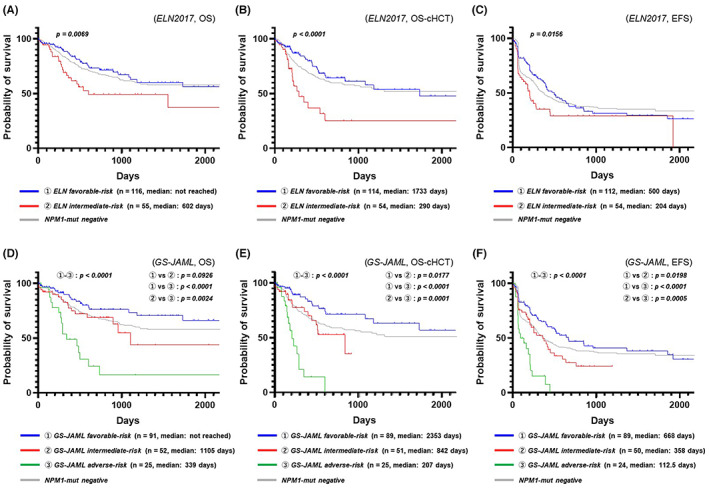
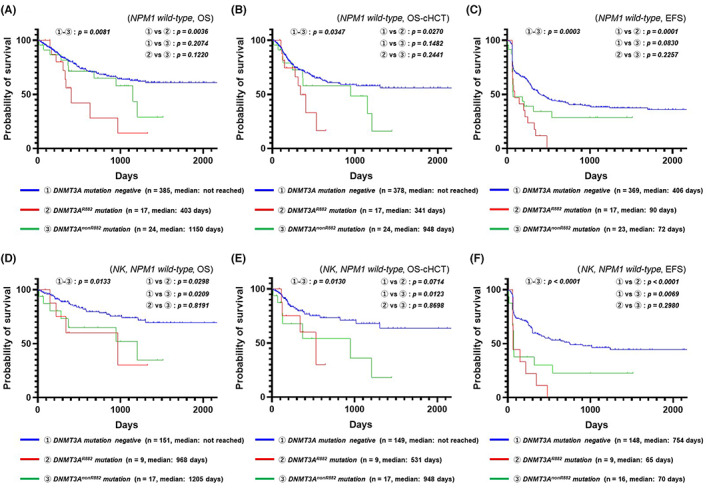
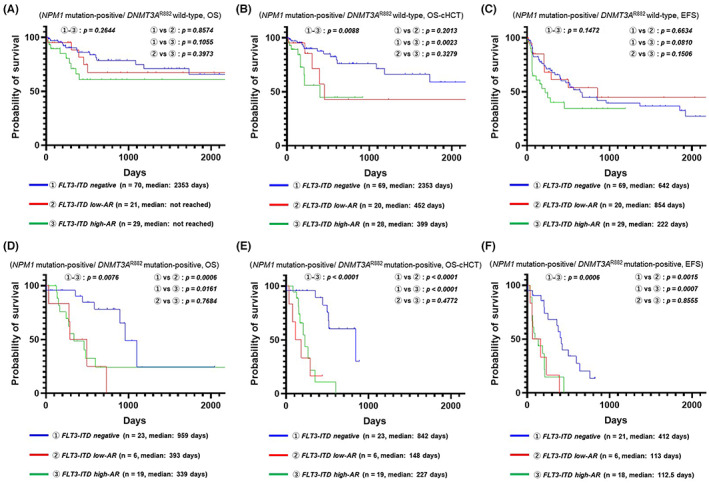
Nucleophosmin1 (NPM1) mutations are the most frequently detected gene mutations in acute myeloid leukemia (AML) and are considered a favorable prognostic factor. We retrospectively analyzed the prognosis of 605 Japanese patients with de novo AML, including 174 patients with NPM1-mutated AML. Although patients with NPM1-mutated AML showed a high remission rate, this was not a favorable prognostic factor for overall survival (OS); this is contrary to generally accepted guidelines. Comprehensive gene mutation analysis showed that mutations in codon R882 of DNA methyltransferase 3A (DNMT3A mutations) were a strong predicative factor indicating poor prognosis in all AML (p < 0.0001) and NPM1-mutated AML cases (p = 0.0020). Furthermore, multivariate analysis of all AML cases showed that DNMT3A mutations and the co-occurrence of internal tandem duplication in FMS-like tyrosine kinase 3 (FLT3-ITD), NPM1 mutations, and DNMT3A mutations (triple mutations) were independent factors predicting a poor prognosis related to OS, with NPM1 mutations being an independent factor for a favorable prognosis (hazard ratios: DNMT3A mutations, 1.946; triple mutations, 1.992, NPM1 mutations, 0.548). Considering the effects of DNMT3A mutations and triple mutations on prognosis and according to the classification of NPM1-mutated AML into three risk groups based on DNMT3A /FLT3-ITD genotypes, we achieved the improved stratification of prognosis (p < 0.0001). We showed that DNMT3A mutations are an independent factor for poor prognosis; moreover, when confounding factors that include DNMT3A mutations were excluded, NPM1 mutations were a favorable prognostic factor. This revealed that ethnological prognostic discrepancies in NPM1 mutations might be corrected through prognostic stratification based on the DNMT3A status.
核磷蛋白 1(Nucleophosmin1,NPM1)突变是急性髓系白血病(acute myeloid leukemia,AML)中最常见的基因突变,被认为是一个有利的预后因素。我们回顾性分析了 605 例日本初诊 AML 患者的预后,其中 174 例为 NPM1 突变型 AML 患者。尽管 NPM1 突变型 AML 患者的缓解率较高,但这并不是总生存期(overall survival,OS)的有利预后因素;这与普遍接受的指南相反。全面的基因突变分析显示,DNA 甲基转移酶 3A(DNA methyltransferase 3A,DNMT3A)密码子 R882 突变是所有 AML(p<0.0001)和 NPM1 突变型 AML 病例(p=0.0020)不良预后的强预测因子。此外,对所有 AML 病例的多变量分析显示,DNMT3A 突变和 FMS 样酪氨酸激酶 3(FMS-like tyrosine kinase 3,FLT3)内部串联重复突变、NPM1 突变和 DNMT3A 突变(三重突变)的共存是 OS 相关不良预后的独立预测因素,而 NPM1 突变是有利预后的独立因素(危险比:DNMT3A 突变,1.946;三重突变,1.992,NPM1 突变,0.548)。考虑到 DNMT3A 突变对预后的影响,并根据 DNMT3A/FLT3-ITD 基因型将 NPM1 突变型 AML 分为三个风险组,我们实现了预后分层的改善(p<0.0001)。我们发现 DNMT3A 突变是不良预后的独立因素;此外,当排除包括 DNMT3A 突变在内的混杂因素时,NPM1 突变是一个有利的预后因素。这表明,通过基于 DNMT3A 状态的预后分层,可以纠正 NPM1 突变的种族预后差异。