Hanff Thomas C, Zhang Yuhui, Zhang Robert S, Genuardi Michael V, Molina Maria, McLean Rhondalyn C, Mazurek Jeremy A, Tanna Monique S, Wald Joyce W, Atluri Pavan, Acker Michael A, Goldberg Lee R, Zamani Payman, Birati Edo Y
Division of Cardiology, Department of Medicine, Perelman School of Medicine, University of Pennsylvania, Philadelphia, PA 19104, USA.
Fuwai Hospital, Peking Union Medical College, Beijing 100006, China.
J Clin Med. 2023 Jan 3;12(1):366. doi: 10.3390/jcm12010366.
Decreased peak oxygen consumption during exercise (peak Vo) is a well-established prognostic marker for mortality in ambulatory heart failure. After heart transplantation, the utility of peak Vo as a marker of post-transplant survival is not well established.
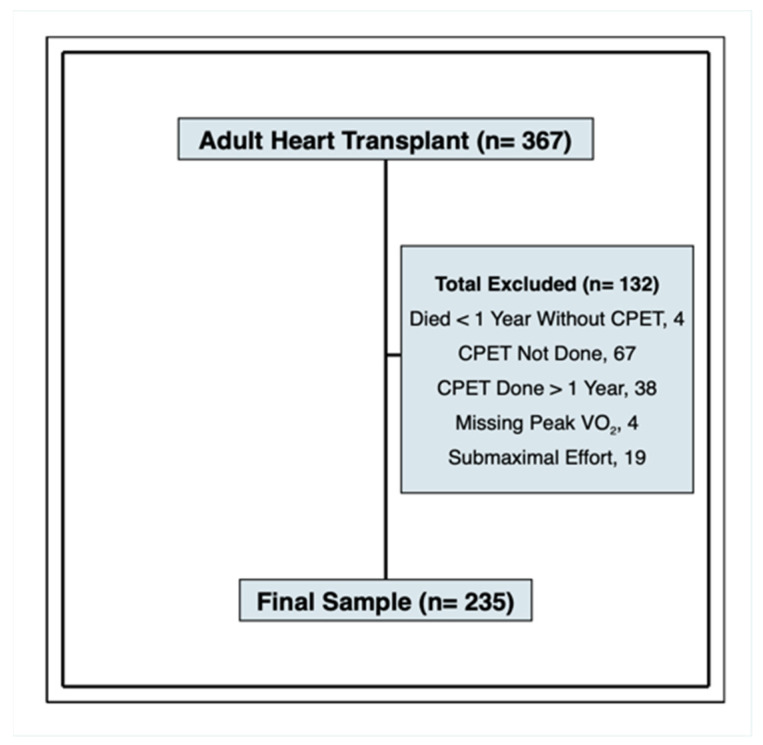
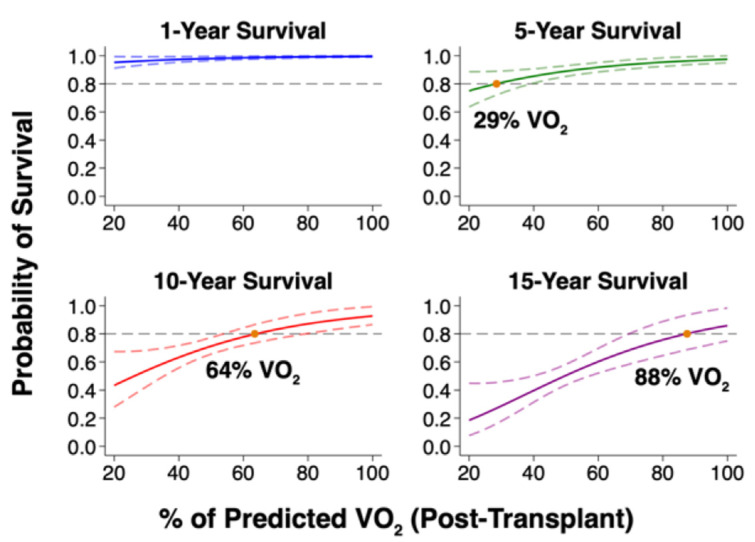
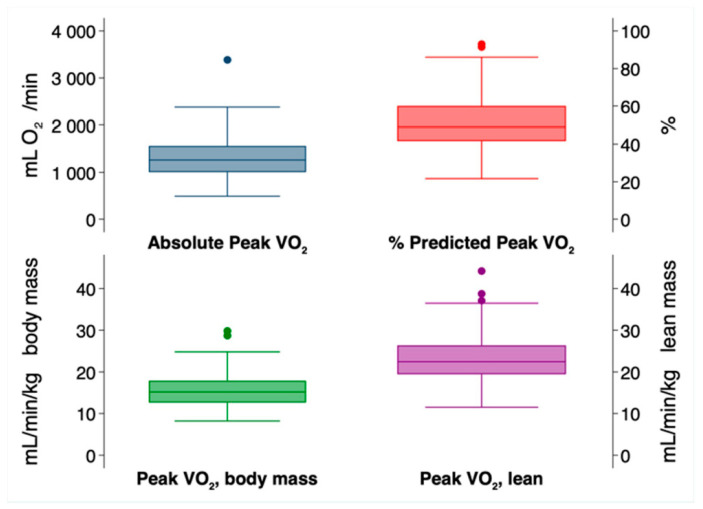
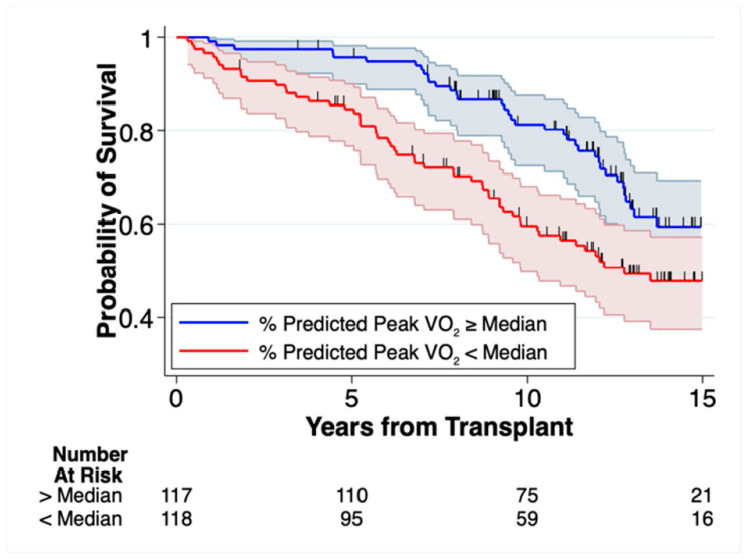
We performed a retrospective analysis of adult heart transplant recipients at the Hospital of the University of Pennsylvania who underwent cardiopulmonary exercise testing within a year of transplant between the years 2000 to 2011. Using time-to-event models, we analyzed the hazard of mortality over nearly two decades of follow-up as a function of post-transplant percent predicted peak Vo (%Vo). A total of 235 patients met inclusion criteria. The median post-transplant %Vo was 49% (IQR 42 to 60). Each standard deviation (±14%) increase in %Vo was associated with a 32% decrease in mortality in adjusted models (HR 0.68, 95% CI 0.53 to 0.87, = 0.002). A %Vo below 29%, 64% and 88% predicted less than 80% survival at 5, 10, and 15 years, respectively.
Post-transplant peak Vo is a highly significant prognostic marker for long-term post-transplant survival. It remains to be seen whether decreased peak Vo post-transplant is modifiable as a target to improve post-transplant longevity.
运动时峰值耗氧量(peak Vo₂)降低是门诊心力衰竭患者死亡率的一个公认的预后标志物。心脏移植后,峰值Vo₂作为移植后生存标志物的效用尚未明确。
我们对宾夕法尼亚大学医院2000年至2011年间在移植后一年内接受心肺运动测试的成年心脏移植受者进行了回顾性分析。使用事件发生时间模型,我们分析了近二十年随访期间死亡率的风险,作为移植后预测峰值Vo₂百分比(%Vo₂)的函数。共有235名患者符合纳入标准。移植后%Vo₂的中位数为49%(四分位间距42至60)。在调整模型中,%Vo₂每增加一个标准差(±14%),死亡率就会降低32%(风险比0.68,95%置信区间0.53至0.87,P = 0.002)。低于29%、64%和88%的%Vo₂分别预测5年、10年和15年的生存率低于80%。
移植后峰值Vo₂是移植后长期生存的一个高度显著的预后标志物。移植后峰值Vo₂降低是否可作为改善移植后寿命的一个可改变的靶点,仍有待观察。