Madhav Akshara, Parate Leena Harshad, Govindswamy Suresh
Department of Anaesthesiology and Pain Relief, Kidwai Memorial Institute of Oncology, Bengaluru, Karnataka, India.
Department of Anaesthesiology, M S Ramaiah Medical College, Bengaluru, Karnataka, India.
Anesth Essays Res. 2022 Jul-Sep;16(3):386-391. doi: 10.4103/aer.aer_110_22. Epub 2022 Dec 9.
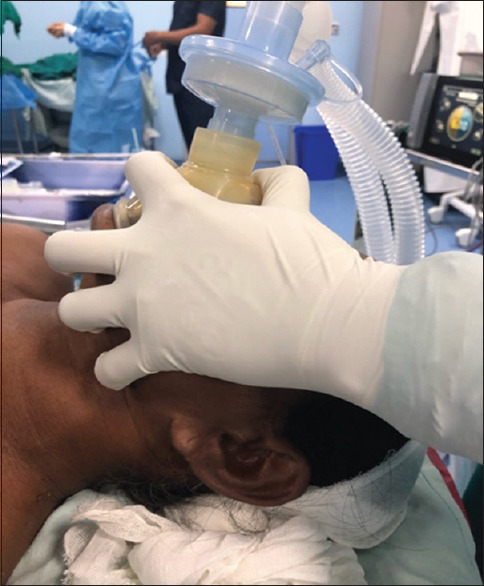
The two most common techniques for mask ventilation are CE and jaw thrust (JT) technique. However, few studies have validated their efficiency in terms of tidal volume (TV).
This study aimed to compare the effectiveness of the CE technique and JT technique during pressure-controlled ventilation (PCV) by the mean of returned TV on apneic anesthetized adults.
This was a prospective, randomized cross over study.
This study was conducted in a tertiary care hospital.
Ethical Committee approval from our institution was taken (ss-1/EC 049/2017) and was registered in Clinical Trials Registry of India (CTRI/2018/04/012958). Sixty-five American Society of Anesthesiologists Physical Status classes I and II adult patients were enrolled in the study. After induction and muscle relaxation, mask ventilation was performed with CE and JT technique on PCV mode (Pinsp 15 cm HO, respiratory rate 15) for 1 min each. The mean of returned TV of last 12 breaths, gastric insufflation, audible mask leak, and operator comfort in each technique were compared.
Statistical software namely IBM SPSS 22.0 and R environment version 3.2.2 (IBM Corp. SPSS Statistics for Windows, Version 22.0. Armonk, NY, USA) were used for data analysis. Microsoft Excel was used to generate graphs and tables. Data were expressed as mean ± standard deviation for continuous variables and number (%) for categorical variables. Student's -test (two tailed, independent) was used to find the significance of the study parameters on a continuous scale. Chi-square/Fisher's exact test was used to find the significance of the study parameters on a categorical scale between two or more groups.
There was a significant increase in mean TV generated by JT technique over CE technique (591.46 ± 140.27 mL vs. 544.59 ± 159.08 mL; < 0.001). Gastric insufflation (12.9% vs. 14.5%) and mask leak (11.3% vs. 38.7%) were more in CE technique. Operator comfort (79% vs. 19.4%) was more in JT technique.
A two-handed JT technique is more effective than a one-handed CE technique for mask ventilation in apneic anesthetized adults.
面罩通气最常用的两种技术是双手挤压法(CE)和提下颌法(JT)。然而,很少有研究在潮气量(TV)方面验证过它们的有效性。
本研究旨在通过对比呼吸暂停的麻醉成年患者呼出潮气量,比较压力控制通气(PCV)期间CE技术和JT技术的有效性。
这是一项前瞻性、随机交叉研究。
本研究在一家三级护理医院进行。
获得了本机构伦理委员会的批准(ss-1/EC 049/2017),并在印度临床试验注册中心注册(CTRI/2018/04/012958)。65例美国麻醉医师协会身体状况分级为I级和II级的成年患者纳入本研究。诱导麻醉和肌肉松弛后,在PCV模式(吸气峰压15 cmH₂O,呼吸频率15次/分钟)下分别用CE技术和JT技术进行面罩通气,每次1分钟。比较每种技术最后12次呼吸的呼出潮气量平均值、胃内充气情况、可闻及的面罩漏气情况以及操作者的舒适度。
使用统计软件IBM SPSS 22.0和R环境版本3.2.2(IBM公司,SPSS Statistics for Windows,版本22.0。美国纽约州阿蒙克)进行数据分析。使用Microsoft Excel生成图表。连续变量数据以均数±标准差表示,分类变量数据以例数(%)表示。采用学生t检验(双侧,独立样本)分析连续变量研究参数的显著性。采用卡方检验/Fisher精确检验分析两组或多组间分类变量研究参数的显著性。
JT技术产生的平均潮气量比CE技术显著增加(591.46±140.27 mL对544.59±159.08 mL;P<0.001)。CE技术的胃内充气情况(12.9%对14.5%)和面罩漏气情况(11.3%对38.7%)更多。JT技术的操作者舒适度(79%对%)更高。
对于呼吸暂停的麻醉成年患者,双手提下颌法面罩通气比单手双手挤压法更有效。