Norwich Medical School, University of East Anglia, Norwich, UK.
Centre for Clinical Brain Sciences, University of Edinburgh, Edinburgh, UK.
Alzheimers Res Ther. 2023 Jan 9;15(1):10. doi: 10.1186/s13195-022-01121-5.
The risk of dementia is higher in women than men. The metabolic consequences of estrogen decline during menopause accelerate neuropathology in women. The use of hormone replacement therapy (HRT) in the prevention of cognitive decline has shown conflicting results. Here we investigate the modulating role of APOE genotype and age at HRT initiation on the heterogeneity in cognitive response to HRT.
The analysis used baseline data from participants in the European Prevention of Alzheimer's Dementia (EPAD) cohort (total n= 1906, women= 1178, 61.8%). Analysis of covariate (ANCOVA) models were employed to test the independent and interactive impact of APOE genotype and HRT on select cognitive tests, such as MMSE, RBANS, dot counting, Four Mountain Test (FMT), and the supermarket trolley test (SMT), together with volumes of the medial temporal lobe (MTL) regions by MRI. Multiple linear regression models were used to examine the impact of age of HRT initiation according to APOE4 carrier status on these cognitive and MRI outcomes.
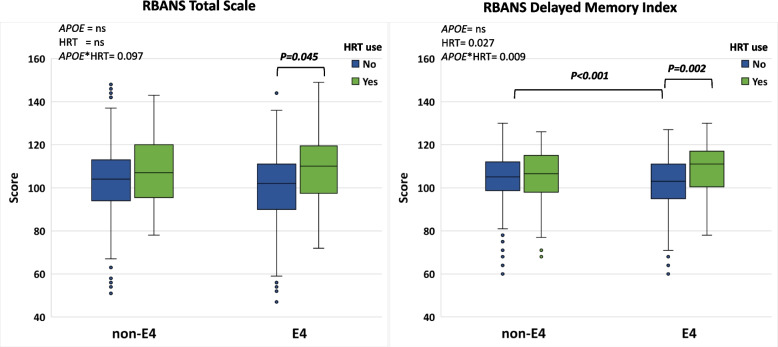
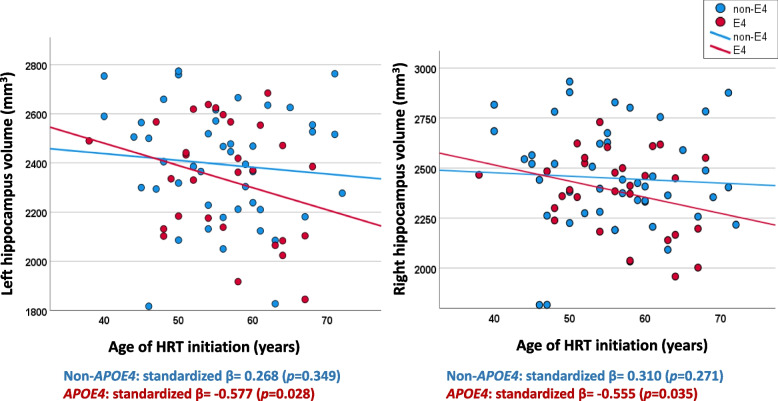
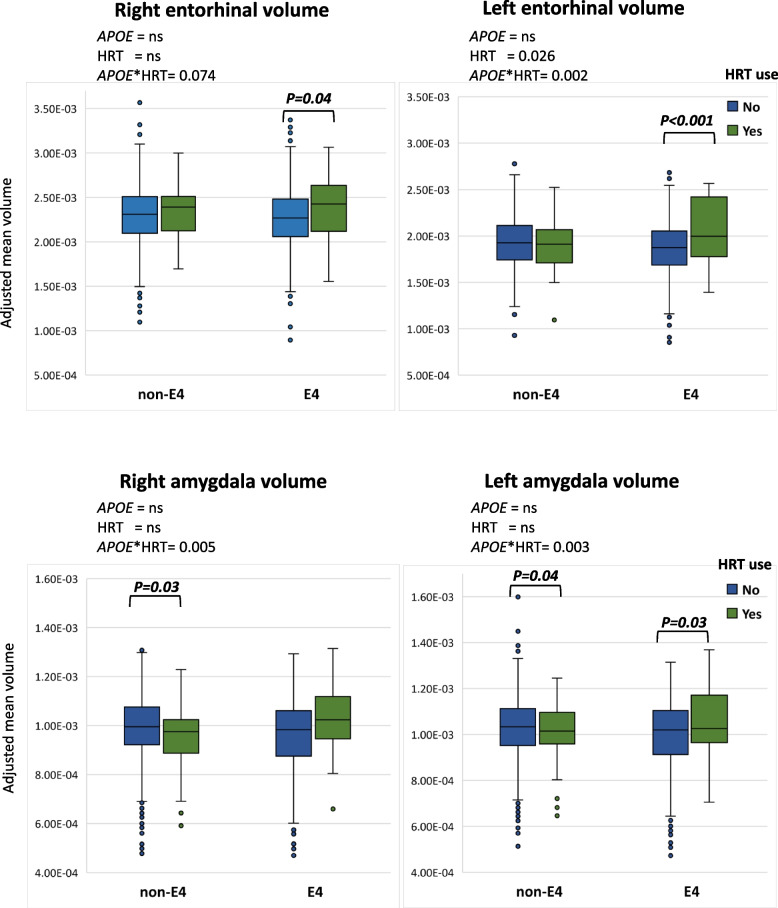
APOE4 HRT users had the highest RBANS delayed memory index score (P-APOE*HRT interaction = 0.009) compared to APOE4 non-users and to non-APOE4 carriers, with 6-10% larger entorhinal (left) and amygdala (right and left) volumes (P-interaction= 0.002, 0.003, and 0.005 respectively). Earlier introduction of HRT was associated with larger right (standardized β= -0.555, p=0.035) and left hippocampal volumes (standardized β= -0.577, p=0.028) only in APOE4 carriers.
HRT introduction is associated with improved delayed memory and larger entorhinal and amygdala volumes in APOE4 carriers only. This may represent an effective targeted strategy to mitigate the higher life-time risk of AD in this large at-risk population subgroup. Confirmation of findings in a fit for purpose RCT with prospective recruitment based on APOE genotype is needed to establish causality.
女性患痴呆症的风险高于男性。绝经期间雌激素水平下降的代谢后果加速了女性的神经病理学变化。激素替代疗法(HRT)在预防认知能力下降方面的应用结果存在矛盾。在这里,我们研究了 APOE 基因型和 HRT 起始年龄对 HRT 认知反应异质性的调节作用。
该分析使用了欧洲预防阿尔茨海默病(EPAD)队列参与者的基线数据(共 1906 人,女性 1178 人,占 61.8%)。采用协方差分析(ANCOVA)模型来测试 APOE 基因型和 HRT 对特定认知测试(如 MMSE、RBANS、点计数、四山测试(FMT)和超市手推车测试(SMT))以及 MRI 测量的内侧颞叶(MTL)区域体积的独立和交互影响。采用多元线性回归模型来检验根据 APOE4 携带状态,HRT 起始年龄对这些认知和 MRI 结果的影响。
APOE4 HRT 使用者的 RBANS 延迟记忆指数评分最高(APOE*HRT 交互作用 P=0.009),与 APOE4 非使用者和非 APOE4 携带者相比,其左右内嗅皮质(左侧)和杏仁核(右侧和左侧)体积分别增加 6-10%(交互作用 P 值分别为 0.002、0.003 和 0.005)。HRT 的早期引入与 APOE4 携带者的右侧(标准化 β=-0.555,p=0.035)和左侧海马体积(标准化 β=-0.577,p=0.028)增大相关。
仅在 APOE4 携带者中,HRT 的引入与延迟记忆改善和内嗅皮质和杏仁核体积增大相关。这可能代表一种针对该高危亚组人群的有效靶向策略,可以降低其一生中患 AD 的风险。需要在基于 APOE 基因型的前瞻性招募的、适合目的的 RCT 中进一步证实,以确定因果关系。