Department of Clinical Genetics, Erasmus MC Cancer Institute, University Medical Center Rotterdam, 3015 CE Rotterdam, the Netherlands.
Department of Gastroenterology and Hepatology, Erasmus MC Cancer Institute, University Medical Center Rotterdam, 3015 CE Rotterdam, the Netherlands.
HGG Adv. 2022 Dec 14;4(1):100167. doi: 10.1016/j.xhgg.2022.100167. eCollection 2023 Jan 12.
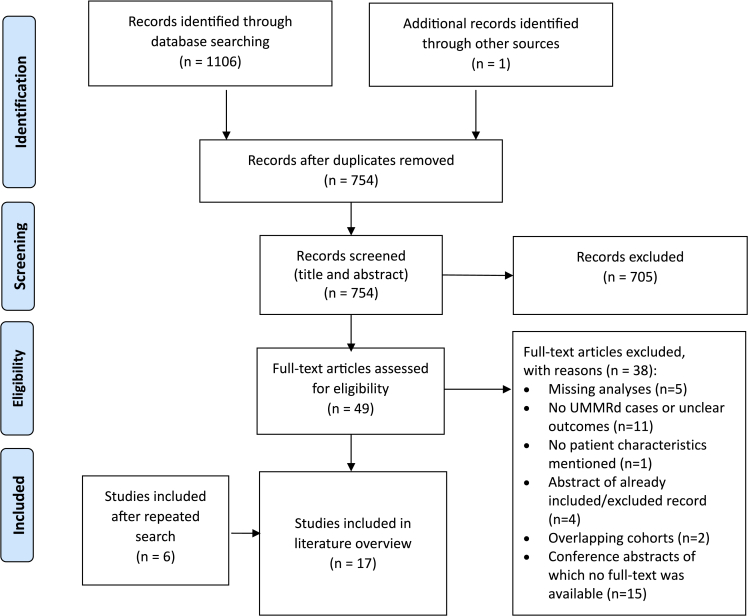
To identify Lynch syndrome (LS) carriers, DNA mismatch repair (MMR) immunohistochemistry (IHC) is performed on colorectal cancers (CRCs). Upon subsequent LS diagnostics, MMR deficiency (MMRd) sometimes remains unexplained (UMMRd). Recently, the importance of complete LS diagnostics to explain UMMRd, involving MMR methylation, germline, and somatic analyses, was stressed. To explore why some MMRd CRCs remain unsolved, we performed a systematic review of the literature and mapped patients with UMMRd diagnosed in our center. A systematic literature search was performed in Ovid Medline, Embase, Web of Science, Cochrane CENTRAL, and Google Scholar for articles on UMMRd CRCs after complete LS diagnostics published until December 15, 2021. Additionally, UMMRd CRCs diagnosed in our center since 1993 were mapped. Of 754 identified articles, 17 were included, covering 74 patients with UMMRd. Five CRCs were microsatellite stable. Upon complete diagnostics, 39 patients had single somatic MMR hits, and six an MMR germline variant of unknown significance (VUS). Ten had somatic pathogenic variants (PVs) in , , , and . The remaining 14 patients were the only identifiable cases in the literature without a plausible identified cause of the UMMRd. Of those, nine were suspected to have LS. In our center, complete LS diagnostics in approximately 5,000 CRCs left seven MMRd CRCs unexplained. All had a somatic MMR hit or MMR germline VUS, indicative of a missed second MMR hit. In vitually all patients with UMMRd, complete LS diagnostics suggest MMR gene involvement. Optimizing detection of currently undetectable PVs and VUS interpretation might explain all UMMRd CRCs, considering UMMRd a case closed.
为了识别林奇综合征(LS)携带者,对结直肠癌(CRC)进行 DNA 错配修复(MMR)免疫组织化学(IHC)检测。在随后的 LS 诊断中,有时会发现 MMR 缺陷(MMRd)无法解释(UMMRd)。最近,强调了进行完整 LS 诊断以解释 UMMRd 的重要性,包括 MMR 甲基化、种系和体细胞分析。为了探究为什么一些 MMRd CRC 仍然无法解释,我们对文献进行了系统回顾,并对在我们中心诊断为 UMMRd 的患者进行了映射。在 Ovid Medline、Embase、Web of Science、Cochrane CENTRAL 和 Google Scholar 中进行了系统的文献检索,检索了截至 2021 年 12 月 15 日发表的关于完全 LS 诊断后 UMMRd CRC 的文章。此外,还对我们中心自 1993 年以来诊断的 UMMRd CRC 进行了映射。在确定的 754 篇文章中,纳入了 17 篇,涵盖了 74 例 UMMRd 患者。有 5 例 CRC 为微卫星稳定。在完成诊断后,39 例患者存在单个体细胞 MMR 突变,6 例存在 MMR 种系意义不明的变异(VUS)。10 例患者在 、 、 或 中存在体细胞致病性变异(PV)。其余 14 例患者是文献中唯一无法确定 MMRd 原因的可识别病例。其中,有 9 例疑似 LS。在我们中心,对大约 5000 例 CRC 进行了完整的 LS 诊断,仍有 7 例 MMRd CRC 无法解释。所有患者均存在体细胞 MMR 突变或 MMR 种系 VUS,提示存在第二个 MMR 突变缺失。在几乎所有 UMMRd 患者中,完整的 LS 诊断均提示 MMR 基因参与。优化目前无法检测到的 PV 和 VUS 解释的检测,考虑到 UMMRd 是一个闭合的病例,可能可以解释所有 UMMRd CRC。