Department of Surgery, The University of Chicago, Chicago, IL, USA.
Departamento de Física, Facultad de Ciencia, Universidad de Santiago de Chile (USACH), Santiago, Chile.
J R Soc Interface. 2023 Jan;20(198):20220598. doi: 10.1098/rsif.2022.0598. Epub 2023 Jan 11.
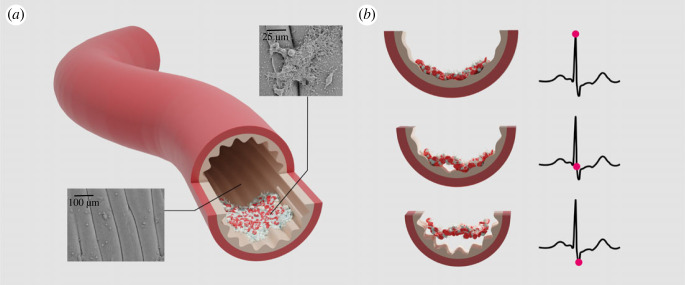
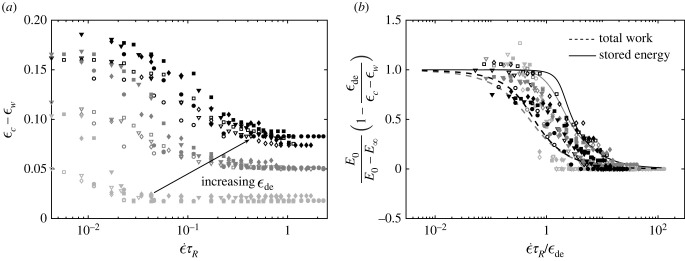
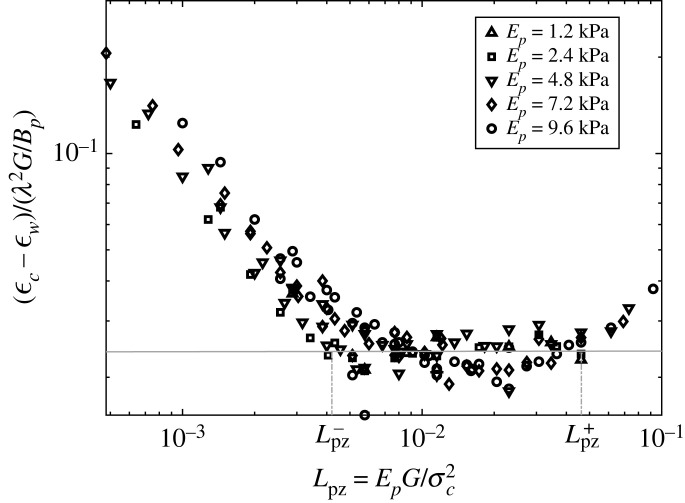
The superiority of many natural surfaces at resisting soft, sticky biofoulants have inspired the integration of dynamic topography with mechanical instability to promote self-cleaning artificial surfaces. The physics behind this novel mechanism is currently limited to elastic biofoulants where surface energy, bending stiffness and topographical wavelength are key factors. However, the viscoelastic nature of many biofoulants causes a complex interplay between these factors with time-dependent characteristics such as material softening and loading rate. Here, we enrich the current elastic theory of topographic de-adhesion using analytical and finite-element models to elucidate the nonlinear, time-dependent interaction of three physical, dimensionless parameters: biofoulant's stiffness reduction, the product of relaxation time and loading rate, and the critical strain for short-term elastic de-adhesion. Theoretical predictions, in good agreement with numerical simulations, provide insight into tuning these control parameters to optimize surface renewal via topographic de-adhesion in the viscoelastic regime.
许多天然表面在抵抗柔软、粘性生物污垢方面的优势,激发了将动态形貌与机械不稳定性相结合以促进自清洁人工表面的灵感。这种新型机制背后的物理原理目前仅限于弹性生物污垢,其中表面能、弯曲刚度和形貌波长是关键因素。然而,许多生物污垢的粘弹性导致这些因素之间的复杂相互作用,具有时间依赖性特征,如材料软化和加载速率。在这里,我们使用分析和有限元模型来丰富当前的形貌脱附弹性理论,阐明三个物理无量纲参数的非线性、时变相互作用:生物污垢的刚度降低、松弛时间和加载速率的乘积,以及短期弹性脱附的临界应变。理论预测与数值模拟很好地吻合,为通过粘弹性状态下的形貌脱附来优化表面更新提供了优化这些控制参数的见解。