Gubinelli F, Sarauskyte L, Venuti C, Kulacz I, Cazzolla G, Negrini M, Anwer D, Vecchio I, Jakobs F, Manfredsson F P, Davidsson M, Heuer A
Behavioural Neuroscience Laboratory, Department of Experimental Medical Sciences, Lund University, Lund, Sweden.
Department of Translational Neuroscience, Barrow Neurological Institute, Phoenix, AZ, USA.
Curr Res Neurobiol. 2022 Dec 16;4:100065. doi: 10.1016/j.crneur.2022.100065. eCollection 2023.
In the last decades different preclinical animal models of Parkinson's disease (PD) have been generated, aiming to mimic the progressive neuronal loss of midbrain dopaminergic (DA) cells as well as motor and non-motor impairment. Among all the available models, AAV-based models of human alpha-synuclein (h-aSYN) overexpression are promising tools for investigation of disease progression and therapeutic interventions.
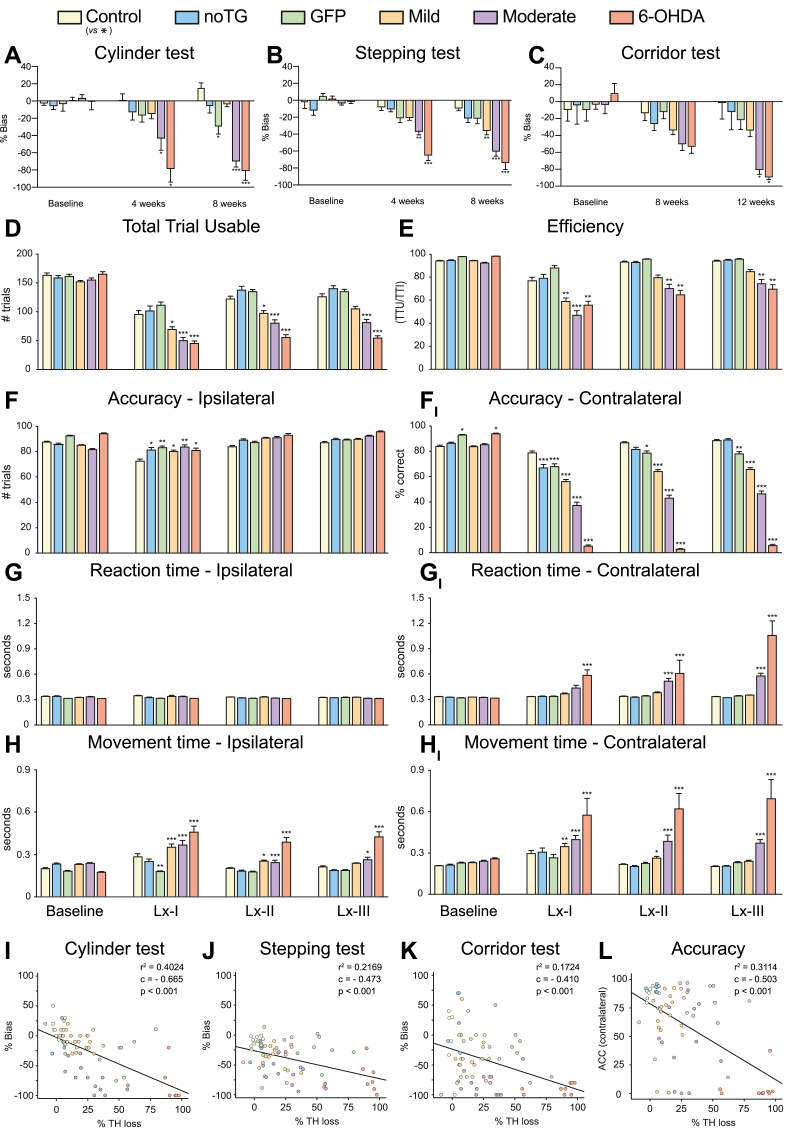
The goal with this work was to characterise the impairment in motor and non-motor domains following nigrostriatal overexpression of h-aSYN and correlate the behavioural deficits with histological assessment of associated pathology.
Intranigral injection of an AAV9 expressing h-aSYN was compared with untreated animals, 6-OHDA and AAV9 expressing either no transgene or GFP. The animals were assessed on a series of simple and complex behavioural tasks probing motor and non-motor domains. Post-mortem neuropathology was analysed using immunohistochemical methods.
Overexpression of h-aSYN led to progressive degeneration of DA neurons of the SN and axonal terminals in the striatum (STR). We observed extensive nigral and striatal pathology, resembling that of human PD brain, as well as the development of stable progressive deficit in simple motor tasks and in non-motor domains such as deficits in motivation and lateralised neglect.
In the present work we characterized a rat model of PD that closely resembles human PD pathology at the histological and behavioural level. The correlation of cell loss with behavioural performance enables the selection of rats which can be used in neuroprotective or neurorestorative therapies.
在过去几十年中,已经建立了不同的帕金森病(PD)临床前动物模型,旨在模拟中脑多巴胺能(DA)细胞的进行性神经元丧失以及运动和非运动功能障碍。在所有可用模型中,基于腺相关病毒(AAV)的人α-突触核蛋白(h-aSYN)过表达模型是研究疾病进展和治疗干预的有前途的工具。
这项工作的目标是表征黑质纹状体中h-aSYN过表达后运动和非运动领域的损伤,并将行为缺陷与相关病理学的组织学评估相关联。
将注射表达h-aSYN的AAV9的动物与未处理的动物、6-羟基多巴胺(6-OHDA)以及注射不表达转基因或绿色荧光蛋白(GFP)的AAV9的动物进行比较。通过一系列简单和复杂的行为任务对动物进行评估,以探究运动和非运动领域。使用免疫组织化学方法分析死后神经病理学。
h-aSYN的过表达导致黑质(SN)的DA神经元和纹状体(STR)中的轴突终末进行性退化。我们观察到广泛的黑质和纹状体病理学,类似于人类PD脑,以及在简单运动任务和非运动领域(如动机缺陷和偏侧忽视)中出现稳定的进行性缺陷。
在本研究中,我们表征了一种在组织学和行为水平上与人类PD病理学非常相似的PD大鼠模型。细胞损失与行为表现之间的相关性使得能够选择可用于神经保护或神经恢复治疗的大鼠。