Lipari Natalie, Galfano Ashley, Venkatesh Shruti, Grezenko Han, Sandoval Ivette M, Manfredsson Fredric P, Bishop Christopher
Department of Psychology, Binghamton University, Binghamton, NY, United States.
Barrow Neurological Institute, Phoenix, AZ, United States.
Front Neural Circuits. 2024 Nov 14;18:1463941. doi: 10.3389/fncir.2024.1463941. eCollection 2024.
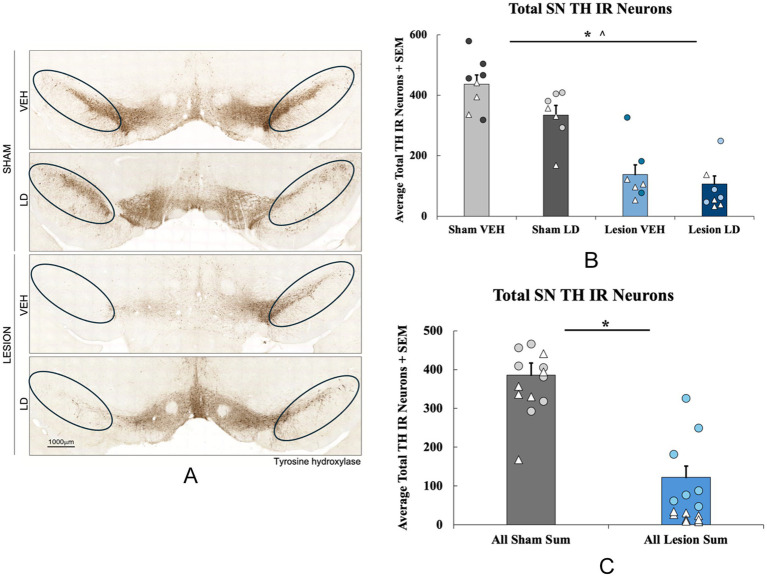
Parkinson's disease (PD) is commonly characterized by severe dopamine (DA) depletion within the substantia nigra (SN) leading to a myriad of motor and non-motor symptoms. One underappreciated and prevalent non-motor symptom, Parkinson's disease-associated psychosis (PDAP), significantly erodes patient and caregiver quality of life yet remains vastly understudied. While the gold standard pharmacotherapy for motor symptoms Levodopa (LD) is initially highly effective, it can lead to motor fluctuations like LD-induced dyskinesia (LID) and non-motor fluctuations such as intermittent PDAP. One source of these fluctuations could be the serotonergic raphe nuclei and their projections. Serotonin (5-HT) neurons possess the machinery necessary to convert and release DA from exogenous LD. In DA-depleted brain regions these 5-HT projections can act as surrogates to the DA system initially compensating but chronically leading to aberrant neuroplasticity which has been linked to LID and may also contribute to non-motor fluctuations. In support, recent work from our lab established a positive relationship between LID and PDAP in parkinsonian rats. Therefore, it was hypothesized that normalizing 5-HT forebrain input would reduce the co-expression of LID and PDAP.
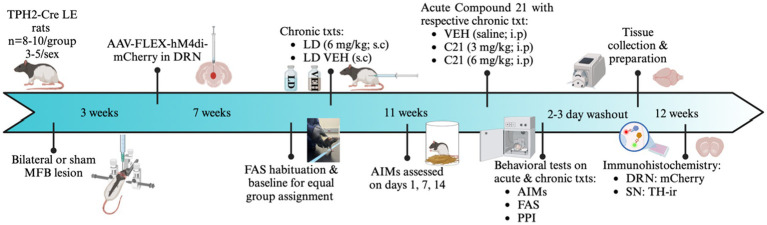
To do so, we expressed 5-HT projection specific inhibitory designer receptor exclusively activated by designer drugs (DREADDs) using Cre-dependent AAV9-hM4di in tryptophan hydroxylase 2 (TPH2)-Cre bilaterally 6-OHDA-lesioned rats. Thereafter we used the designer drug Compound 21 to selectively inhibit 5-HT raphe projections during LD treatment to modulate the expression of PDAP, assayed by prepulse inhibition (PPI) and LID, quantified by the abnormal involuntary movements (AIMs) test.
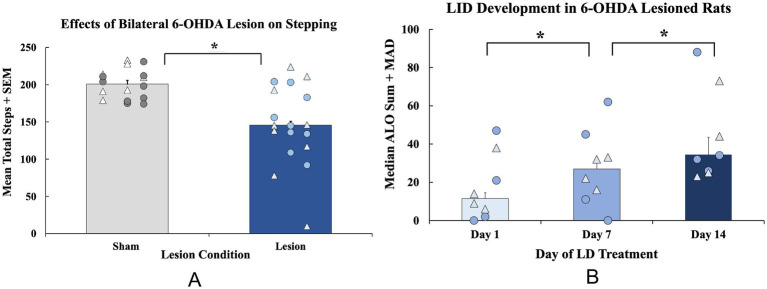
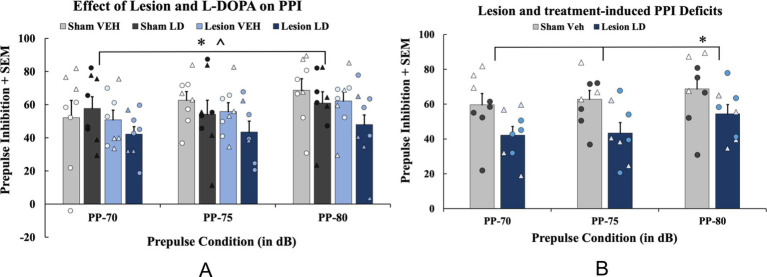
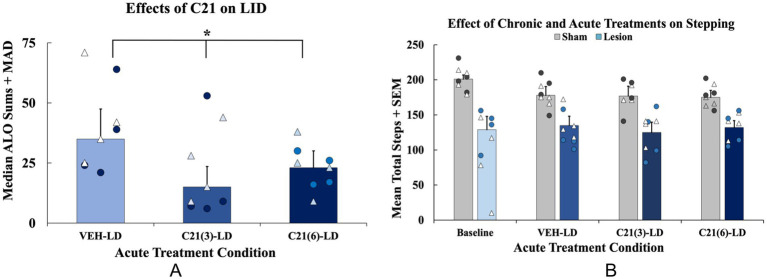
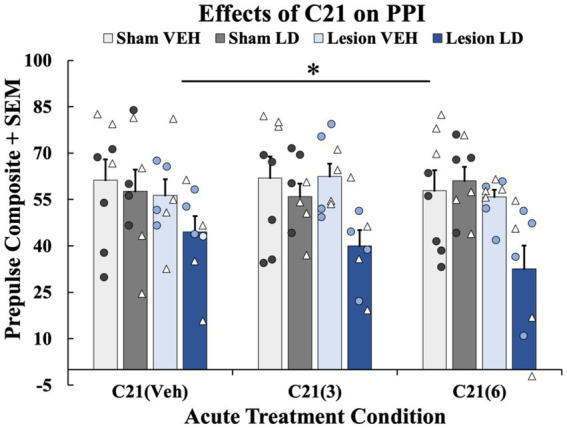
Our results suggest that chemogenetic inhibition of 5-HT raphe-projecting cells significantly reduces LID without affecting stepping ability or established sensorimotor gating deficits.
Overall, this study provides further evidence for the complex influence of 5-HT raphe-projecting neurons on LD's neurobehavioral effects.
帕金森病(PD)的常见特征是黑质(SN)内严重的多巴胺(DA)耗竭,导致一系列运动和非运动症状。一种未得到充分重视且普遍存在的非运动症状——帕金森病相关精神病(PDAP),严重侵蚀患者和照顾者的生活质量,但仍未得到充分研究。虽然治疗运动症状的金标准药物左旋多巴(LD)最初非常有效,但它会导致运动波动,如左旋多巴诱导的运动障碍(LID),以及非运动波动,如间歇性PDAP。这些波动的一个来源可能是血清素能中缝核及其投射。血清素(5-HT)神经元具备将外源性LD转化并释放DA所需的机制。在DA耗竭的脑区,这些5-HT投射可充当DA系统的替代物,最初起到补偿作用,但长期会导致异常神经可塑性,这与LID有关,也可能导致非运动波动。作为支持,我们实验室最近的研究在帕金森病大鼠中建立了LID与PDAP之间的正相关关系。因此,有人推测使5-HT前脑输入正常化会减少LID和PDAP的共表达。
为此,我们在双侧经6-羟基多巴胺(6-OHDA)损伤的大鼠中,使用依赖于Cre的腺相关病毒9型-hM4di(AAV9-hM4di)在色氨酸羟化酶2(TPH2)-Cre大鼠中表达仅由设计药物激活的5-HT投射特异性抑制性设计受体(DREADDs)。此后,我们在LD治疗期间使用设计药物化合物21选择性抑制5-HT中缝投射,以调节PDAP的表达,通过前脉冲抑制(PPI)进行测定,LID通过异常不自主运动(AIMs)测试进行量化。
我们的结果表明,对5-HT中缝投射细胞进行化学遗传学抑制可显著降低LID,而不影响步行动力或已有的感觉运动门控缺陷。
总体而言,本研究为5-HT中缝投射神经元对LD神经行为效应的复杂影响提供了进一步证据。