Oncology Department, University Hospital Geneva (HUG), Geneva, Switzerland.
Department of Translational Molecular Pathology, The University of Texas MD Anderson Cancer Center, Houston, TX 77030, USA.
Pharmacol Ther. 2023 Feb;242:108344. doi: 10.1016/j.pharmthera.2023.108344. Epub 2023 Jan 9.
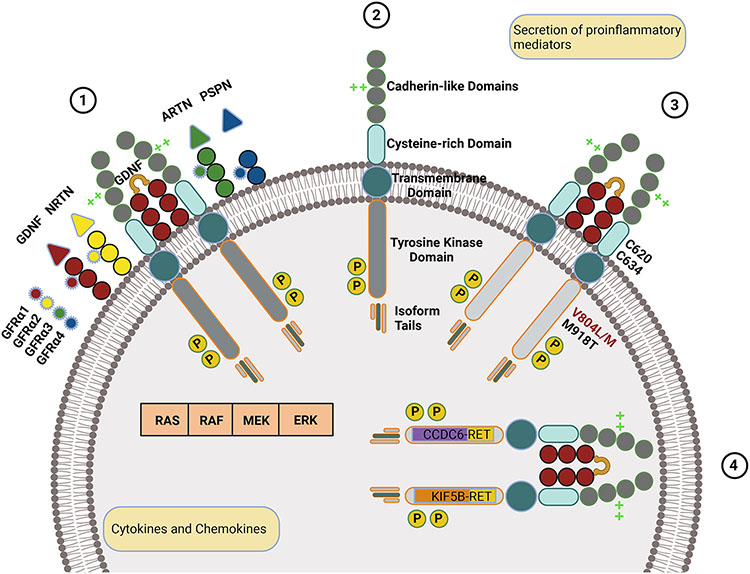
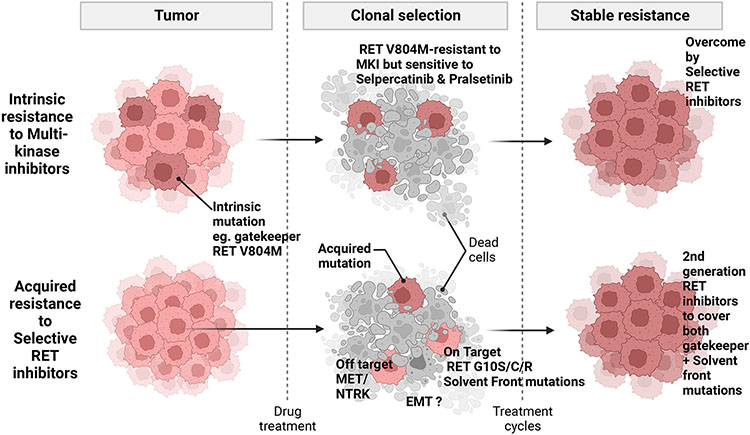
Precision oncology informed by genomic information has evolved in leaps and bounds over the last decade. Although non-small cell lung cancer (NSCLC) has moved to center-stage as the poster child of precision oncology, multiple targetable genomic alterations have been identified in various cancer types. RET alterations occur in roughly 2% of all human cancers. The role of RET as oncogenic driver was initially identified in 1985 after the discovery that transfection with human lymphoma DNA transforms NIH-3T3 fibroblasts. Germline RET mutations are causative of multiple endocrine neoplasia type 2 syndrome, and RET fusions are found in 10-20% of papillary thyroid cases and are detected in most patients with advanced sporadic medullary thyroid cancer. RET fusions are oncogenic drivers in 2% of Non-small cell lung cancer. Rapid translation and regulatory approval of selective RET inhibitors, selpercatinib and pralsetinib, have opened up the field of RET precision oncology. This review provides an update on RET precision oncology from bench to bedside and back. We explore the impact of selective RET inhibitor in patients with advanced NSCLC, thyroid cancer, and other cancers in a tissue-agnostic fashion, resistance mechanisms, and future directions.
过去十年间,基于基因组信息的精准肿瘤学取得了飞速发展。虽然非小细胞肺癌(NSCLC)已经成为精准肿瘤学的典范,但在多种癌症类型中已经确定了多个可靶向的基因组改变。RET 改变发生在大约 2%的所有人类癌症中。1985 年,在发现用人类淋巴瘤 DNA 转染 NIH-3T3 成纤维细胞可转化为肿瘤后,最初确定了 RET 作为致癌驱动基因的作用。种系 RET 突变是多发性内分泌肿瘤 2 型综合征的病因,在 10-20%的甲状腺乳头状癌病例中发现了 RET 融合,并在大多数晚期散发性甲状腺髓样癌患者中检测到。RET 融合是 2%的非小细胞肺癌的致癌驱动基因。选择性 RET 抑制剂塞尔帕替尼和普拉替尼的快速转化和监管批准为 RET 精准肿瘤学领域开辟了道路。这篇综述从实验室到临床再回到实验室,提供了 RET 精准肿瘤学的最新进展。我们探讨了选择性 RET 抑制剂在晚期 NSCLC、甲状腺癌和其他癌症患者中的疗效,以及耐药机制和未来方向。