Gouda Mohamed A, Subbiah Vivek
Department of Investigational Cancer Therapeutics, The University of Texas MD Anderson Cancer Center. Houston, TX, USA.
Sarah Cannon Research Institute, 1100 Dr. Martin L. King Jr. Blvd. Suite 800. Nashville, TN 37203, USA.
Ther Adv Med Oncol. 2023 Jun 21;15:17588359231177015. doi: 10.1177/17588359231177015. eCollection 2023.
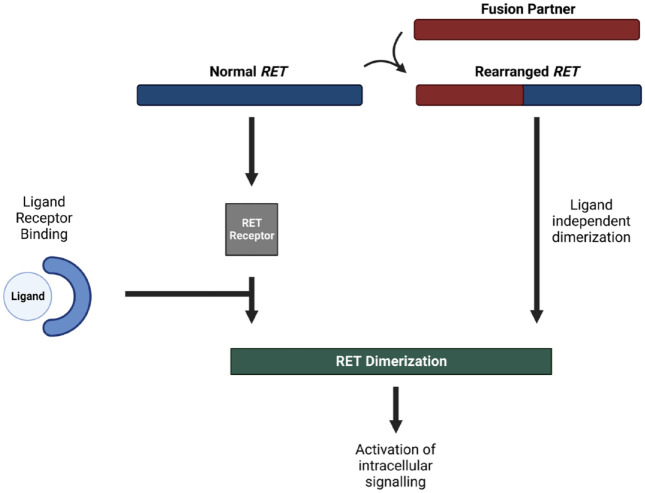
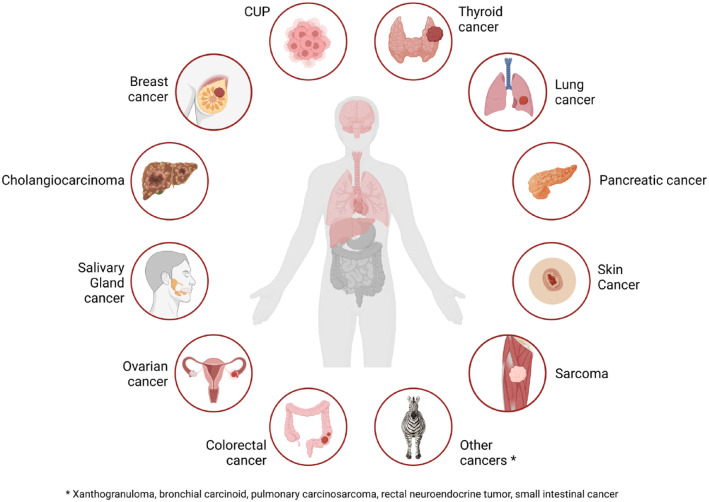
Rearranged during transfection () is a protooncogene that encodes for receptor tyrosine kinase with downstream effects on multiple cellular pathways. Activating can occur and lead to uncontrolled cellular proliferation as a hallmark of cancer development. Oncogenic fusions are present in nearly 2% of patients with non-small cell lung cancer (NSCLC), 10-20% of patients with thyroid cancer, and <1% across the pan-cancer spectrum. In addition, mutations are drivers in 60% of sporadic medullary thyroid cancers and 99% of hereditary thyroid cancers. The discovery, rapid clinical translation, and trials leading to FDA approvals of selective inhibitors, selpercatinib and pralsetinib, have revolutionized the field of precision therapy. In this article, we review the current status on the use of the selective inhibitor, selpercatinib, in fusion-positive tumors: NSCLC, thyroid cancers, and the more recent tissue-agnostic activity leading to FDA approval.
转染期间重排基因()是一种原癌基因,编码受体酪氨酸激酶,对多种细胞途径具有下游效应。激活该基因可导致不受控制的细胞增殖,这是癌症发展的一个标志。致癌性基因融合存在于近2%的非小细胞肺癌(NSCLC)患者、10 - 20%的甲状腺癌患者中,在所有癌症类型中占比不到1%。此外,该基因突变是60%的散发性甲状腺髓样癌和99%的遗传性甲状腺癌的驱动因素。选择性抑制剂塞尔帕替尼和普拉替尼的发现、快速临床转化以及导致FDA批准的试验,彻底改变了精准治疗领域。在本文中,我们回顾了选择性抑制剂塞尔帕替尼在基因融合阳性肿瘤(NSCLC、甲状腺癌)中的应用现状,以及导致FDA批准的最新的组织非特异性活性。