MS Center, Neurology and Research Center for Clinical Neuroimmunology and Neuroscience Basel (RC2NB), Departments of Head, Spine and Neuromedicine, Biomedicine and Clinical Research, University Hospital Basel and University Basel, Basel, Switzerland.
Massachusetts General Hospital for Children, Boston, MA, USA.
Mult Scler. 2023 Mar;29(3):385-394. doi: 10.1177/13524585221144742. Epub 2023 Jan 12.
The phase 3 TERIKIDS study demonstrated efficacy and manageable safety for teriflunomide versus placebo in children with relapsing multiple sclerosis (RMS).
Evaluate plasma neurofilament light chain (pNfL) concentrations in TERIKIDS.
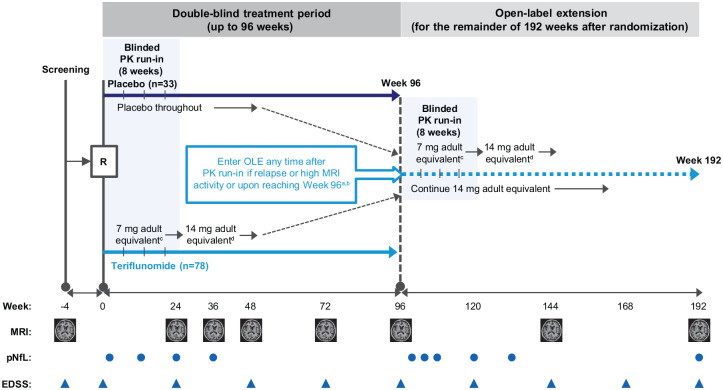
Patients received placebo or teriflunomide (14 mg adult equivalent) for up to 96 weeks in the double-blind (DB) period. In the open-label extension (OLE), all patients received teriflunomide until up to 192 weeks after randomization. pNfL was measured using single-molecule array assay (Simoa NF-light).
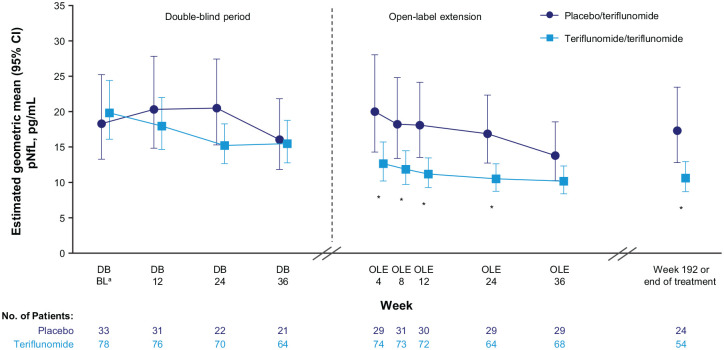
Baseline mean age was 14.5 years; 69.4% were female. Baseline geometric least square mean pNfL levels were similar for teriflunomide ( = 78) and placebo ( = 33) patients (19.83 vs 18.30 pg/mL). Over the combined DB and OLE periods, pNfL values were lower for teriflunomide versus placebo (analysis of variance < 0.01; Week 192: 10.61 vs 17.32 pg/mL). Observed between-group pNfL differences were attenuated upon adjustment for gadolinium (Gd)-enhancing or new/enlarged T2 lesion counts at DB Week 24. Higher baseline pNfL levels were associated with shorter time since first MS symptom onset, higher baseline Gd-enhancing lesion counts and T2 lesion volume, and increased hazard of high magnetic resonance imaging activity or clinical relapse during the DB period.
Teriflunomide treatment was associated with significantly reduced pNfL levels in children with RMS.
CLINICALTRIALS.GOV IDENTIFIER: NCT02201108.
TERIKIDS 三期研究表明,与安慰剂相比,特立氟胺在复发型多发性硬化(RMS)儿童中具有疗效和可管理的安全性。
评估 TERIKIDS 中血浆神经丝轻链(pNfL)浓度。
患者在双盲(DB)期接受安慰剂或特立氟胺(成人等效剂量 14mg)治疗,最多 96 周。在开放标签扩展(OLE)中,所有患者在随机分组后最多接受 192 周的特立氟胺治疗。使用单分子阵列分析(Simoa NF-light)测量 pNfL。
基线时的平均年龄为 14.5 岁;69.4%为女性。特立氟胺(=78)和安慰剂(=33)患者的基线几何均数最小二乘 pNfL 水平相似(19.83 与 18.30 pg/mL)。在 DB 和 OLE 联合期间,特立氟胺组的 pNfL 值低于安慰剂组(方差分析<0.01;第 192 周:10.61 与 17.32 pg/mL)。在调整 DB 第 24 周时钆增强或新/扩大 T2 病变计数后,观察到的组间 pNfL 差异减弱。较高的基线 pNfL 水平与首发 MS 症状后时间较短、较高的基线钆增强病变计数和 T2 病变体积以及在 DB 期间发生高磁共振成像活动或临床复发的风险增加有关。
特立氟胺治疗与 RMS 儿童的 pNfL 水平显著降低相关。
NCT02201108。