From the Neurologic Clinic and Policlinic (J.K., C.B., L.K.), Departments of Medicine, Biomedicine and Clinical Research, University Hospital Basel, University of Basel; Novartis Pharma AG (H.K., D.A.H., F.D., D.T., D.L.), Basel, Switzerland; Novartis Healthcare Pvt. Ltd. (U.K.), Hyderabad, India; and DATAMAP GmbH (R.M.), Freiburg, Germany.
Neurology. 2019 Mar 5;92(10):e1007-e1015. doi: 10.1212/WNL.0000000000007032. Epub 2019 Feb 8.
To assess the value of blood neurofilament light chain (NfL) as a biomarker of recent, ongoing, and future disease activity and tissue damage and its utility to monitor treatment response in relapsing-remitting multiple sclerosis.
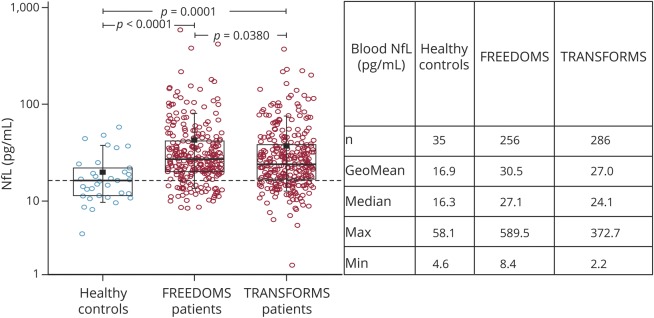
We measured NfL in blood samples from 589 patients with relapsing-remitting multiple sclerosis (from phase 3 studies of fingolimod vs placebo, FREEDOMS and interferon [IFN]-β-1a, TRANSFORMS) and 35 healthy controls and compared NfL levels with clinical and MRI-related outcomes.
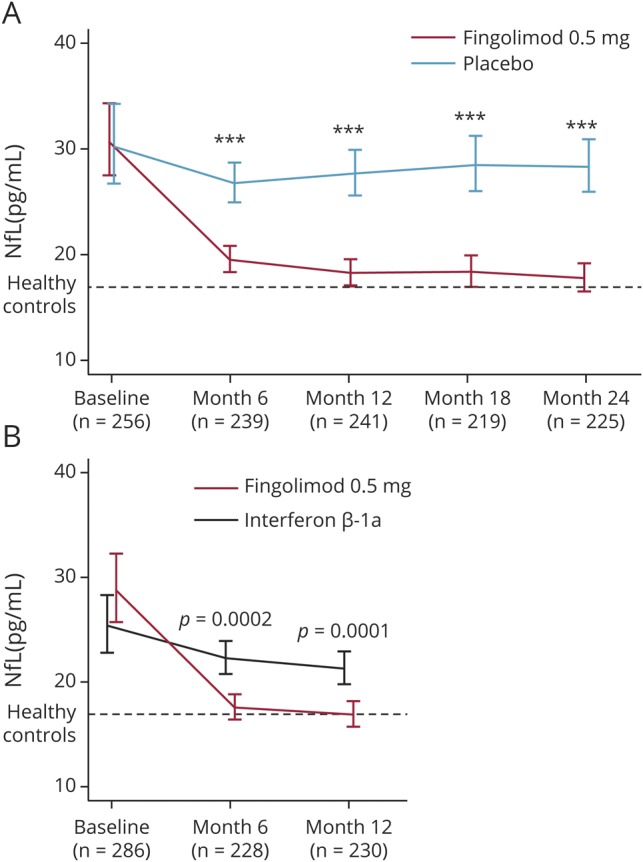
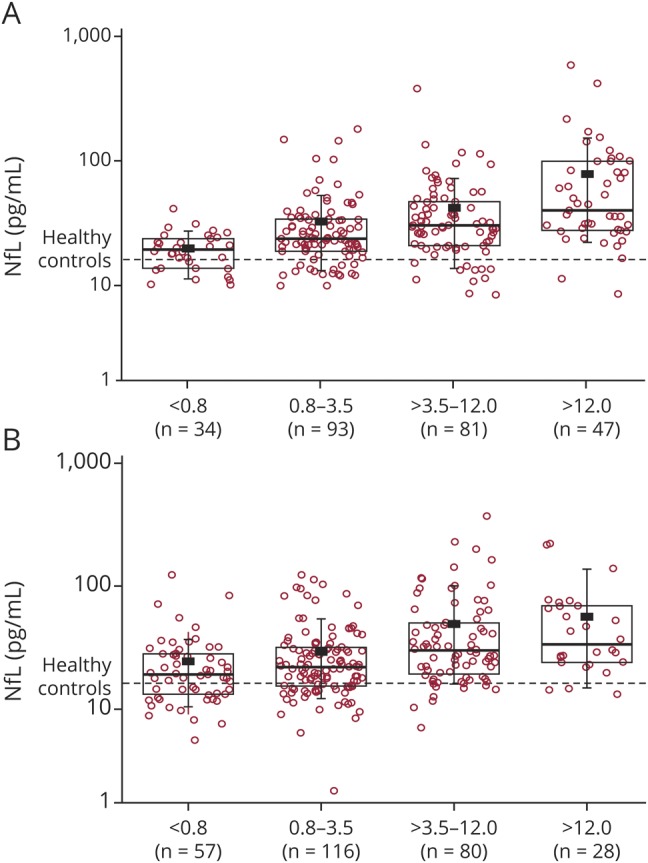
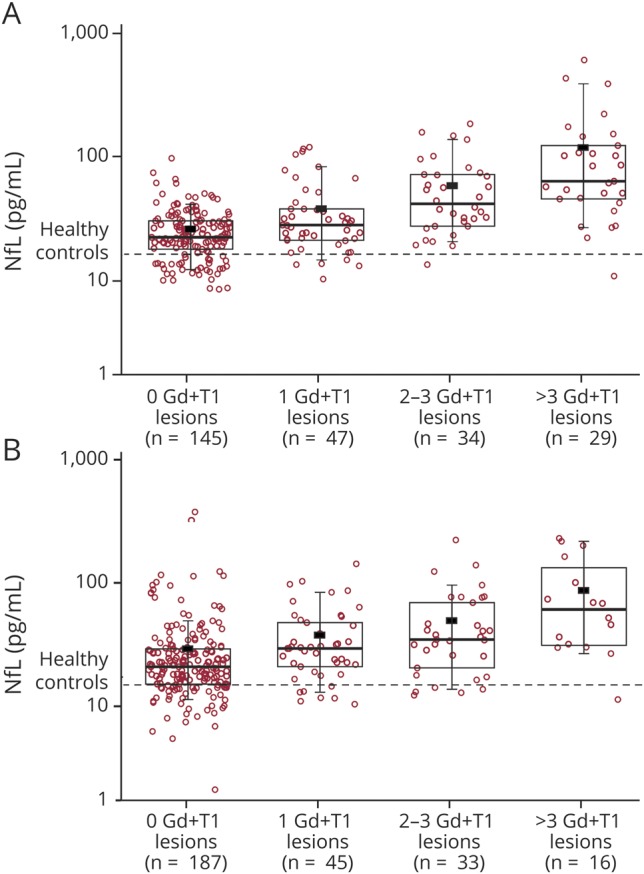
At baseline, NfL levels (pg/mL) were higher in patients than in healthy controls (30.5 and 27.0 vs 16.9, = 0.0001) and correlated with T2 lesion load and number of gadolinium-enhancing T1 lesions ( < 0.0001, both). Baseline NfL levels, treatment, and number of new or enlarging T2 lesions during the studies predicted NfL levels at the end of study (all < 0.01). High vs low baseline NfL levels were associated (estimate [95% confidence interval]) with an increased number of new or enlarging T2 lesions (ratio of mean: 2.64 [1.51-4.60]; = 0.0006), relapses (rate ratio: 2.53 [1.67-3.83]; < 0.0001), brain volume loss (difference in means: -0.78% [-1.02 to -0.54]; < 0.0001), and risk of confirmed disability worsening (hazard ratio: 1.94 [0.97-3.87]; = 0.0605). Fingolimod significantly reduced NfL levels already at 6 months (vs placebo 0.73 [0.656-0.813] and IFN 0.789 [0.704-0.884]), which was sustained until the end of the studies (vs placebo 0.628 [0.552-0.714] and IFN 0.794 [0.705-0.894]; < 0.001, both studies at all assessments).
Blood NfL levels are associated with clinical and MRI-related measures of disease activity and neuroaxonal damage and have prognostic value. Our results support the utility of blood NfL as an easily accessible biomarker of disease evolution and treatment response.
评估血液神经丝轻链(NfL)作为近期、持续和未来疾病活动和组织损伤生物标志物的价值,及其在监测复发缓解型多发性硬化症治疗反应中的效用。
我们测量了 589 例复发缓解型多发性硬化症患者(来自 fingolimod 与安慰剂的 3 期研究,FREEDOMS 和干扰素[IFN]-β-1a,TRANSFORMS)和 35 名健康对照者的血液样本中的 NfL 水平,并将 NfL 水平与临床和 MRI 相关结局进行比较。
基线时,患者的 NfL 水平(pg/mL)高于健康对照者(30.5 和 27.0 比 16.9, = 0.0001),且与 T2 病变负荷和钆增强 T1 病变数相关(均 < 0.0001)。研究期间的基线 NfL 水平、治疗和新出现或扩大的 T2 病变数预测研究结束时的 NfL 水平(均 < 0.01)。高基线 NfL 水平与新出现或扩大的 T2 病变数增加相关(平均比:2.64 [1.51-4.60]; = 0.0006)、复发(比值比:2.53 [1.67-3.83]; < 0.0001)、脑容量损失(平均差值:-0.78% [-1.02 至 -0.54]; < 0.0001)和确诊残疾恶化风险增加(风险比:1.94 [0.97-3.87]; = 0.0605)相关。Fingolimod 在 6 个月时已显著降低 NfL 水平(与安慰剂相比为 0.73 [0.656-0.813]和 IFN 0.789 [0.704-0.884]),且持续至研究结束(与安慰剂相比为 0.628 [0.552-0.714]和 IFN 0.794 [0.705-0.894];均 < 0.001,两项研究所有评估)。
血液 NfL 水平与疾病活动和神经轴索损伤的临床和 MRI 相关指标相关,具有预后价值。我们的结果支持血液 NfL 作为一种易于获取的疾病演变和治疗反应生物标志物的效用。