MRC Centre for Global Infectious Disease Analysis, Department of Infectious Disease Epidemiology, Imperial College London, London, UK
MRC Centre for Global Infectious Disease Analysis, Department of Infectious Disease Epidemiology, Imperial College London, London, UK.
BMJ Open. 2023 Jan 12;13(1):e067327. doi: 10.1136/bmjopen-2022-067327.
This study examined whether HIV status and antiretroviral therapy (ART) exposure were associated with self-reported hypertension in Zimbabwe.
Study data were taken from a cross-sectional, general population survey, which included HIV testing (July 2018-December 2019).
The data were collected in Manicaland Province, Zimbabwe.
9780 people aged 15 years and above were included.
Self-reported hypertension was the outcome measure. This was defined as reporting a previous diagnosis of hypertension by a doctor or nurse. After weighting of survey responses by age and sex using household census data, χ tests and logistic regression were used to explore whether HIV status and ART exposure were associated with self-reported hypertension.
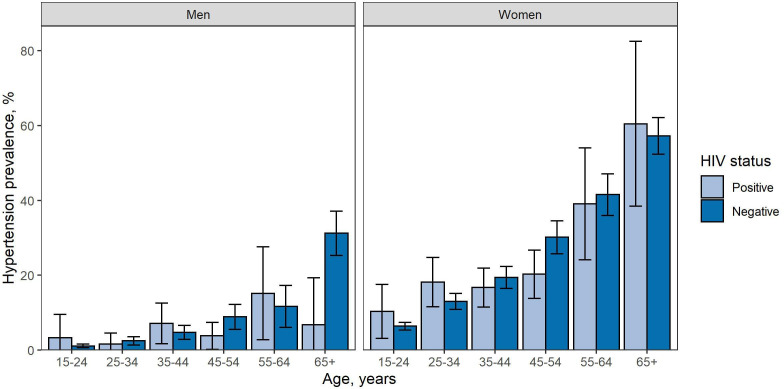
The weighted prevalence of self-reported hypertension was 13.6% (95% CI 12.9% to 14.2%) and the weighted prevalence of HIV was 11.1% (10.4% to 11.7%). In univariable analyses, there was no evidence of a difference in the weighted prevalence of self-reported hypertension between people living with HIV (PLHIV) and HIV-negative people (14.1%, 11.9% to 16.3% vs 13.3%, 12.6% to 14.0%; p=0.503) or between ART-exposed and ART-naive PLHIV (14.8%, 12.0% to 17.7% vs 12.8%, 9.1% to 16.4%,p=0.388). Adjusting for socio-demographic variables in logistic regression did not alter this finding (ORs:HIV status:0.88, 0.70 to 1.10, p=0.261; ART exposure:0.83, 0.53 to 1.30, p=0.411).
Approximately one in seven PLHIV self-reported having hypertension, highlighting an important burden of disease. However, no associations were found between HIV status or ART exposure and self-reported hypertension, suggesting that it will be valuable to focus on managing other risk factors for hypertension in this population. These findings should be fully accounted for as Zimbabwe reorients its health system towards non-communicable disease control and management.
本研究旨在探讨在津巴布韦,艾滋病毒状况和抗逆转录病毒治疗(ART)暴露是否与自我报告的高血压相关。
研究数据来自横断面、一般人群调查,包括艾滋病毒检测(2018 年 7 月至 2019 年 12 月)。
数据来自津巴布韦马尼卡兰省。
纳入了 9780 名 15 岁及以上的人群。
自我报告的高血压为结局测量指标。该指标定义为报告医生或护士之前诊断为高血压。使用家庭人口普查数据对调查应答进行年龄和性别加权后,使用卡方检验和逻辑回归来探讨艾滋病毒状况和 ART 暴露是否与自我报告的高血压相关。
自我报告的高血压加权患病率为 13.6%(95%置信区间 12.9%至 14.2%),艾滋病毒加权患病率为 11.1%(10.4%至 11.7%)。在单变量分析中,艾滋病毒感染者(PLHIV)和艾滋病毒阴性人群之间自我报告的高血压加权患病率无差异(14.1%,11.9%至 16.3% vs. 13.3%,12.6%至 14.0%;p=0.503),或在接受 ART 治疗和未接受 ART 治疗的 PLHIV 之间无差异(14.8%,12.0%至 17.7% vs. 12.8%,9.1%至 16.4%;p=0.388)。在校正社会人口统计学变量的逻辑回归中,这一发现没有改变(比值比:HIV 状况:0.88,0.70 至 1.10,p=0.261;ART 暴露:0.83,0.53 至 1.30,p=0.411)。
大约每 7 名 PLHIV 中就有 1 人自我报告患有高血压,这突显了一个重要的疾病负担。然而,未发现 HIV 状况或 ART 暴露与自我报告的高血压之间存在关联,这表明在该人群中关注高血压的其他危险因素管理将是有价值的。这些发现应该在津巴布韦重新调整其卫生系统以控制和管理非传染性疾病时充分考虑。