Department of Pharmacy, Beijing Children's Hospital, Capital Medical University, National Center for Children's Health, Beijing, 100045, People's Republic of China.
Department of Pharmacy, Children's Hospital of Soochow University, Suzhou, Jiangsu, 215025, People's Republic of China.
Int J Nanomedicine. 2023 Jan 5;18:79-94. doi: 10.2147/IJN.S394819. eCollection 2023.
Nanomedicines have significant advantages in enhancing the oral bioavailability of drugs, but a deeper understanding of the underlying mechanisms remains to be interpreted. Hence, the present study aims to explain the uptake and trafficking mechanism for 6-MP nanomedicines we previously constructed.
6-MP loaded poly(lactide-co-glycolide) (PLGA) nanomedicines (6-MPNs) were prepared by the multiple emulsion method. The transcytosis mechanism of 6-MPNs was investigated in Caco-2 cells, Caco-2 monolayers, follicle associated epithelium (FAE) monolayers and rats, including transmembrane pathway, intracellular trafficking, paracellular transport and the involvement of transporter.
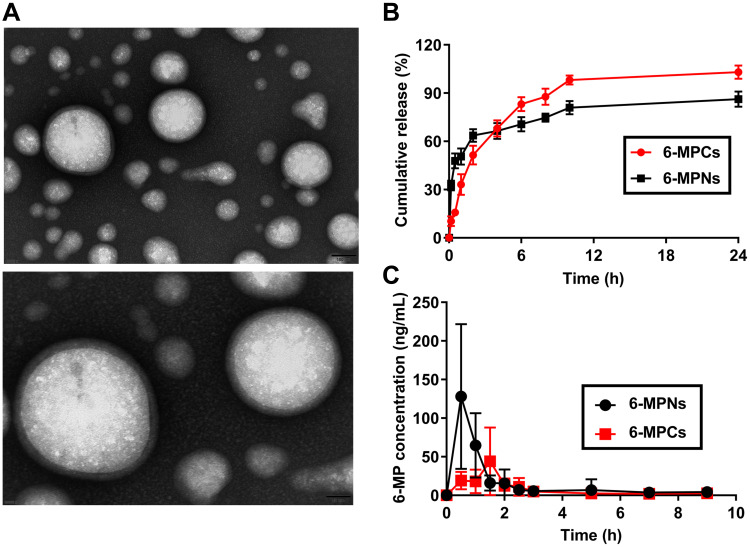
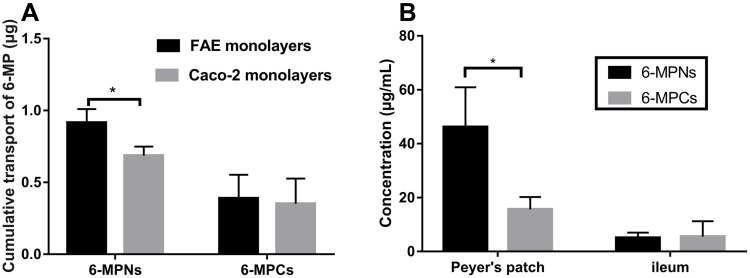
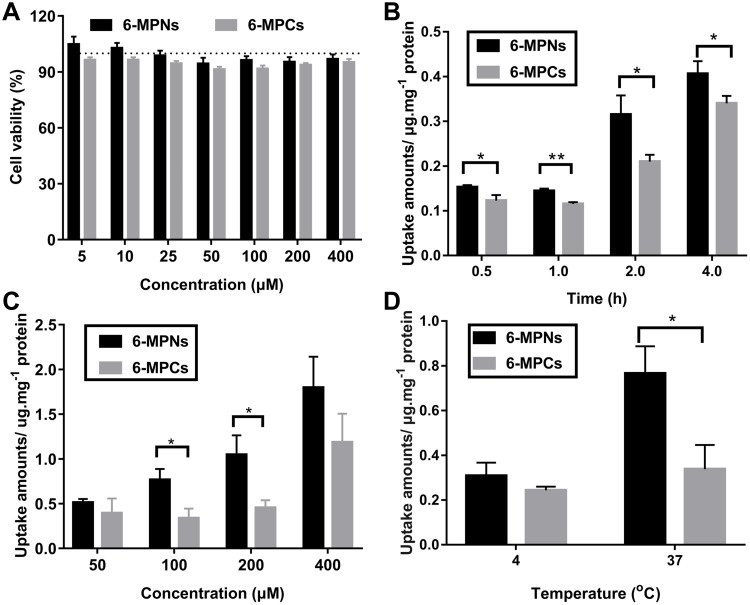
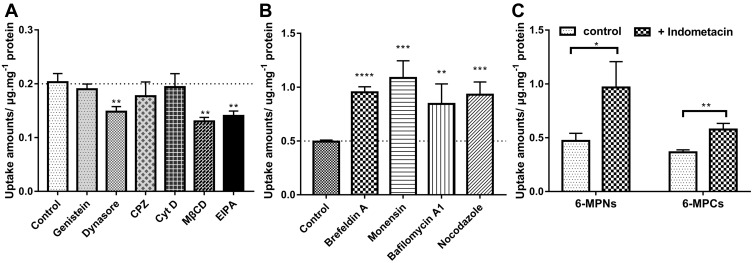
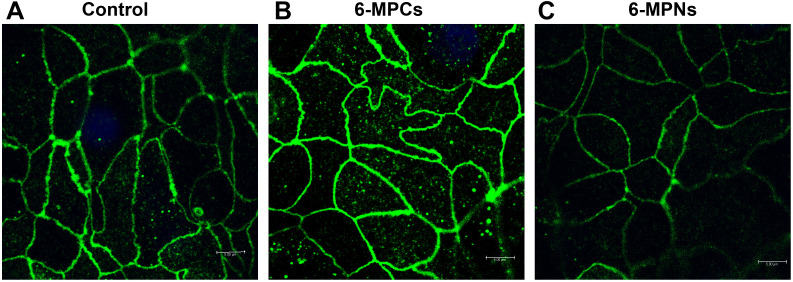
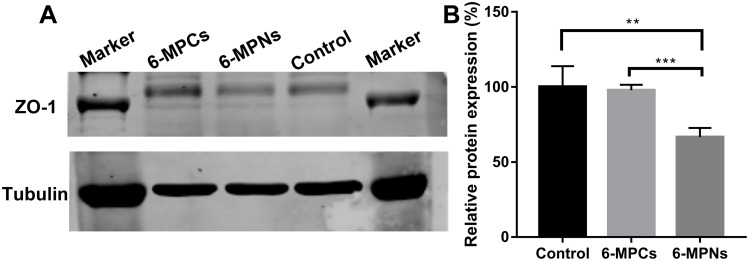
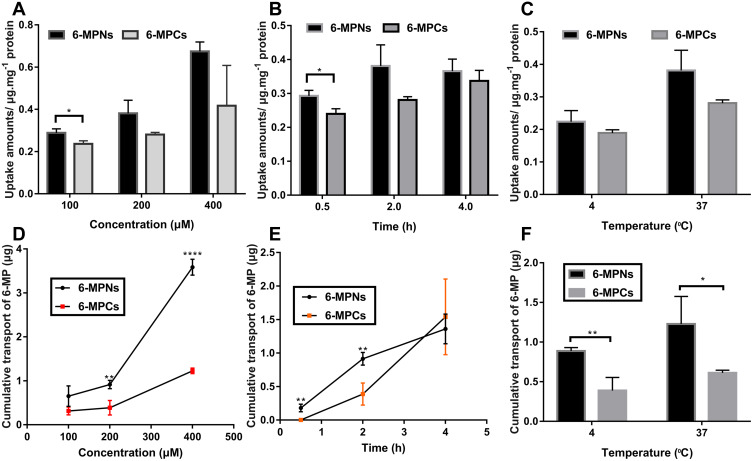
Pharmacokinetics in rats showed that the area under the curve (AUC) of 6-MP in the 6-MPNs group (147.3 ± 42.89 μg/L·h) was significantly higher than that in the 6-MP suspensions (6-MPCs) group (70.31 ± 18.24 μg/L·h). The uptake of 6-MPNs in Caco-2 cells was time-, concentration- and energy-dependent. The endocytosis of intact 6-MPNs was mediated mainly through caveolae/lipid raft, caveolin and micropinocytosis. The intracellular trafficking of 6-MPNs was affected by endoplasmic reticulum (ER)-Golgi complexes, late endosome-lysosome and microtubules. The multidrug resistance associated protein 4 (MRP4) transporter-mediated transport of free 6-MP played a vital role on the transmembrane of 6-MPNs. The trafficking of 6-MPNs from the apical (AP) side to the basolateral (BL) side in Caco-2 monolayers was obviously improved. Besides, 6-MPNs affected the distribution and expression of zona occludens-1 (ZO-1). The transport of 6-MPNs in FAE monolayers was concentration- and energy-dependent, while reaching saturation over time. 6-MPNs improved the absorption of the intestinal Peyer's patches (PPs) in rats.
6-MPNs improve the oral bioavailability through multiple pathways, including active transport, paracellular transport, lymphatic delivery and MRP4 transporter. The findings of current study may shed light on the cellular uptake and transcellular trafficking mechanism of oral nanomedicines.
纳米药物在提高药物口服生物利用度方面具有显著优势,但对其潜在机制仍需深入解释。因此,本研究旨在解释我们之前构建的 6-巯基嘌呤纳米药物(6-MPNs)的摄取和转运机制。
采用复乳法制备 6-巯基嘌呤载聚乳酸-羟基乙酸共聚物(PLGA)纳米药物(6-MPNs)。在 Caco-2 细胞、Caco-2 单层、滤泡相关上皮(FAE)单层和大鼠中研究了 6-MPNs 的转胞吞作用机制,包括跨膜途径、细胞内转运、细胞旁转运和转运体的参与。
大鼠药代动力学研究表明,6-MPNs 组(147.3±42.89μg/L·h)的 6-MP 曲线下面积(AUC)明显高于 6-MP 混悬液(6-MPCs)组(70.31±18.24μg/L·h)。6-MPNs 在 Caco-2 细胞中的摄取具有时间、浓度和能量依赖性。完整 6-MPNs 的内吞作用主要通过小窝/脂筏、窖蛋白和微吞噬作用介导。6-MPNs 的细胞内转运受内质网(ER)-高尔基体复合物、晚期内体-溶酶体和微管的影响。多药耐药相关蛋白 4(MRP4)转运体介导的游离 6-MP 的转运对 6-MPNs 的跨膜转运起着至关重要的作用。6-MPNs 从 Caco-2 单层的顶侧(AP)到基底外侧(BL)的转运明显改善。此外,6-MPNs 影响了封闭蛋白-1(ZO-1)的分布和表达。FAE 单层中 6-MPNs 的转运具有浓度和能量依赖性,且随时间达到饱和。6-MPNs 改善了大鼠肠道派尔集合淋巴结(PPs)的吸收。
6-MPNs 通过主动转运、细胞旁转运、淋巴输送和 MRP4 转运体等多种途径提高口服生物利用度。本研究结果可为口服纳米药物的细胞摄取和跨细胞转运机制提供启示。