Department of Mechanical and Aerospace Engineering, Henry Samueli School of Engineering, University of California, Irvine, Irvine, CA, USA.
Department of Biomedical Engineering, Henry Samueli School of Engineering, University of California, Irvine, Irvine, CA, USA.
Neurorehabil Neural Repair. 2023 Jan;37(1):53-65. doi: 10.1177/15459683221146995. Epub 2023 Jan 12.
Upper extremity (UE) stroke rehabilitation requires patients to perform exercises at home, yet patients show limited benefit from paper-based home exercise programs.
To compare the effectiveness of 2 home exercise programs for reducing UE impairment: a paper-based approach and a sensorized exercise system that incorporates recommended design features for home rehabilitation technology.
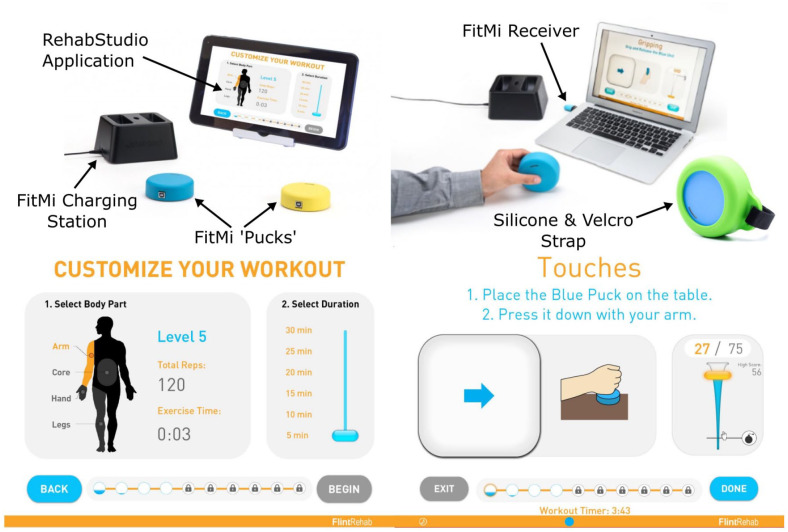
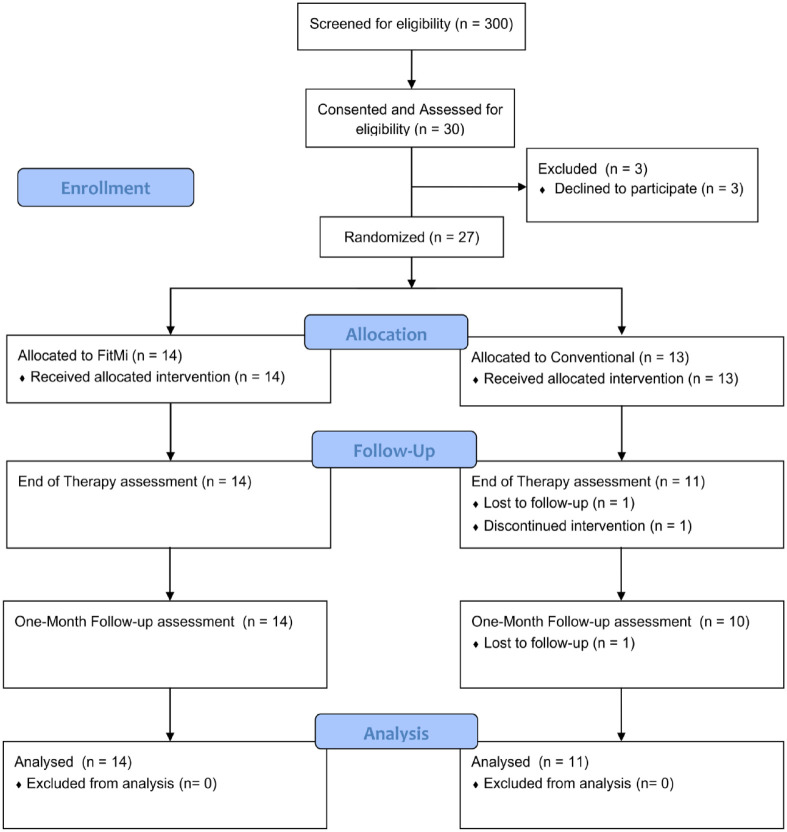
In this single-blind, randomized controlled trial, 27 participants in the subacute phase of stroke were assigned to the sensorized exercise (n = 14) or conventional therapy group (n = 13), though 2 participants in the conventional therapy group were lost to follow-up. Participants were instructed to perform self-guided movement training at home for at least 3 hours/week for 3 consecutive weeks. The sensorized exercise group used FitMi, a computer game with 2 puck-like sensors that encourages movement intensity and auto-progresses users through 40 exercises. The conventional group used a paper book of exercises. The primary outcome measure was the change in Upper Extremity Fugl-Meyer (UEFM) score from baseline to follow-up. Secondary measures included the Modified Ashworth Scale for spasticity (MAS) and the Visual Analog Pain (VAP) scale.
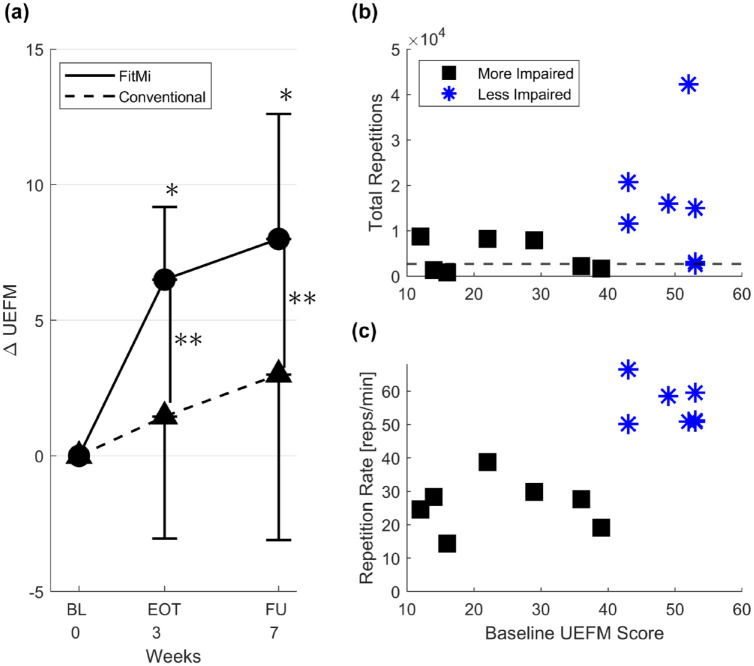
Participants who used FitMi improved by an average of 8.0 ± 4.6 points on the UEFM scale compared to 3.0 ± 6.1 points for the conventional participants, a significant difference (-test, = .029). FitMi participants exhibited no significant changes in UE MAS or VAP scores.
A sensor-based exercise system incorporating a suite of recommended design features significantly and safely reduced UE impairment compared to a paper-based, home exercise program.
ClinicalTrials.gov Identifier: NCT03503617.
上肢(UE)中风康复需要患者在家中进行锻炼,但患者从基于纸张的家庭锻炼计划中获益有限。
比较两种用于减少 UE 损伤的家庭锻炼计划的效果:基于纸张的方法和一种传感器运动系统,该系统结合了家庭康复技术的推荐设计功能。
在这项单盲、随机对照试验中,27 名处于中风亚急性期的参与者被分配到传感器运动组(n=14)或常规治疗组(n=13),但常规治疗组中有 2 名参与者失访。参与者被指示在家中进行自我引导的运动训练,每周至少 3 小时,连续 3 周。传感器运动组使用 FitMi,这是一款带有 2 个类似 puck 的传感器的电脑游戏,鼓励运动强度,并通过 40 个练习自动为用户提供进度。常规组使用一本练习册。主要结局测量指标是从基线到随访时的上肢 Fugl-Meyer(UEFM)评分变化。次要测量指标包括痉挛的改良 Ashworth 量表(MAS)和视觉模拟疼痛(VAP)量表。
使用 FitMi 的参与者 UEFM 量表的平均改善为 8.0±4.6 分,而常规参与者为 3.0±6.1 分,差异具有统计学意义(-检验, = .029)。FitMi 参与者的 UE MAS 或 VAP 评分没有显著变化。
与基于纸张的家庭锻炼计划相比,结合了一系列推荐设计功能的基于传感器的运动系统可显著且安全地减少 UE 损伤。
ClinicalTrials.gov 标识符:NCT03503617。