Institute of Clinical Blood Transfusion, Guangzhou Blood Center, Guangzhou, China.
School of Laboratory Medicine and Biotechnology, Southern Medical University, Guangzhou, China.
Blood. 2023 Apr 27;141(17):2141-2150. doi: 10.1182/blood.2022018152.
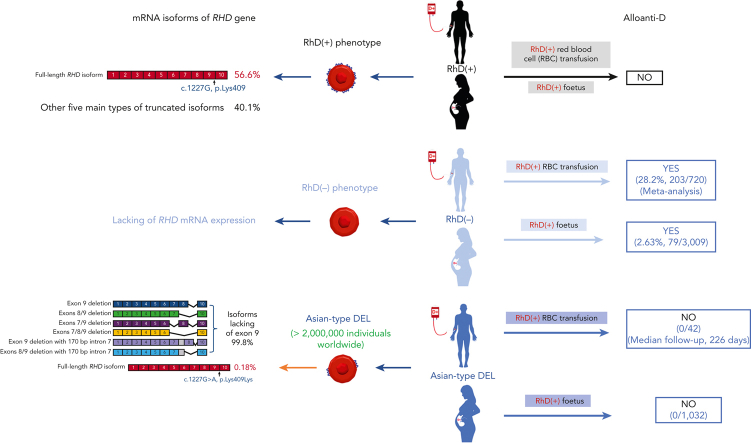
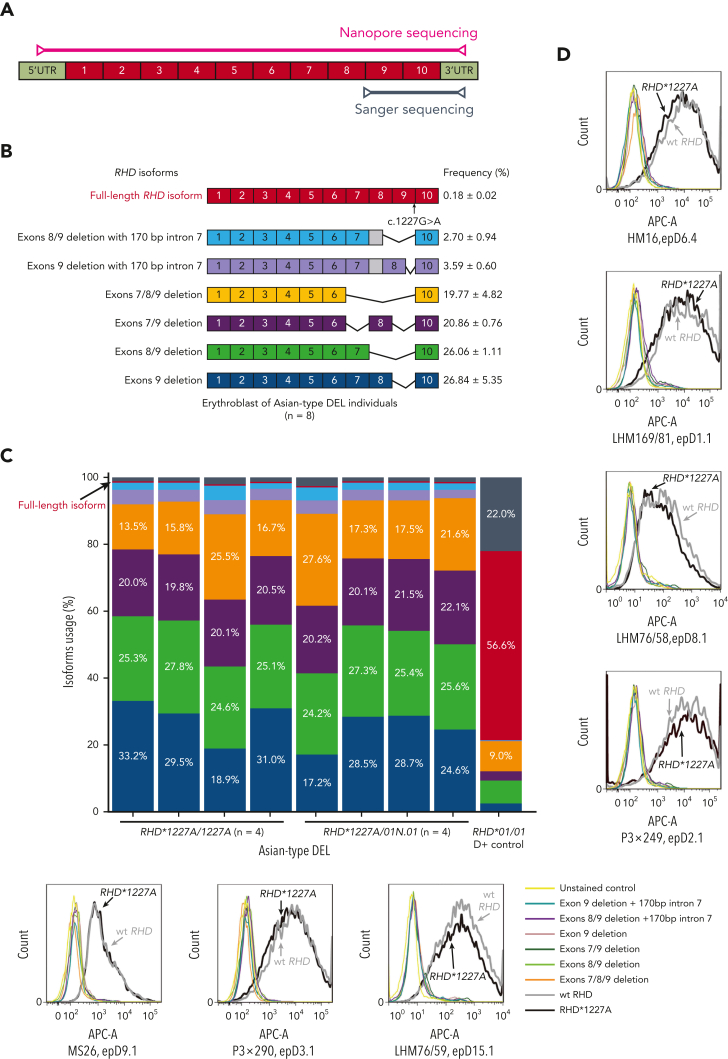
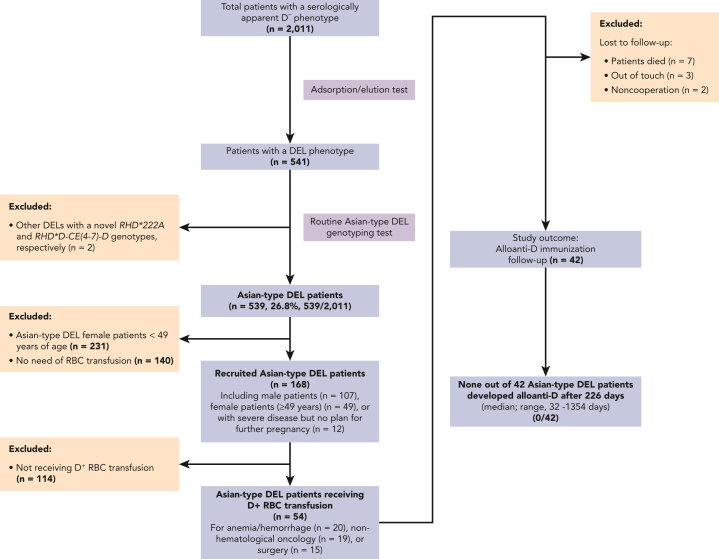
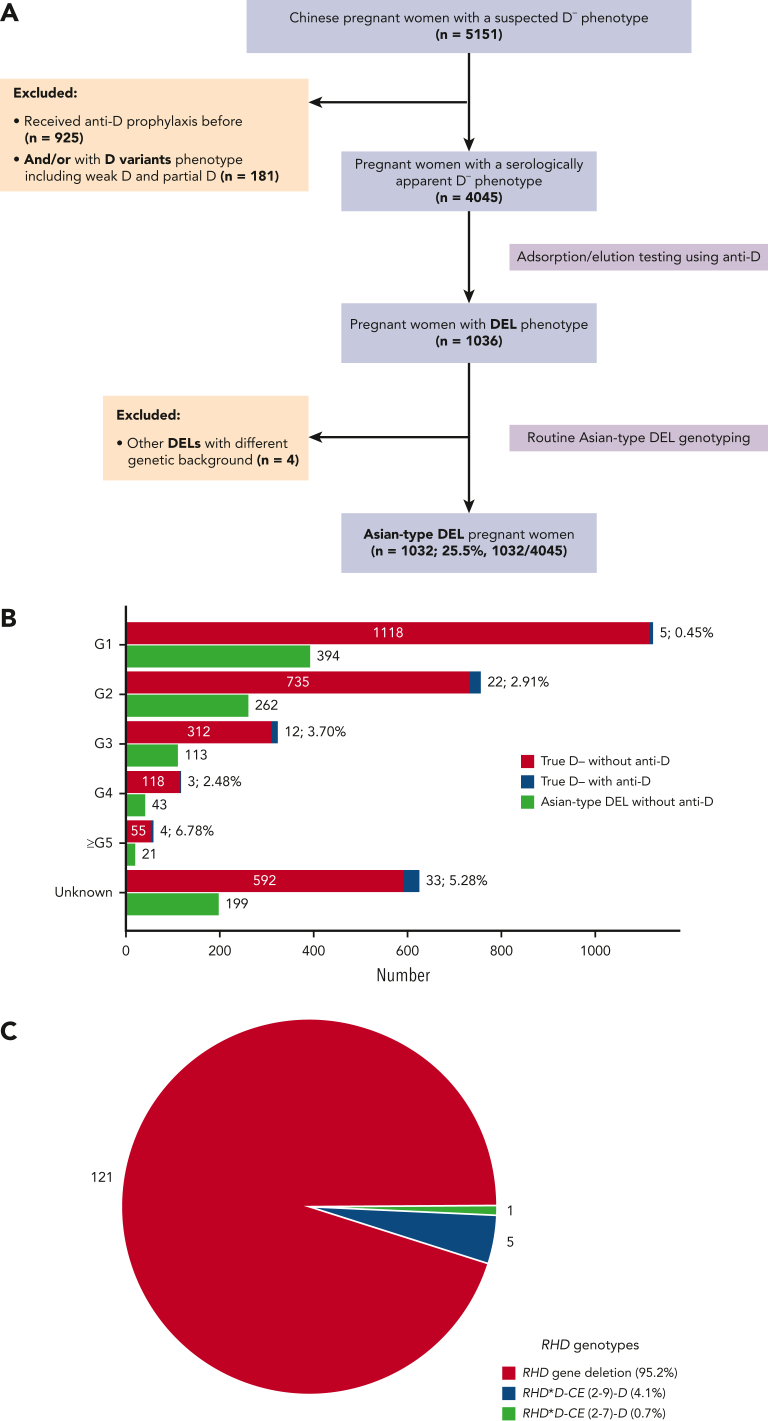
Red blood cells (RBCs) of Asian-type DEL phenotype express few RhD proteins and are typed as serologic RhD-negative (D-) phenotype in routine testing. RhD-positive (D+) RBC transfusion for patients with Asian-type DEL has been proposed but has not been generally adopted because of a lack of direct evidence regarding its safety and the underlying mechanism. We performed a single-arm multicenter clinical trial to document the outcome of D+ RBC transfusion in patients with Asian-type DEL; none of the recipients (0/42; 95% confidence interval, 0-8.40) developed alloanti-D after a median follow-up of 226 days. We conducted a large retrospective study to detect alloanti-D immunization in 4045 serologic D- pregnant women throughout China; alloanti-D was found only in individuals with true D- (2.63%, 79/3009), but not in those with Asian-type DEL (0/1032). We further retrospectively examined 127 serologic D- pregnant women who had developed alloanti-D and found none with Asian-type DEL (0/127). Finally, we analyzed RHD transcripts from Asian-type DEL erythroblasts and examined antigen epitopes expressed by various RHD transcripts in vitro, finding a low abundance of full-length RHD transcripts (0.18% of the total) expressing RhD antigens carrying the entire repertoire of epitopes, which could explain the immune tolerance against D+ RBCs. Our results provide multiple lines of evidence that individuals with Asian-type DEL cannot produce alloanti-D when exposed to D+ RBCs after transfusion or pregnancy. Therefore, we recommend considering D+ RBC transfusion and discontinuing anti-D prophylaxis in patients with Asian-type DEL, including pregnant women. This clinical trial is registered at www.clinicaltrials.gov as #NCT03727230.
红细胞(RBC)的亚洲型 DEL 表型表达少量 RhD 蛋白,在常规检测中被定型为血清学 RhD 阴性(D-)表型。对于亚洲型 DEL 患者,已经提出输注 RhD 阳性(D+)RBC,但由于缺乏安全性和潜在机制的直接证据,尚未普遍采用。我们进行了一项单臂多中心临床试验,以记录亚洲型 DEL 患者接受 D+ RBC 输血的结果;在中位随访 226 天后,没有 42 名接受者(0/42;95%置信区间,0-8.40)发生 alloanti-D。我们进行了一项大型回顾性研究,以检测中国 4045 名血清学 D-孕妇的 alloanti-D 免疫;仅在真正的 D-个体中发现 alloanti-D(2.63%,79/3009),而在亚洲型 DEL 个体中未发现(0/1032)。我们进一步回顾性检查了 127 名血清学 D-孕妇,发现她们均未发生 alloanti-D,且无亚洲型 DEL(0/127)。最后,我们分析了亚洲型 DEL 红细胞的 RHD 转录本,并在体外检查了各种 RHD 转录本表达的抗原表位,发现全长 RHD 转录本的丰度较低(占总转录本的 0.18%),表达携带整个表位库的 RhD 抗原,这可以解释对 D+ RBC 的免疫耐受。我们的研究结果提供了多条证据,表明输注或妊娠后接触 D+ RBC 时,亚洲型 DEL 个体不能产生 alloanti-D。因此,我们建议考虑对亚洲型 DEL 患者(包括孕妇)输注 D+ RBC,并停止抗-D 预防。这项临床试验在 www.clinicaltrials.gov 上注册为 #NCT03727230。