Ang Samuel P, Sidharthan Shawn, Lai Wilson, Hussain Nasir, Patel Kiran V, Gulati Amitabh, Henry Onyeaka, Kaye Alan D, Orhurhu Vwaire
Department of Anesthesiology, Perioperative and Pain Medicine, Brigham and Women's Hospital, Harvard Medical School, Boston, USA.
Department of Neurology, Northwell Health-Donald and Barbara Zucker School of Medicine at Hofstra, Hempstead, NY, USA.
Pain Ther. 2023 Apr;12(2):355-375. doi: 10.1007/s40122-022-00465-y. Epub 2023 Jan 13.
Pain is a global phenomenon encompassing many subtypes that include neuropathic, musculoskeletal, acute postoperative, cancer, and geriatric pain. Traditionally, opioids have been a mainstay pharmacological agent for managing many types of pain. However, opioids have been a subject of controversy with increased addiction, fatality rates, and cost burden on the US healthcare system. Cannabinoids have emerged as a potentially favorable alternative or adjunctive treatment for various types of acute and chronic pain. This narrative review seeks to describe the efficacy, risks, and benefits of cannabinoids as an adjunct or even potential replacement for opioids in the treatment of various subtypes of pain.
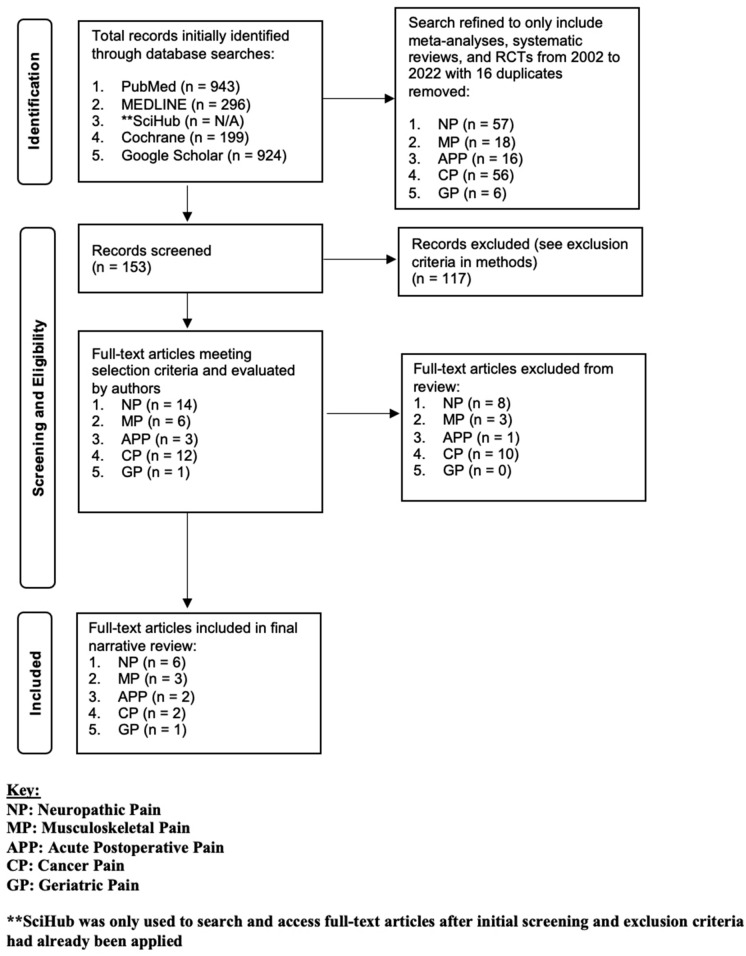
In June of 2022, we performed a comprehensive search across multiple databases for English-language studies related to the use of cannabinoids in the treatment of various types pain: neuropathic pain, musculoskeletal pain, acute postoperative pain, cancer pain, and geriatric pain. Data from meta-analyses, systematic reviews, and randomized control trials (RCTs) were prioritized for reporting. We sought to focus our reported analysis on more recent literature as well as include older relevant studies with particularly notable findings.
There is conflicting evidence for the use of cannabinoids in the management of pain. While cannabinoids have shown efficacy in treating specific chronic pain subtypes such as neuropathic pain, fibromyalgia pain, and geriatric pain, they do not show as clear benefit in acute postoperative and the majority of musculoskeletal pain syndromes. Data trends towards cannabinoids having a positive effect in treating cancer pain, but results are not as conclusive. To date, there is a paucity of data comparing cannabinoids directly to opioids for pain relief. Overall, the side effects of cannabinoids appear to be relatively mild. However, there is still potential for addiction, altered brain development, psychiatric comorbidities, and drug-drug interactions.
Cannabinoids may be effective in specific subtypes of pain, but current evidence and guidelines do not yet support its use as the first-line treatment for any type of acute or chronic pain. Rather, it may be considered a good adjunct or alternative for patients who have failed more typical or conservative measures. Additional studies are needed with standardized forms of cannabinoids, route of delivery, and dosing for greater-powered analysis. Providers must weigh the individualized patient risks, benefits, and concurrent medication list in order to determine whether cannabinoids are appropriate for a patient's pain treatment plan.
疼痛是一种全球性现象,包含多种亚型,包括神经性疼痛、肌肉骨骼疼痛、急性术后疼痛、癌症疼痛和老年疼痛。传统上,阿片类药物一直是治疗多种疼痛的主要药物。然而,阿片类药物一直存在争议,因为其成瘾性、死亡率增加以及给美国医疗保健系统带来的成本负担。大麻素已成为治疗各种急性和慢性疼痛的潜在有利替代或辅助治疗方法。本叙述性综述旨在描述大麻素作为阿片类药物在治疗各种疼痛亚型中的辅助药物甚至潜在替代品的疗效、风险和益处。
2022年6月,我们在多个数据库中进行了全面搜索,以查找与使用大麻素治疗各种类型疼痛相关的英文研究:神经性疼痛、肌肉骨骼疼痛、急性术后疼痛、癌症疼痛和老年疼痛。优先报告来自荟萃分析、系统评价和随机对照试验(RCT)的数据。我们试图将报告的分析重点放在最新文献上,并纳入具有特别显著发现的较旧相关研究。
关于使用大麻素治疗疼痛存在相互矛盾的证据。虽然大麻素在治疗特定慢性疼痛亚型(如神经性疼痛、纤维肌痛疼痛和老年疼痛)方面显示出疗效,但在急性术后疼痛和大多数肌肉骨骼疼痛综合征中并未显示出同样明显的益处。数据显示大麻素在治疗癌症疼痛方面有积极作用的趋势,但结果并不那么确凿。迄今为止,将大麻素与阿片类药物直接比较用于缓解疼痛的数据很少。总体而言,大麻素的副作用似乎相对较轻。然而,仍有成瘾、影响大脑发育、精神共病和药物相互作用的可能性。
大麻素可能对特定疼痛亚型有效,但目前的证据和指南尚不支持将其用作任何类型急性或慢性疼痛的一线治疗方法。相反,对于那些更典型或保守措施失败的患者,它可能被视为一种良好的辅助药物或替代品。需要进行更多关于标准化大麻素形式、给药途径和剂量的研究,以便进行更有力的分析。医疗服务提供者必须权衡个体患者的风险、益处和同时使用的药物清单,以确定大麻素是否适合患者的疼痛治疗计划。