Maccabitech Institute for Research & Innovation, Maccabi Healthcare Services, 4 Kaufmann St. Sharbat House, 8th Floor, 6801200, Tel Aviv, Israel.
Net Health Systems, Pittsburg, PA, USA.
Health Qual Life Outcomes. 2023 Jan 13;21(1):2. doi: 10.1186/s12955-023-02087-0.
Patient-reported outcome measures (PROMs) are recommended for assessing patient-centered outcomes in inflammatory bowel disease (IBD). The main aims were to assess the level of participation in an electronic PROM (ePROM) data collection system among patients with IBD, and evaluate reliability and validity of the resulting scores.
Patients included in the IBD registry of Maccabi Healthcare Services, a state-mandated healthcare provider for over 2.6 million people in Israel, were invited to complete the IBD-Control measure and a general health item, with follow-up ePROMs at 3 and 6 months including a global rating of change item. Descriptive statistics were used to compare patient characteristics by participation rate, and assess survey completion time. Initial scores were assessed for internal consistency reliability using Cronbach's alpha. Test-retest reliability was assessed using the intraclass correlation coefficient from paired scores of patients identified as unchanged between the initial and first follow-up. Construct validity was assessed by the ability of IBD-control scores to discriminate between patient sub-groups in expected ways. Empirical validity was assessed using ePROM score correlations with laboratory markers of disease activity. Score coverage was also assessed.
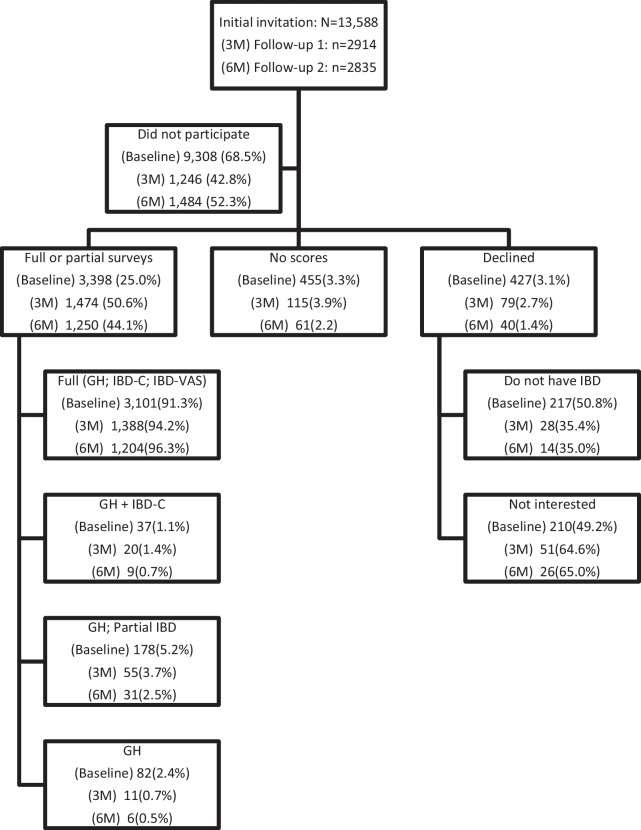
A total of 13,588 patients were invited to participate [Mean age = 49 years (SD = 17); females = 51%]. Participation rate was 31.5%. Participants compared to non-participants were slightly older, were more likely to be female, to have a history of biologic treatment, to have higher socio-economic status, and to be more experienced in the usage of the digital patient portal. Median survey completion time was approximately 1:30 min. Internal consistency and test-retest reliability were 0.86 and 0.98, respectively. Scores discriminated between patient sub-groups in clinically expected ways, with expected correlations to laboratory markers of disease activity. A notable ceiling effect was observed (> 15%) for IBD-Control scores.
Feasibility, reliability, and validity of the ePROM system was supported for measuring the level of perceived disease control in patients diagnosed with IBD in Israel. Additional research is needed to identify ways to increase patient participation, assess clinical implications of the identified measurement ceiling of the IBD-control, and evaluate the added value of the derived scores in support of clinical decision making.
患者报告的结局测量(PROMs)被推荐用于评估炎症性肠病(IBD)中的以患者为中心的结局。主要目的是评估 IBD 患者参与电子 PROM(ePROM)数据收集系统的程度,并评估由此产生的评分的可靠性和有效性。
邀请 Maccabi 医疗保健服务的 IBD 登记处的患者完成 IBD-Control 测量和一般健康项目,并在 3 个月和 6 个月时进行后续 ePROM,包括一项变化整体评分项目。使用描述性统计数据比较参与率的患者特征,并评估调查完成时间。使用 Cronbach's alpha 评估初始评分的内部一致性可靠性。使用在初始和第一次随访之间确定无变化的患者配对评分的组内相关系数评估测试-重测可靠性。通过 IBD-Control 评分以预期方式区分患者亚组的能力评估结构有效性。使用 ePROM 评分与疾病活动的实验室标志物的相关性评估实证有效性。还评估了评分的覆盖范围。
共邀请了 13588 名患者参加[平均年龄为 49 岁(标准差为 17 岁);女性占 51%]。参与率为 31.5%。与非参与者相比,参与者年龄稍大,女性更多,有生物治疗史,社会经济地位更高,对数字患者门户的使用经验更丰富。调查完成时间中位数约为 1:30 分钟。内部一致性和测试-重测可靠性分别为 0.86 和 0.98。评分以临床预期的方式区分患者亚组,与疾病活动的实验室标志物有预期的相关性。观察到 IBD-Control 评分存在明显的天花板效应(>15%)。
支持在以色列诊断为 IBD 的患者中使用电子 PROM 系统测量感知疾病控制水平的可行性、可靠性和有效性。需要进一步研究以确定增加患者参与度的方法,评估 IBD-Control 确定的测量上限的临床意义,并评估支持临床决策的衍生评分的附加价值。