Wang Jia-Sha, Bai Wei, Wang Yue, Liang Yu-Hong
Department of Cariology and Endodontology, Peking University School and Hospital of Stomatology & National Clinical Research Center for Oral Diseases & National Engineering Research of Oral Biomaterials and Digital Medical Devices & Beijing Key Laboratory of Digital Stomatology, Beijing, China.
Dental Center, China-Japan Friendship Hospital, Beijing, China.
J Dent Sci. 2023 Jan;18(1):129-134. doi: 10.1016/j.jds.2022.06.025. Epub 2022 Jul 12.
BACKGROUND/PURPOSE: Different moisture condition may affect the adhesion between obturation materials and root canal walls, thus further affect the quality of root canal obturation. The aim of this study was to evaluate the influence of dentin moisture conditions after different root canal drying protocols on the push-out strength of bioceramic root canal sealer.
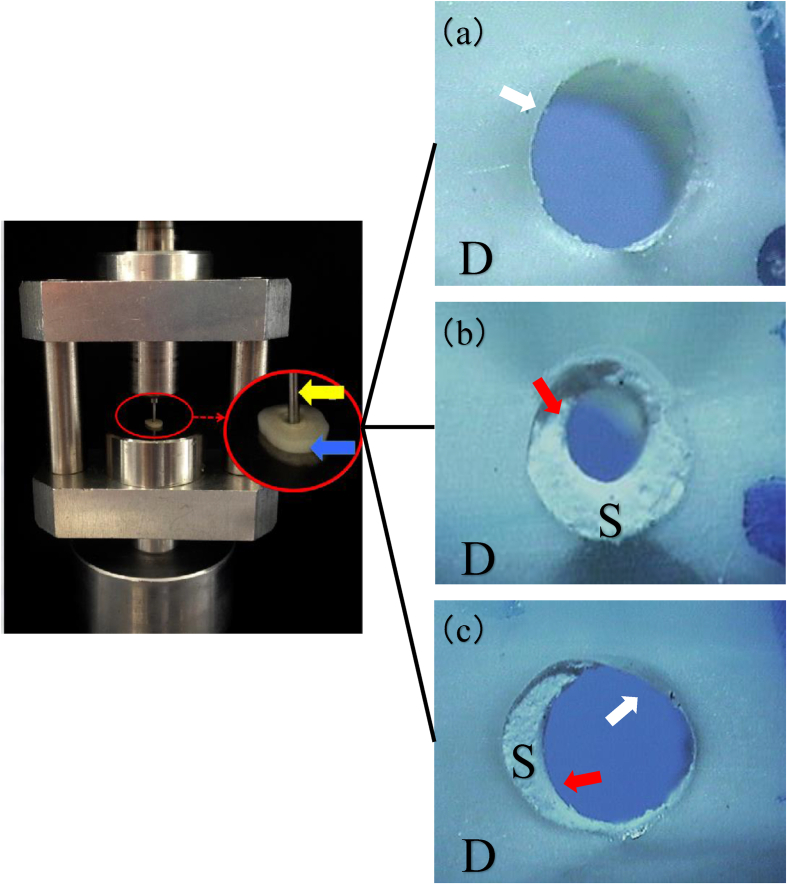
Twenty root canals from extracted human decoronated premolars were prepared in vitro to #30/0.09 taper and assigned to 4 moisture condition groups after using different root canal drying protocols: normal moisture (paper point) group: the canals were blot dried with paper points until the last one appeared dry. Ethanol dry group: the canals were dried with paper points followed by dehydration with 95% ethanol. Isopropanol dry group: the canals were dried with paper points followed by dehydration with 70% isopropanol. Complete dry group: the canals were dried in an air-blowing thermostatic oven for at least 6 h until there was no change in weight at an interval of 1 h. After drying, the canals were obturated with bioceramic sealer iRoot SP. Then, each root was sectioned into eight slices with 1-mm-thick using a diamond saw (40 slices each group). The push-out strength was tested for each slice between the sealer and dentin wall using a universal testing machine at a crosshead speed of 0.5 mm/min, and failure modes were recorded. Two-way analysis of variance and Tukey test were used to analyze the push-out strength. Logarithmic linear regression analysis was used to compare the failure modes.
Push-out strength was statistically different in different moisture groups ( < 0.05). After drying using paper point, iRoot SP specimens showed the highest push-out strength (2.04 ± 0.03 MPa), followed by 95% ethanol, 70% isopropanol. The lowest push-out strength (0.68 ± 0.04 MPa) was observed under complete dry. For the failure modes, the majority were cohesive failures in the coronal and middle thirds of the root; while in the apical third, mixed failure was common.
Different drying protocols influenced the push-out strength between bioceramic sealer and canal wall.
背景/目的:不同的湿度条件可能会影响封闭材料与根管壁之间的黏附力,进而影响根管充填的质量。本研究的目的是评估不同根管干燥方案后牙本质湿度条件对生物陶瓷根管封闭剂推出强度的影响。
从拔除的人离体前磨牙制备20个根管,预备至#30/0.09锥度,在使用不同根管干燥方案后分为4个湿度条件组:正常湿度(纸尖)组:用纸条吸干根管,直到最后一张纸条看起来干燥。乙醇干燥组:先用纸条吸干根管,再用95%乙醇脱水。异丙醇干燥组:先用纸条吸干根管,再用70%异丙醇脱水。完全干燥组:将根管置于鼓风恒温箱中干燥至少6小时,每隔1小时称重,直至重量无变化。干燥后,用生物陶瓷封闭剂iRoot SP充填根管。然后,用金刚石锯将每个牙根切成8片,每片厚1毫米(每组40片)。使用万能试验机以0.5毫米/分钟的十字头速度测试封闭剂与牙本质壁之间每片的推出强度,并记录失败模式。采用双向方差分析和Tukey检验分析推出强度。采用对数线性回归分析比较失败模式。
不同湿度组的推出强度有统计学差异(<0.05)。用纸条干燥后,iRoot SP标本的推出强度最高(2.04±0.03兆帕),其次是95%乙醇、70%异丙醇。完全干燥条件下的推出强度最低(0.68±0.04兆帕)。对于失败模式,大多数是牙根冠部和中部三分之一的内聚性失败;而在根尖三分之一处,混合性失败很常见。
不同的干燥方案影响生物陶瓷封闭剂与根管壁之间的推出强度。