Yang Song, Lu Shuyan, Ren Limei, Bian Shuai, Zhao Daqing, Liu Meichen, Wang Jiawen
Jilin Ginseng Academy, Changchun University of Chinese Medicine, Changchun, Jilin, China.
J Ginseng Res. 2023 Jan;47(1):133-143. doi: 10.1016/j.jgr.2022.07.005. Epub 2022 Aug 17.
Past studies suggested that ginseng extracts and ginseng-derived molecules exerted significant regulatory effects on skin. However, no reports have described the effects of ginseng-derived nanoparticles (GDNPs) on skin cell proliferation and wound healing. In this study, we investigated whether GDNPs regulate the proliferation of skin cells and promote wound healing in a mouse model.
GDNPs were separated and purified via differential centrifugation and sucrose/D2O gradient ultracentrifugation. GDNP uptake, cell proliferation and cell cycle progression were measured by confocal microscopy, CCK-8 assay and flow cytometry, respectively. Cell migration and angiogenic effects were assessed by the wound scratch assay and tube formation assay, respectively. ELISA was used to detect extracellular matrix secretion. The relevant signaling pathway was confirmed by western blotting. The effects of GDNPs on skin wound healing were assessed by wound observation, HE staining, and western blotting.
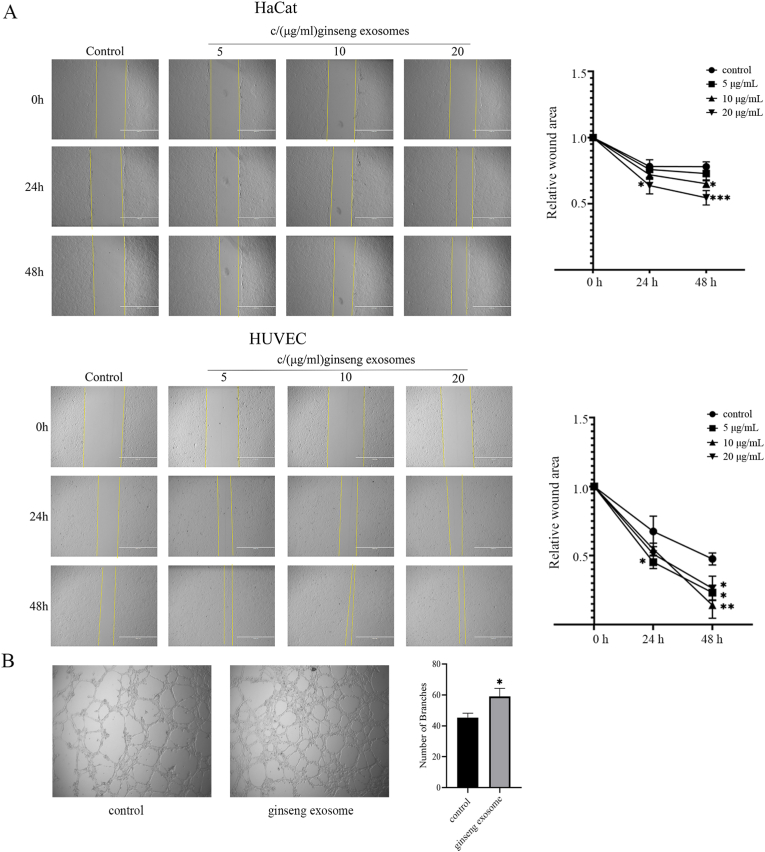
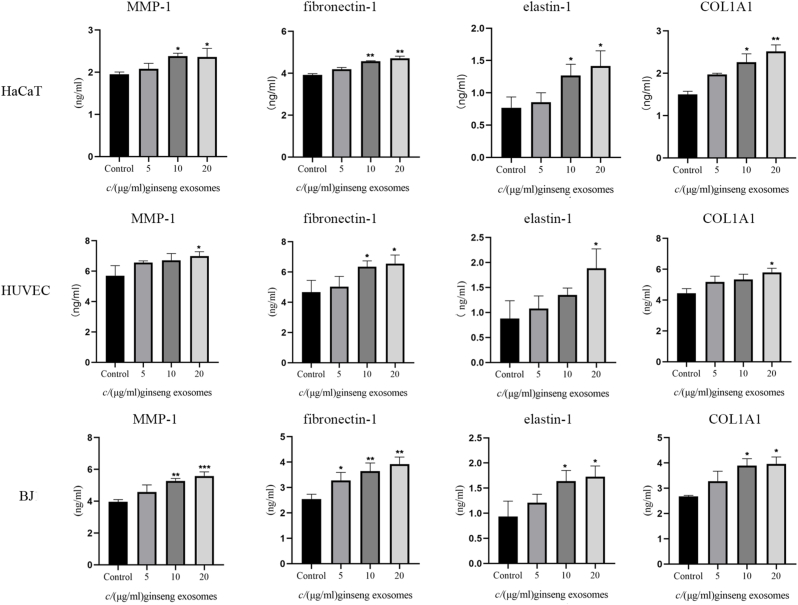
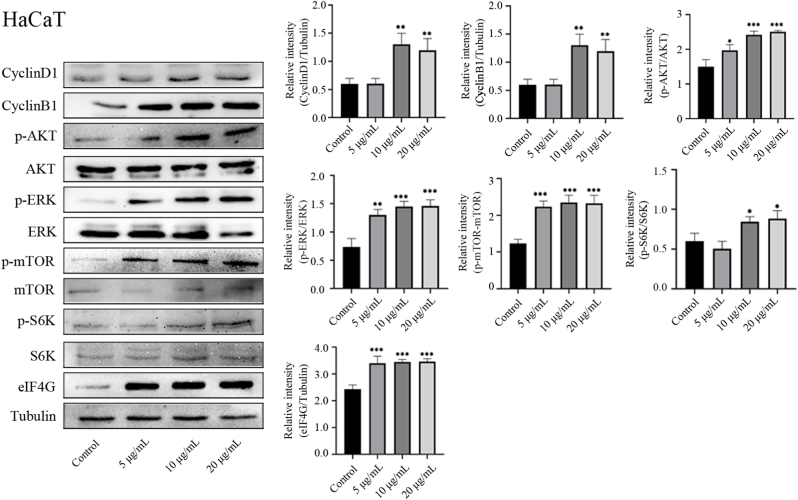
GDNPs possessed the essential features of exosomes, and they were accumulated by skin cells. Treatment with GDNPs notably enhanced the proliferation of HaCaT, BJ and HUVECs. GDNPs also enhanced the migration in HaCaT cells and HUVECs and angiogenesis in HUVECs. GDNPs increased the secretion of MMP-1, fibronectin-1, elastin-1, and COL1A1 in all three cell lines. GDNPs regulated cell proliferation through the ERK and AKT/ mTOR pathways. Furthermore, GDNPs facilitated skin wound healing and decreased inflammation in a mouse skin wound model.
GDNPs can promote skin wound healing through the ERK and AKT/mTOR pathways. GDNPs thus represent an alternative treatment for chronic skin wounds.
以往研究表明,人参提取物和人参衍生分子对皮肤具有显著的调节作用。然而,尚无报道描述人参衍生纳米颗粒(GDNPs)对皮肤细胞增殖和伤口愈合的影响。在本研究中,我们调查了GDNPs是否能调节小鼠模型中皮肤细胞的增殖并促进伤口愈合。
通过差速离心和蔗糖/D2O梯度超速离心分离和纯化GDNPs。分别通过共聚焦显微镜、CCK-8法和流式细胞术测量GDNP摄取、细胞增殖和细胞周期进程。分别通过伤口划痕试验和管形成试验评估细胞迁移和血管生成作用。采用ELISA检测细胞外基质分泌。通过蛋白质印迹法确认相关信号通路。通过伤口观察、HE染色和蛋白质印迹法评估GDNPs对皮肤伤口愈合的影响。
GDNPs具有外泌体的基本特征,并被皮肤细胞积累。用GDNPs处理显著增强了HaCaT、BJ和HUVECs的增殖。GDNPs还增强了HaCaT细胞和HUVECs的迁移以及HUVECs的血管生成。GDNPs增加了所有三种细胞系中MMP-1、纤连蛋白-1、弹性蛋白-1和COL1A1的分泌。GDNPs通过ERK和AKT/mTOR途径调节细胞增殖。此外,在小鼠皮肤伤口模型中,GDNPs促进了皮肤伤口愈合并减轻了炎症。
GDNPs可通过ERK和AKT/mTOR途径促进皮肤伤口愈合。因此,GDNPs代表了一种治疗慢性皮肤伤口的替代方法。