Laboratory for Quantum Semiconductors and Photon-based BioNanotechnology, Department of Electrical and Computer Engineering, Interdisciplinary Institute for Technological Innovation (3IT), CNRS IRL-3463, Université de Sherbrooke, 3000, boul. de l'Université, Sherbrooke, QC, J1K 0A5, Canada.
Biotechnology Laboratory, Environmental Health Science and Research Bureau, Healthy Environments and Consumer Safety Branch, Health Canada, 251 Sir Frederick Banting Driveway, Ottawa, ON, K1A 0K9, Canada.
Sci Rep. 2023 Jan 16;13(1):831. doi: 10.1038/s41598-023-27900-0.
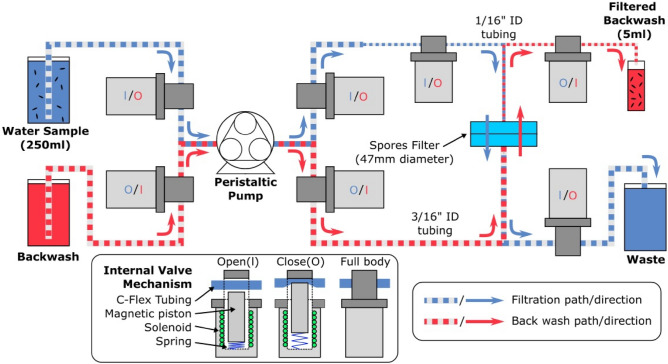
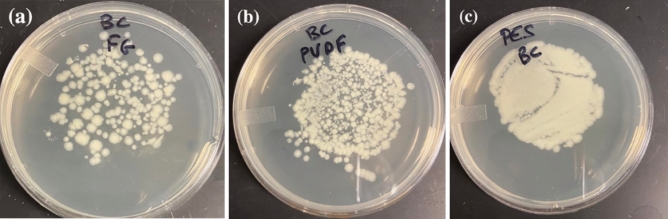
Monitoring the presence of pathogenic Bacillus spores is important for industrial applications, as well as necessary for ensuring human health. Bacillus thuringiensis is used as a biopesticide against several insect pests. Bacillus cereus spores are a significant cause of food poisoning, and Bacillus anthracis is a recognized biosecurity threat. Laboratory-based methods, such as polymerase chain reaction, enzyme-linked immunosorbent assay, or matrix-assisted laser desorption ionization spectroscopy provide sensitive detection of bacteria and spores, but the application of those methods for quasi-continuous environmental monitoring presents a significant challenge requiring frequent human intervention. To address this challenge, we developed a workstation for quasi-autonomous monitoring of water reservoirs for the presence of bacteria and spores, and designed and validated the functionality of a microprocessor-controlled module capable of repetitive collection and pre-concentration of spores in liquid samples tested with fiberglass (FG), polyether sulfone and polyvinylidene fluoride filters. The best results were obtained with FG filters delivering a 20× concentration of B. thuringiensis and B. cereus spores from saline suspensions. The successful 20× pre-concentration of Bacillus spores demonstrated with FG filters could be repeated up to 3 times when bleach decontamination is applied between filtrations. Taken together, our results demonstrate an attractive instrument suitable for semi-automated, quasi-continuous sampling and pre-processing of water samples for biosensing of bacterial spores originating from a complex environment.
监测致病芽孢杆菌的存在对于工业应用很重要,对于确保人类健康也是必要的。苏云金芽孢杆菌被用作防治多种昆虫害虫的生物农药。蜡样芽孢杆菌孢子是食物中毒的一个重要原因,炭疽芽孢杆菌是公认的生物安全威胁。基于实验室的方法,如聚合酶链反应、酶联免疫吸附测定或基质辅助激光解吸电离光谱,提供了对细菌和孢子的敏感检测,但这些方法在准连续环境监测中的应用提出了一个重大挑战,需要频繁的人工干预。为了解决这个挑战,我们开发了一个工作站,用于准自主监测水库中细菌和孢子的存在,并设计和验证了一个微处理器控制模块的功能,该模块能够重复收集和预浓缩液体样品中的孢子,该液体样品用玻璃纤维(FG)、聚醚砜和聚偏氟乙烯过滤器进行测试。从盐水中获得的苏云金芽孢杆菌和蜡样芽孢杆菌孢子,FG 过滤器可获得最佳的 20 倍浓缩效果。FG 过滤器成功地对芽孢杆菌孢子进行了 20 倍浓缩,在每次过滤之间进行漂白消毒,可以重复进行 3 次。总之,我们的研究结果展示了一种有吸引力的仪器,适合用于半自动化、准连续采样和预处理水样,用于生物传感来自复杂环境的细菌孢子。