The Department of Public Health, College of Health, Community, and Policy, The University of Texas at San Antonio, San Antonio, TX, USA.
The Department of Demography, College of Health, Community, and Policy, The University of Texas at San Antonio, San Antonio, TX, USA.
Am J Health Promot. 2023 Jul;37(6):766-777. doi: 10.1177/08901171231152140. Epub 2023 Jan 17.
To examine the associations between gender role discrepancy (non-conformity to socially prescribed masculine gender role norms) and discrepancy stress (distress arising from this discrepancy) on COVID-19 prevention behaviors among men, and the potential moderating effects of race/ethnicity, sexual orientation, and income on these relationships.
A national online survey was conducted between May and June 2021.
The United States.
749 adult men residing in the United States.
A scale measured gender role discrepancy and discrepancy stress. COVID-19 prevention outcomes were constructed and included self-reported vaccination status/intentions, social distancing, mask-wearing, and hand-sanitizing.
Multivariate generalized linear models were performed in SPSS.
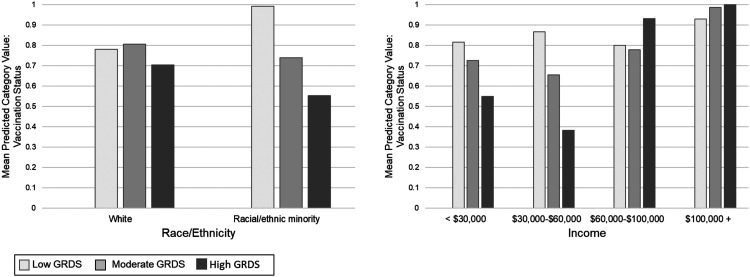
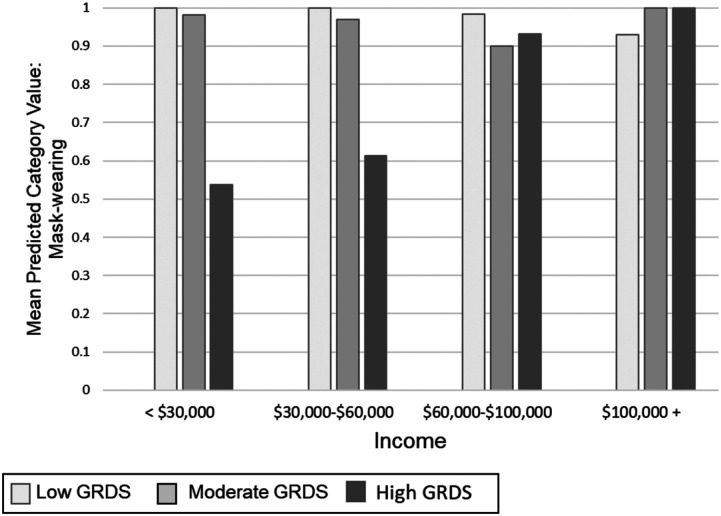
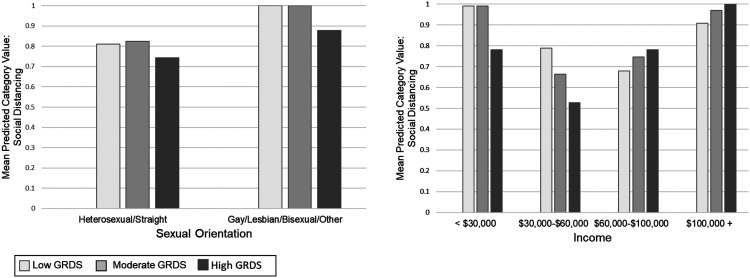
Gender role discrepancy associated with greater odds of vaccination (AOR = 1.35, 95% CI = 1.02-1.78, = .04), while discrepancy stress associated with lower odds of vaccination (AOR = .48, 95% CI = .35-.68, < 0. 001) and mask-wearing (AOR = .54, 95% CI = .37-.79, = .001) for men overall. Discrepancy stress's negative effect on specific COVID-19 prevention behaviors was only apparent or was amplified for men in lower income brackets (vaccination, social distancing, mask-wearing), racial/ethnic minority men (vaccination), and sexual minority men (social distancing).
This study demonstrates that gender role discrepancy stress negatively affects men's engagement in COVID-19 prevention, particularly for men in marginalized populations.
探讨男性性别角色差异(不符合社会规定的男性性别角色规范)和差异压力(这种差异引起的痛苦)与 COVID-19 预防行为之间的关系,并检验种族/民族、性取向和收入对这些关系的潜在调节作用。
2021 年 5 月至 6 月期间进行了一项全国性在线调查。
美国。
749 名居住在美国的成年男性。
使用量表测量性别角色差异和差异压力。COVID-19 预防结果包括自我报告的疫苗接种状况/意向、社交距离、戴口罩和手部消毒。
在 SPSS 中进行了多变量广义线性模型分析。
性别角色差异与更高的疫苗接种几率相关(AOR = 1.35,95%CI = 1.02-1.78, =.04),而差异压力与更低的疫苗接种几率相关(AOR =.48,95%CI =.35-.68, < 0.001)和戴口罩(AOR =.54,95%CI =.37-.79, =.001)。对于总体男性而言,差异压力对特定 COVID-19 预防行为的负面影响仅在收入较低的男性(疫苗接种、社交距离、戴口罩)、种族/民族少数男性(疫苗接种)和性少数男性(社交距离)中明显或放大。
本研究表明,性别角色差异压力会对男性参与 COVID-19 预防产生负面影响,尤其是对处于边缘地位的男性群体。