Ludmer Centre for Neuroinformatics and Mental Health, Douglas Hospital Research Center, Montreal, QC, Canada.
Department of Psychiatry, McGill University, Montreal, QC, Canada.
Pediatr Res. 2023 Aug;94(2):564-574. doi: 10.1038/s41390-022-02415-y. Epub 2023 Jan 17.
Although investigations have begun to differentiate biological and neurobiological responses to a variety of adversities, studies considering both endocrine and immune function in the same datasets are limited.
Associations between proximal (family functioning, caregiver depression, and anxiety) and distal (SES-D; socioeconomic disadvantage) early-life adversities with salivary inflammatory biomarkers (IL-1β, IL-6, IL-8, and TNF-α) and hair HPA markers (cortisol, cortisone, and dehydroepiandrosterone) were examined in two samples of young U.S. children (N = 142; N = 145).
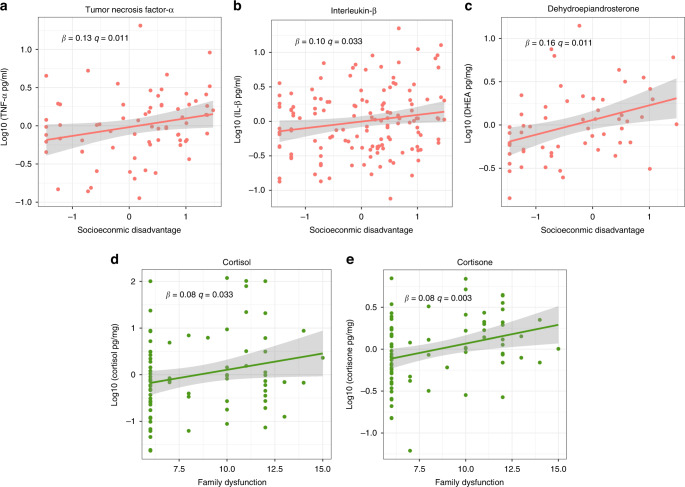
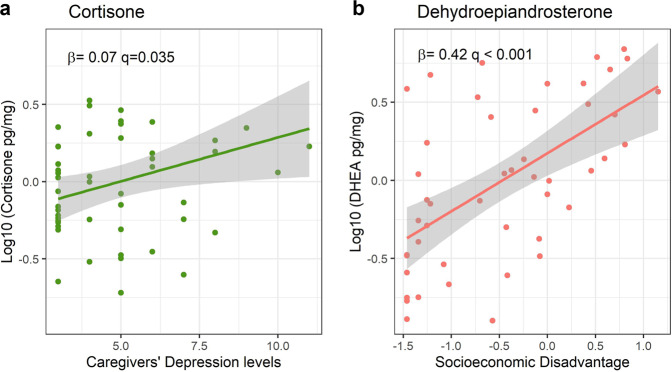
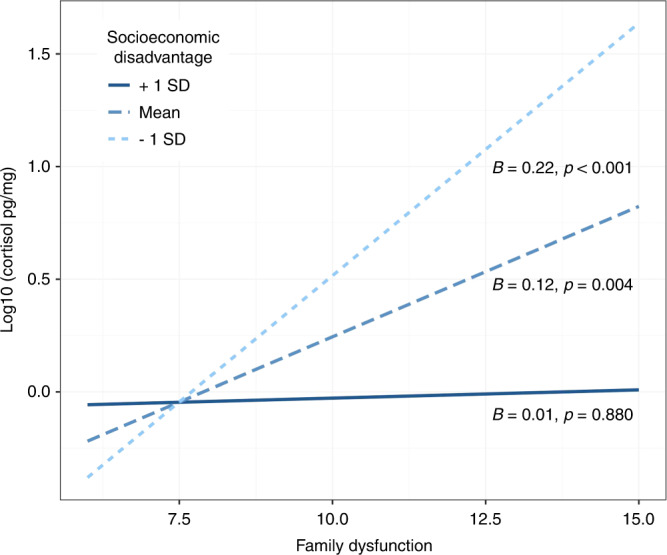
Children exposed to higher SES-D had higher levels of TNF-α (B = 0.13, p = 0.011), IL-1β (B = 0.10, p = 0.033), and DHEA (B = 0.16, p = 0.011). Higher family dysfunction was associated with higher cortisol (B = 0.08, p = 0.033) and cortisone (B = 0.05, p = 0.003). An interaction between SES-D and family dysfunction was observed for cortisol levels (p = 0.020) whereby children exposed to lower/average levels of SES-D exhibited a positive association between family dysfunction and cortisol levels, whereas children exposed to high levels of SES-D did not. These findings were partially replicated in the second sample.
Our results indicate that these biological response systems may react differently to different forms of early-life adversity.
Different forms of early-life adversity have varied stress signatures, and investigations of early-life adversities with inflammation and HPA markers are lacking. Children with higher socioeconomic disadvantage had higher TNF-α, IL-1β, and DHEA. Higher family dysfunction was associated with higher hair cortisol and cortisone levels, and the association between family dysfunction and cortisol was moderated by socioeconomic disadvantage. Biological response systems (immune and endocrine) were differentially associated with distinct forms of early-life adversities.
尽管已经开始研究各种逆境对生物和神经生物学的反应,但在同一数据集中同时考虑内分泌和免疫功能的研究仍然有限。
在两个美国儿童样本中(n=142;n=145),研究了近端(家庭功能、照顾者抑郁和焦虑)和远端(SES-D;社会经济劣势)早期逆境与唾液炎症生物标志物(IL-1β、IL-6、IL-8 和 TNF-α)和头发 HPA 标志物(皮质醇、皮质酮和脱氢表雄酮)之间的关联。
SES-D 暴露水平较高的儿童 TNF-α(B=0.13,p=0.011)、IL-1β(B=0.10,p=0.033)和 DHEA(B=0.16,p=0.011)水平较高。家庭功能障碍程度较高与皮质醇(B=0.08,p=0.033)和皮质酮(B=0.05,p=0.003)水平较高有关。SES-D 和家庭功能障碍之间观察到皮质醇水平的交互作用(p=0.020),即暴露于低/平均 SES-D 的儿童中,家庭功能障碍与皮质醇水平呈正相关,而暴露于高 SES-D 的儿童则没有。这些发现部分在第二个样本中得到了复制。
我们的结果表明,这些生物反应系统可能对不同形式的早期生活逆境有不同的反应。
不同形式的早期生活逆境具有不同的应激特征,而炎症和 HPA 标志物的早期生活逆境研究仍缺乏。社会经济劣势较高的儿童 TNF-α、IL-1β 和 DHEA 水平较高。家庭功能障碍程度较高与头发皮质醇和皮质酮水平较高有关,家庭功能障碍与皮质醇之间的关系受到社会经济劣势的调节。生物反应系统(免疫和内分泌)与不同形式的早期生活逆境有不同的关联。