Department of Orthopaedic Surgery, Chungbuk National University Hospital, Chungbuk National University College of Medicine, Cheongju, Republic of Korea.
Department of Orthopaedic Surgery, Hyundae General Hospital, Chung-Ang University College of Medicine, Namyangju-Si, Kyunggi-Do, Republic of Korea.
J Orthop Surg Res. 2023 Jan 17;18(1):49. doi: 10.1186/s13018-023-03525-x.
The quality of reduction is an important factor affecting clinical outcomes for displaced femoral neck fractures (FNFs). However, concerns remain about the invasiveness of open reduction and internal fixation (ORIF) as compared to that of closed reduction and internal fixation (CRIF), and the choice between ORIF and CRIF as an optimal treatment strategy for displaced pediatric FNF remains controversial.
MEDLINE, Embase, and the Cochrane Library were systematically searched for studies published up to December 22, 2022, that compared ORIF and CRIF techniques for treating FNF in children. Pooled analysis identified differences in surgical outcomes between ORIF and CRIF, especially regarding postoperative complications, such as osteonecrosis of the femoral head (ONFH), nonunion, coxa vara deformity, leg-length discrepancy LLD, and premature physeal closure (PPC).
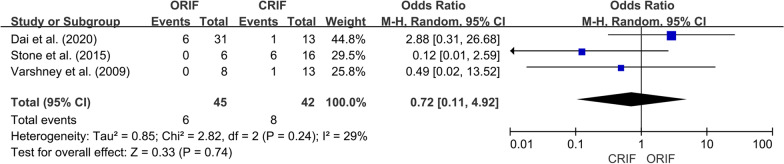
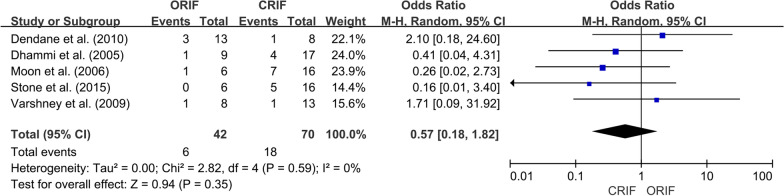
We included 15 studies with 635 pediatric FNF cases in our review. Of these, 324 and 311 were treated with ORIF and CRIF, respectively. The pooled analysis revealed that no significant differences existed between each reduction technique for ONFH (odds ratio [OR] = 0.89; 95% confidence interval [CI] 0.51-1.56; P = 0.69), nonunion (OR = 0.51; 95% CI 0.18-1.47; P = 0.21), coxa vara deformity (OR = 0.58; 95% CI 0.20-1.72; P = 0.33), LLD (OR = 0.57; 95% CI 0.18-1.82; P = 0.35), and PPC (OR = 0.72; 95% CI 0.11-4.92; P = 0.74).
Despite concerns about the invasiveness of ORIF, no differences in complications exist between ORIF and CRIF after FNF in children. Therefore, we believe that ORIF should be performed in FNF when the fracture is irreducible by closed manner.
复位质量是影响移位股骨颈骨折(FNF)临床结果的一个重要因素。然而,与闭合复位内固定(CRIF)相比,开放式复位内固定(ORIF)的侵入性仍然存在争议,ORIF 和 CRIF 作为治疗儿童移位 FNF 的最佳治疗策略之间的选择仍存在争议。
系统检索了截至 2022 年 12 月 22 日发表的比较儿童 FNF 中 ORIF 和 CRIF 技术的 MEDLINE、Embase 和 Cochrane 图书馆的研究。汇总分析确定了 ORIF 和 CRIF 之间手术结果的差异,特别是在术后并发症方面,如股骨头坏死(ONFH)、骨不连、髋内翻畸形、下肢长度差异(LLD)和骺板过早闭合(PPC)。
我们的综述纳入了 15 项研究,共纳入 635 例儿童 FNF 病例。其中,324 例和 311 例分别接受 ORIF 和 CRIF 治疗。汇总分析显示,两种复位技术治疗 ONFH(比值比 [OR] = 0.89;95%置信区间 [CI] 0.51-1.56;P = 0.69)、骨不连(OR = 0.51;95%CI 0.18-1.47;P = 0.21)、髋内翻畸形(OR = 0.58;95%CI 0.20-1.72;P = 0.33)、LLD(OR = 0.57;95%CI 0.18-1.82;P = 0.35)和 PPC(OR = 0.72;95%CI 0.11-4.92;P = 0.74)之间无显著差异。
尽管 ORIF 的侵入性令人担忧,但在儿童 FNF 后,ORIF 和 CRIF 之间的并发症无差异。因此,我们认为当骨折无法通过闭合方式复位时,应在 FNF 中进行 ORIF。