Laboratorio de Análisis Clínicos, Facultad de Veterinaria, Universidad de la República, Montevideo, Uruguay.
Laboratorio de Vectores y Enfermedades Transmitidas, Centro Universitario Litoral Norte, Universidad de la República, Salto, Uruguay.
Open Vet J. 2022 Nov-Dec;12(6):868-876. doi: 10.5455/OVJ.2022.v12.i6.13. Epub 2022 Nov 19.
Chronic lymphocytic leukemia (CLL) is the most common type of leukemia in dogs. It is characterized by the proliferation of neoplastic lymphocytes in the bone marrow, which are morphologically normal (mature), but non-functional. CLL in canines commonly originates in cytotoxic T lymphocytes (TCD8), and although there is controversy regarding the prognostic value of the immunophenotype, this cell lineage may be associated with a good prognosis.
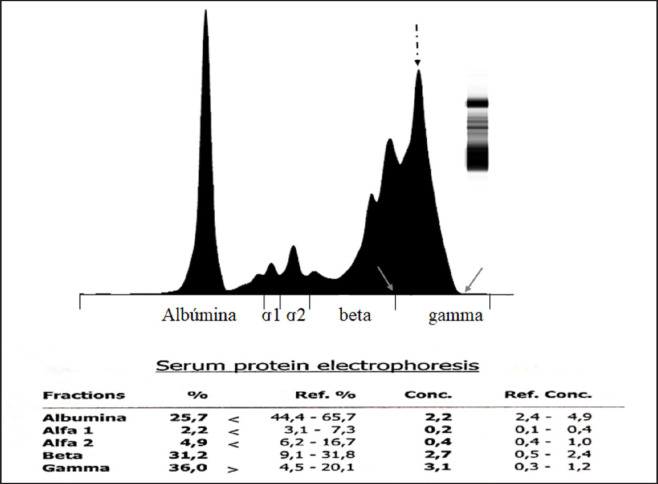
A 10-year-old, entire female, mixed-breed dog was brought to the University Hospital of the Veterinary Faculty () for consultation because a routine pre-surgical check-up revealed lymphocytic leukocytosis, normocytic anemia, and hyperglobulinemia due to an oligoclonal gammopathy. The ultrasound revealed splenomegaly. PCR performed on blood was negative for . Blood and bone marrow flow cytometry was performed to complement the diagnosis and carry out the immunophenotype, which showed CLL of CD8 T-cell lineage. The clinical suspicion of CLL was confirmed by a myelogram. Chemotherapy treatment based on alkylating agents and glucocorticoids was established. So far, the patient has an overall survival of 13 months with a good response to treatment.
The combination of the immunophenotyping test, the myelogram, and the hematological and biochemical profile confirmed the presence of T-CLL in our patient. Flow cytometry, increasingly used in veterinary medicine, allowed us to confirm the diagnosis of CLL originating in cytotoxic T lymphocytes in our patient, through the presence of positive staining of primary antibodies specific for the canine species CD45, CD3, CD5, and CD8 and the absence of staining for CD4, CD21, and CD34.
慢性淋巴细胞白血病(CLL)是犬类最常见的白血病类型。其特征是骨髓中肿瘤性淋巴细胞的增殖,这些淋巴细胞形态正常(成熟),但无功能。犬类的 CLL 通常起源于细胞毒性 T 淋巴细胞(TCD8),尽管免疫表型的预后价值存在争议,但这种细胞谱系可能与良好的预后相关。
一只 10 岁、整体、混种雌性犬因常规术前检查发现淋巴细胞白细胞增多、正细胞正色素性贫血和寡克隆丙种球蛋白血症引起的高球蛋白血症而被带到兽医大学附属医院就诊。超声检查显示脾肿大。血液 PCR 检测为阴性。进行了血液和骨髓流式细胞术以补充诊断并进行免疫表型检查,结果显示为 CD8 T 细胞谱系的 CLL。骨髓涂片进一步证实了 CLL 的临床怀疑。基于烷化剂和糖皮质激素的化疗治疗方案得以确立。迄今为止,该患者的总生存时间为 13 个月,对治疗的反应良好。
免疫表型检查、骨髓涂片和血液学及生化学特征的综合分析证实了我们患者存在 T-CLL。流式细胞术在兽医领域的应用越来越广泛,通过对犬种特异性的 CD45、CD3、CD5 和 CD8 等主要抗体的阳性染色和 CD4、CD21 和 CD34 等抗体的阴性染色,我们得以在该患者中确认起源于细胞毒性 T 淋巴细胞的 CLL 诊断。