Department for the Ecology of Animal Societies, Max Planck Institute of Animal Behavior, Bücklestraße 5a, Konstanz, 78467, Germany.
Animal Behaviour and Cognition, Department of Biology, Utrecht University, Padualaan 8, Utrecht, CA 3584, The Netherlands.
Proc Biol Sci. 2023 Jan 25;290(1991):20221754. doi: 10.1098/rspb.2022.1754. Epub 2023 Jan 18.
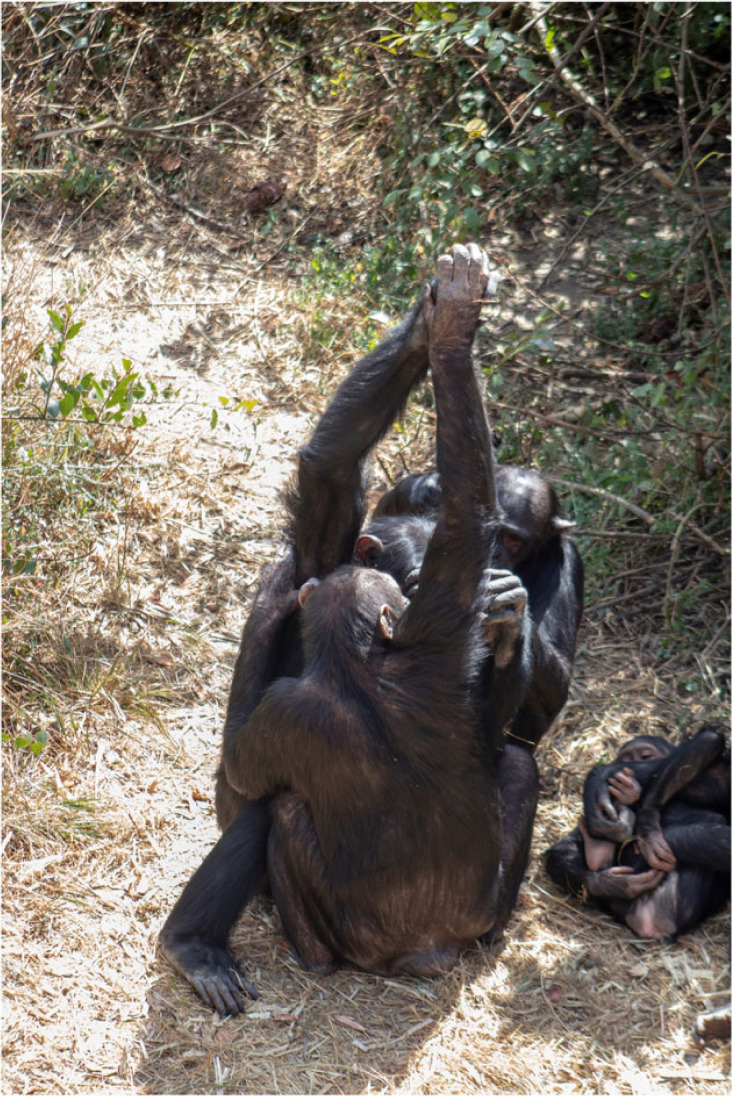
Human culture thrives by virtue of communication, yet whether communication plays an influential role in the cultural lives of other animals remains understudied. Here, we investigated whether chimpanzees use communication to engage in a cultural practice by analysing grooming handclasp (GHC) interactions-a socio-cultural behaviour requiring interindividual coordination for successful execution. Previous accounts attributed GHC initiations to behavioural shaping, whereby the initiator physically moulds the partner's arm into the desired GHC posture. Using frame-by-frame analysis and matched-control methodology, we find that chimpanzees do not only shape their partner's posture (22%), but also use gestural communication to initiate GHC (44%), which requires an active and synchronized response from the partner. Moreover, in a third (34%) of the GHC initiations, the requisite coordination was achieved by seemingly effortless synchrony. Lastly, using a longitudinal approach, we find that for GHC initiations, communication occurs more frequently than shaping in experienced dyads and less in mother-offspring dyads. These findings are consistent with ontogenetic ritualization, thereby reflecting first documentation of chimpanzees communicating to coordinate a cultural practice. We conclude that chimpanzees show interactional flexibility in the socio-cultural domain, opening the possibility that the interplay between communication and culture is rooted in our deep evolutionary history.
人类文化之所以繁荣,得益于交流,但交流是否对其他动物的文化生活产生影响,这一问题仍有待研究。在这里,我们通过分析梳理手握手(GHC)互动——一种需要个体间协调才能成功完成的社会文化行为,来研究黑猩猩是否通过交流参与一种文化实践。先前的研究认为 GHC 的发起是由行为塑造的,即发起者通过身体将伙伴的手臂塑造成理想的 GHC 姿势。通过逐帧分析和匹配控制方法,我们发现黑猩猩不仅塑造了伙伴的姿势(22%),还通过手势交流发起 GHC(44%),这需要伙伴的积极和同步响应。此外,在三分之一(34%)的 GHC 发起中,通过看似毫不费力的同步实现了所需的协调。最后,通过纵向研究,我们发现对于 GHC 的发起,在有经验的对中,交流比塑造更频繁,而在母子对中则较少。这些发现与个体发生的仪式化一致,从而反映了黑猩猩为协调文化实践而进行交流的首次记录。我们得出的结论是,黑猩猩在社会文化领域表现出互动的灵活性,这为沟通和文化之间的相互作用根植于我们的深远进化历史提供了可能性。