Department of Clinical Pharmacology and Medicine, College of Medicine, Al-Mustansiriya University, Baghdad, Iraq.
Department of Pharmacology and Therapeutics, Faculty of Veterinary Medicine, Damanhour University, Damanhour, 22511, AlBeheira, Egypt.
Mol Cell Biochem. 2023 Oct;478(10):2271-2279. doi: 10.1007/s11010-023-04658-7. Epub 2023 Jan 18.
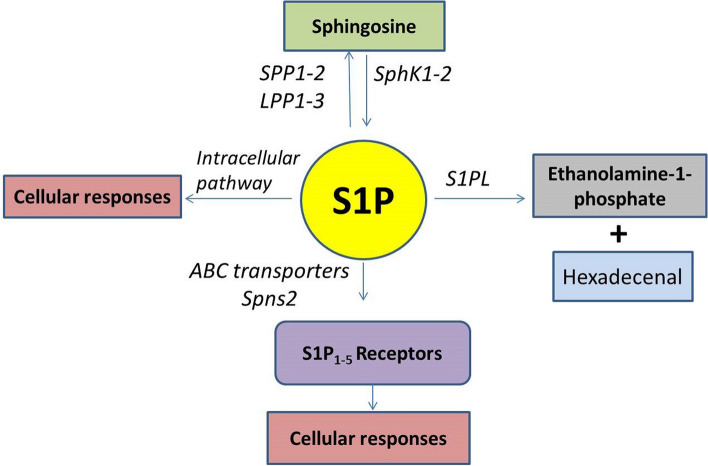
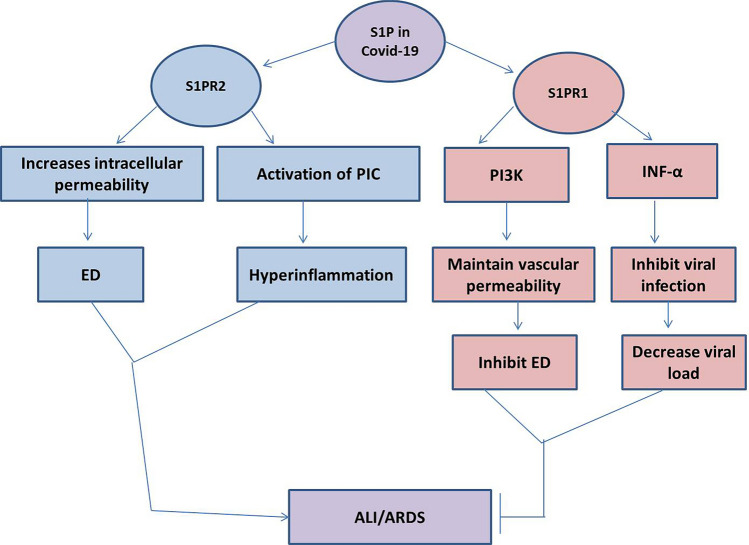
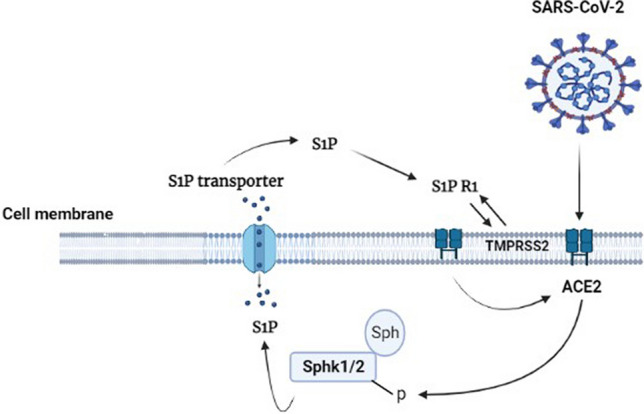
Severe acute respiratory syndrome coronavirus type 2 (SARS-CoV-2) infection leads to hyper-inflammation and amplified immune response in severe cases that may progress to cytokine storm and multi-organ injuries like acute respiratory distress syndrome and acute lung injury. In addition to pro-inflammatory cytokines, different mediators are involved in SARS-CoV-2 pathogenesis and infection, such as sphingosine-1-phosphate (S1P). S1P is a bioactive lipid found at a high level in plasma, and it is synthesized from sphingomyelin by the action of sphingosine kinase. It is involved in inflammation, immunity, angiogenesis, vascular permeability, and lymphocyte trafficking through G-protein coupled S1P receptors. Reduction of the circulating S1P level correlates with COVID-19 severity. S1P binding to sphingosine-1-phosphate receptor 1 (S1PR1) elicits endothelial protection and anti-inflammatory effects during SARS-CoV-2 infection, by limiting excessive INF-α response and hindering mitogen-activated protein kinase and nuclear factor kappa B action. However, binding to S1PR2 opposes the effect of S1PR1 with vascular inflammation, endothelial permeability, and dysfunction as the concomitant outcome. This binding also promotes nod-like receptor pyrin 3 (NLRP3) inflammasome activation, causing liver inflammation and fibrogenesis. Thus, higher expression of macrophage S1PR2 contributes to the activation of the NLRP3 inflammasome and the release of pro-inflammatory cytokines. In conclusion, S1PR1 agonists and S1PR2 antagonists might effectively manage COVID-19 and its severe effects. Further studies are recommended to elucidate the potential conflict in the effects of S1P in COVID-19.
严重急性呼吸综合征冠状病毒 2 型(SARS-CoV-2)感染可导致严重病例的过度炎症和免疫反应增强,进而可能导致细胞因子风暴和多器官损伤,如急性呼吸窘迫综合征和急性肺损伤。除了促炎细胞因子外,SARS-CoV-2 的发病机制和感染还涉及多种介质,如鞘氨醇-1-磷酸(S1P)。S1P 是一种在血浆中含量较高的生物活性脂质,它由鞘氨醇激酶作用于鞘磷脂合成。它参与炎症、免疫、血管生成、血管通透性和淋巴细胞迁移,通过 G 蛋白偶联 S1P 受体。循环 S1P 水平的降低与 COVID-19 的严重程度相关。S1P 与鞘氨醇-1-磷酸受体 1(S1PR1)结合,可在 SARS-CoV-2 感染过程中通过限制过度的 INF-α 反应和阻碍丝裂原活化蛋白激酶和核因子 kappa B 作用,引发内皮保护和抗炎作用。然而,与 S1PR2 结合则会拮抗 S1PR1 的作用,导致血管炎症、内皮通透性和功能障碍等伴随后果。这种结合还会促进核苷酸结合寡聚化结构域样受体蛋白 3(NLRP3)炎性小体的激活,导致肝脏炎症和纤维化。因此,巨噬细胞 S1PR2 的高表达有助于 NLRP3 炎性小体的激活和促炎细胞因子的释放。总之,S1PR1 激动剂和 S1PR2 拮抗剂可能有效治疗 COVID-19 及其严重影响。建议进一步研究以阐明 S1P 在 COVID-19 中的潜在作用冲突。