Department of Chemistry, University of Fribourg, Fribourg, 1700, Switzerland.
Institute of Chemical Sciences and Engineering (ISIC), École Polytechnique Fédérale de Lausanne, Sion, 1950, Switzerland.
Nat Commun. 2023 Jan 18;14(1):299. doi: 10.1038/s41467-023-35934-1.
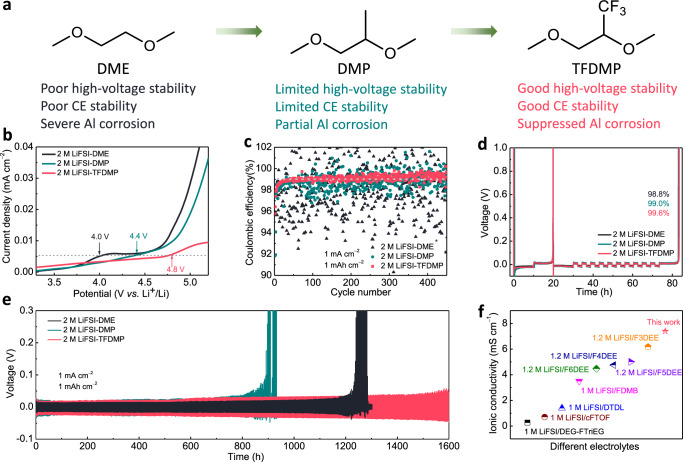
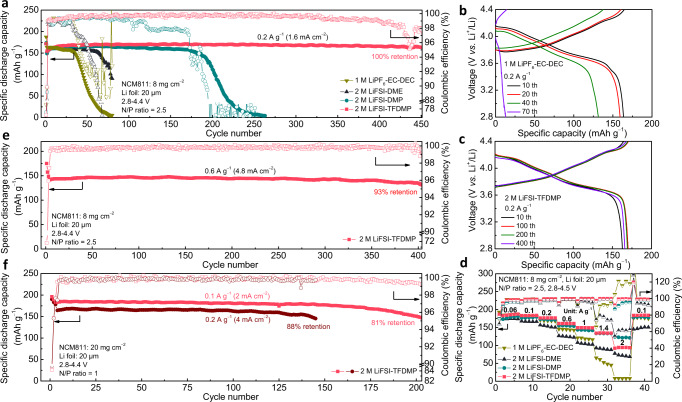
Fluorination of ether solvents is an effective strategy to improve the electrochemical stability of non-aqueous electrolyte solutions in lithium metal batteries. However, excessive fluorination detrimentally impacts the ionic conductivity of the electrolyte, thus limiting the battery performance. Here, to maximize the electrolyte ionic conductivity and electrochemical stability, we introduce the targeted trifluoromethylation of 1,2-dimethoxyethane to produce 1,1,1-trifluoro-2,3-dimethoxypropane (TFDMP). TFDMP is used as a solvent to prepare a 2 M non-aqueous electrolyte solution comprising bis(fluorosulfonyl)imide salt. This electrolyte solution shows an ionic conductivity of 7.4 mS cm at 25 °C, an oxidation stability up to 4.8 V and an efficient suppression of Al corrosion. When tested in a coin cell configuration at 25 °C using a 20 μm Li metal negative electrode, a high mass loading LiNiCoMnO-based positive electrode (20 mg cm) with a negative/positive (N/P) capacity ratio of 1, discharge capacity retentions (calculated excluding the initial formation cycles) of 81% after 200 cycles at 0.1 A g and 88% after 142 cycles at 0.2 A g are achieved.
醚溶剂的氟化是提高锂电池中非水电解质溶液电化学稳定性的有效策略。然而,过度氟化会损害电解质的离子电导率,从而限制电池性能。在这里,为了最大限度地提高电解质的离子电导率和电化学稳定性,我们引入了 1,2-二甲氧基乙烷的靶向三氟甲基化,以生成 1,1,1-三氟-2,3-二甲氧基丙烷(TFDMP)。TFDMP 用作溶剂,制备了包含双(氟磺酰基)酰亚胺盐的 2 M 非水电解质溶液。该电解质溶液在 25°C 时的离子电导率为 7.4 mS cm,氧化稳定性高达 4.8 V,并且有效抑制了 Al 腐蚀。在 25°C 下使用 20 μm Li 金属负极的纽扣电池配置中进行测试时,采用 20 mg cm 的高负载量 LiNiCoMnO 基正极(N/P 容量比为 1),在 0.1 A g 下循环 200 次后,放电容量保持率(计算时不包括初始形成循环)为 81%,在 0.2 A g 下循环 142 次后,放电容量保持率为 88%。