Laboratorio Nacional de Análisis y Síntesis Ecológica, Escuela Nacional de Estudios Superiores, Unidad Morelia, 58190, Morelia, Michoacán, México.
Universidad de Costa Rica, Escuela de Biología, San Pedro, 2600, Costa Rica.
Sci Rep. 2023 Jan 18;13(1):1017. doi: 10.1038/s41598-022-25469-8.
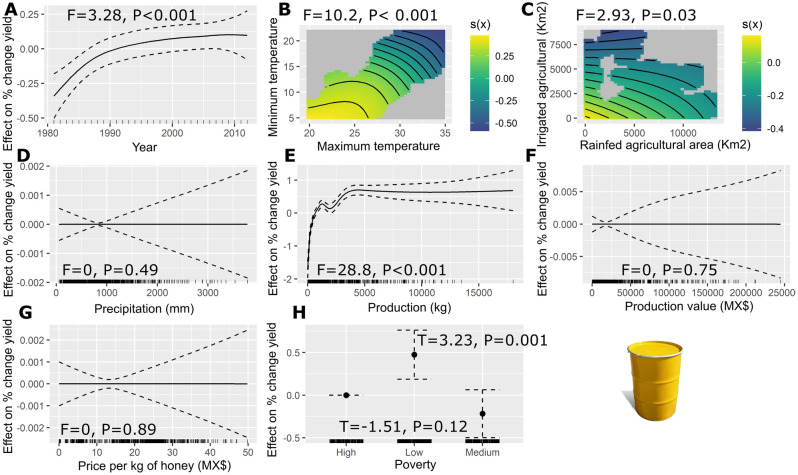
Honey bee decline is currently one of the world's most serious environmental issues, and scientists, governments, and producers have generated interest in understanding its causes and consequences in honey production and food supply. Mexico is one of the world's top honey producers, however, the honey bee population's status has not been documented to date. Based on 32 years of data from beekeeping, we make a country-level assessment of honey bee colony trends in Mexico. We use generalized additive mixed models to measure the associations between the percent change in honey bee hives and the percent change in honey yield per hive in relation to land-use, climate, and socioeconomic conditions. Despite the fact that the average annual yield per hive increased from 1980 to 2012, we detected a significant decline in the percent change in the number of honey bee hives across the time period studied. We also found a relationship between climatic conditions and agricultural land use, with agriculture increases and high temperatures producing a decrease in the percent change in honey yield. We found a relationship between a reduction in the temperature range (the difference between maximum and minimum temperatures) and a decrease in the percent change in the number of hives, while socioeconomic factors related to poverty levels have an impact on the number of hives and honey yields. Although long-term declines in hive numbers are not correlated with poverty levels, socioeconomic factors in states with high and medium poverty levels limit the increase in honey yield per hive. These results provide evidence that land-use changes, unfavorable climatic conditions, political, and socioeconomic factors are partially responsible for the reductions in the percent change in honey bee hives in Mexico.
蜜蜂数量减少是目前世界上最严重的环境问题之一,科学家、政府和生产者都有兴趣了解其对蜂蜜生产和食物供应的原因和后果。墨西哥是世界上最大的蜂蜜生产国之一,但迄今为止,尚未记录蜜蜂数量的状况。基于 32 年的养蜂数据,我们对墨西哥的蜜蜂种群趋势进行了国家层面的评估。我们使用广义加性混合模型来衡量蜜蜂蜂巢数量变化百分比与每只蜂巢蜂蜜产量变化百分比之间与土地利用、气候和社会经济条件的关系。尽管每只蜂巢的平均年蜂蜜产量从 1980 年到 2012 年有所增加,但我们发现,在研究期间,蜜蜂蜂巢数量的变化百分比呈显著下降趋势。我们还发现了气候条件与农业土地利用之间的关系,随着农业的增加和高温,蜂蜜产量的变化百分比下降。我们发现,温度范围(最高温和最低温之间的差异)的减少与蜂巢数量变化百分比的减少之间存在关系,而与贫困水平相关的社会经济因素则对蜂巢数量和蜂蜜产量产生影响。尽管蜂巢数量的长期下降与贫困水平无关,但高贫困和中等贫困水平州的社会经济因素限制了每只蜂巢蜂蜜产量的增加。这些结果表明,土地利用变化、不利的气候条件、政治和社会经济因素是导致墨西哥蜜蜂蜂巢数量变化百分比减少的部分原因。