University of Denver, Center for Orthopaedic Biomechanics, Denver, CO, USA.
Sci Data. 2023 Jan 18;10(1):34. doi: 10.1038/s41597-022-01905-2.
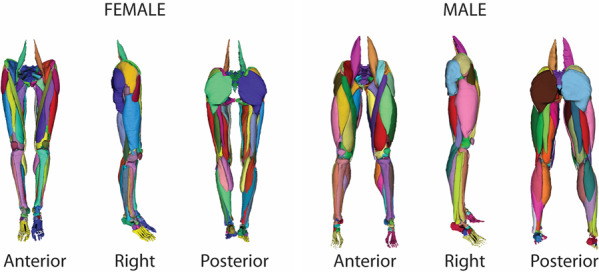
Models and simulations of human function impact medicine and medical technology. Particularly, musculoskeletal modeling provides an avenue for insight into the human body, which might not be otherwise possible. However, reaching the ultimate goal of functional multi-scale human models has been slowed by the lack of freely available datasets of anatomical models and geometries. Moreover, female-specific geometries have been neglected with a widespread emphasis on male geometry. To help realize this goal, we have developed and shared complete three-dimensional musculoskeletal geometries extracted from the National Libraries of Medicine Visible Human Female and Male cryosections. Muscle, bone, cartilage, ligament, and fat from the pelvis to the ankle were digitized and exported. These geometries provide a foundation for continued work in human musculoskeletal simulation with high-fidelity deformable tissues that enable a better understanding of normal function and the evaluation of pathologies and treatments. This work is novel as it includes both the male and female Visible Human specimens, outputs at multiple levels of post-processing for maximum data reuse, and is publicly available.
人体功能的模型和模拟影响着医学和医疗技术。特别是,肌肉骨骼建模为深入了解人体提供了一个途径,如果没有这种方法,可能无法实现。然而,由于缺乏免费的解剖模型和几何形状数据集,实现功能多尺度人体模型的最终目标一直很缓慢。此外,女性特定的几何形状被忽视了,而普遍强调男性几何形状。为了帮助实现这一目标,我们已经开发并共享了从国立医学图书馆冰冻切片可视人体女性和男性中提取的完整的三维肌肉骨骼几何形状。从骨盆到脚踝的肌肉、骨骼、软骨、韧带和脂肪都进行了数字化和输出。这些几何形状为人体肌肉骨骼模拟的进一步工作提供了基础,具有高逼真度的可变形组织,可以更好地理解正常功能,并评估病理和治疗。这项工作是新颖的,因为它包括男性和女性可视人体标本,提供了多个后处理级别的输出,以实现最大的数据重用,并公开发布。